Helena Blavatsky
Helena Blavatsky
| |
|---|---|

Blavatsky in 1877
| |
| Born |
Yelena Petrovna von Hahn
12 August [O.S. 31 July] 1831
Yekaterinoslav, Russian Empire (now Ukraine)
|
| Died | 8 May 1891 (aged 59)
London, United Kingdom
|
| Era | 19th-century philosophy |
| School | Theosophy |
Notable ideas
| Causeless cause, Itchasakti, triple manifestation |

Helena Petrovna Blavatsky (Russian: Еле́на Петро́вна Блава́тская, Yelena Petrovna Blavatskaya, often known as Madame Blavatsky; 12 August [O.S. 31 July] 1831 – 8 May 1891) was a controversial Russian occultist, philosopher, and author who co-founded the Theosophical Society in 1875. She gained an international following as the leading theoretician of Theosophy, the esoteric movement that the society promoted.
Born into an aristocratic Russian-German family in Yekaterinoslav, then in the Russian Empire (now Ukraine), Blavatsky traveled widely around the empire as a child. Largely self-educated, she developed an interest in Western esotericism during her teenage years. According to her later claims, in 1849 she embarked on a series of world travels, visiting Europe, the Americas, and India. She also claimed that during this period she encountered a group of spiritual adepts, the "Masters of the Ancient Wisdom", who sent her to Shigatse, Tibet, where they trained her to develop a deeper understanding of the synthesis of religion, philosophy and science. Both contemporary critics and later biographers have argued that some or all of these foreign visits were fictitious, and that she spent this period in Europe. By the early 1870s, Blavatsky was involved in the Spiritualist movement; although defending the genuine existence of Spiritualist phenomena, she argued against the mainstream Spiritualist idea that the entities contacted were the spirits of the dead. Relocating to the United States in 1873, she befriended Henry Steel Olcott and rose to public attention as a spirit medium, attention that included public accusations of fraudulence.
In 1875 New York City, Blavatsky co-founded the Theosophical Society with Olcott and William Quan Judge. In 1877, she published Isis Unveiled, a book outlining her Theosophical world-view. Associating it closely with the esoteric doctrines of Hermeticism and Neoplatonism, Blavatsky described Theosophy as "the synthesis of science, religion and philosophy", proclaiming that it was reviving an "Ancient Wisdom" which underlay all the world's religions. In 1880, she and Olcott moved to India, where the Society was allied to the Arya Samaj, a Hindu reform movement. That same year, while in Ceylon, she and Olcott became the first people from the United States to formally convert to Buddhism. Although opposed by the British administration, Theosophy spread rapidly in India but experienced internal problems after Blavatsky was accused of producing fraudulent paranormal phenomena. Amid ailing health, in 1885 she returned to Europe, there establishing the Blavatsky Lodge in London. Here she published The Secret Doctrine, a commentary on what she claimed were ancient Tibetan manuscripts, as well as two further books, The Key to Theosophy and The Voice of the Silence. She died of influenza.
Blavatsky was a controversial figure during her lifetime, championed by supporters as an enlightened guru and derided as a fraudulent charlatan and plagiarist by critics. Her Theosophical doctrines influenced the spread of Hindu and Buddhist ideas in the West as well as the development of Western esoteric currents like Ariosophy, Anthroposophy, and the New Age Movement.
Early life[edit]
Developing a reliable account of Blavatsky's life has proved difficult for biographers because in later life she deliberately provided contradictory accounts and falsifications about her own past.[4] Further, very few of her own writings authored prior to 1873 survive, meaning that biographers must rely heavily on these unreliable later accounts.[5] The accounts of her early life provided by her family members have also been considered dubious by biographers.[6]
Childhood: 1831–1849[edit]
Birth and family background[edit]

Blavatsky was born as Helena Petrovna von Hahn in the Ukrainian town of Yekaterinoslav, then part of the Russian Empire.[7] Her birth date was 12 August 1831, although according to the Julian calendar used in 19th-century Russia it was 31 July.[8] Immediately after her birth, she was baptized into the Russian Orthodox Church.[9] At the time, Yekaterinoslav was undergoing a cholera epidemic, and her mother contracted the disease shortly after childbirth; despite the expectations of their doctor, both mother and child survived the epidemic.[10]
Blavatsky's family was aristocratic.[11] Her mother was Helena Andreyevna von Hahn (Russian: Елена Андреевна Ган, 1814–1842; née Fadeyeva), a self-educated 17-year-old who herself was the daughter of Princess Yelena Pavlovna Dolgorukaya, a similarly self-educated aristocrat.[12] Blavatsky's father was Pyotr Alexeyevich von Hahn (Russian: Пётр Алексеевич Ган, 1798–1873), a descendant of the German von Hahn aristocratic family, who served as a captain in the Russian Royal Horse Artillery, and would later rise to the rank of colonel.[13] Pyotr had not been present at his daughter's birth, having been in Poland fighting to suppress the November Uprising against Russian rule, and first saw her when she was six months old.[14] As well as her Russian and German ancestry, Blavatsky could also claim French heritage, for a great-great grandfather had been a French Huguenot nobleman who had fled to Russia to escape persecution, there serving in the court of Catherine the Great.[15]
As a result of Pyotr's career, the family frequently moved to different parts of the Empire, accompanied by their servants,[16] a mobile childhood that may have influenced Blavatsky's largely nomadic lifestyle in later life.[17] A year after Pyotr's arrival in Yekaterinoslav, the family relocated to the nearby army town of Romankovo.[18] When Blavatsky was two years old, her younger brother, Sasha, died in another army town when no medical help could be found.[19] In 1835, mother and daughter moved to Odessa, where Blavatsky's maternal grandfather Andrei Fadeyev, a civil administrator for the imperial authorities, had recently been posted. It was in this city that Blavatsky's sister Vera Petrovna was born.[20]
St. Petersburg, Poltava, and Saratov[edit]
After a return to rural Ukraine, Pyotr was posted to Saint Petersburg, where the family moved in 1836. Blavatsky's mother liked the city, there establishing her own literary career, penning novels under the pseudonym of "Zenaida R-va" and translating the works of the English novelist Edward Bulwer-Lytton for Russian publication.[21] When Pyotr returned to Ukraine circa 1837, she remained in the city.[22] After Fadeyev was assigned to become a trustee for the Kalmyk people of Central Asia, Blavatsky and her mother accompanied him to Astrakhan, where they befriended a Kalmyk leader, Tumen.[23] The Kalmyks were practitioners of Tibetan Buddhism, and it was here that Blavatsky gained her first experience with the religion.[24]

In 1838, Blavatsky's mother moved with her daughters to be with her husband at Poltava, where she taught Blavatsky how to play the piano and organised for her to take dance lessons.[25] As a result of her poor health, Blavatsky's mother returned to Odessa, where Blavatsky learned English from a British governess.[26] They next moved to Saratov, where a brother, Leonid, was born in June 1840.[27] The family proceeded to Poland and then back to Odessa, where Blavatsky's mother died of tuberculosis in June 1842, aged 28.[28]
The three surviving children were sent to live with their maternal grandparents in Saratov, where their grandfather Andrei had been appointed Governor of Saratov Governorate.[29] The historian Richard Davenport-Hines described the young Blavatsky as "a petted, wayward, invalid child" who was a "beguiling story-teller".[30] Accounts provided by relatives reveal that she socialized largely with lower-class children and that she enjoyed playing pranks and reading.[31] She was educated in French, art, and music, all subjects designed to enable her to find a husband.[32] With her grandparents she holidayed in Tumen's Kalmyk summer camp, where she learned horse riding and some Tibetan.[33]
She later claimed that in Saratov she discovered the personal library of her maternal great-grandfather, Prince Pavel Vasilevich Dolgorukov (d. 1838); it contained a variety of books on esoteric subjects, encouraging her burgeoning interest in it.[34] Dolgorukov had been initiated into Freemasonry in the late 1770s and had belonged to the Rite of Strict Observance; there were rumors that he had met both Alessandro Cagliostro and the Count of St. Germain.[35] She also later stated that at this time of life she began to experience visions in which she encountered a "Mysterious Indian" man, and that in later life she would meet this man in the flesh.[36] Many biographers have considered this to be the first appearance of the "Masters" in her life story.[37]
According to some of her later accounts, in 1844–45 Blavatsky was taken by her father to England, where she visited London and Bath.[38] According to this story, in London she received piano lessons from the Bohemian composer Ignaz Moscheles, and performed with Clara Schumann.[39] However, some Blavatsky biographers believe that this visit to Britain never took place, particularly as no mention of it is made in her sister's memoirs.[40] After a year spent living with her aunt, Yekaterina Andreyevna Witte,[41] she moved to Tiflis, Georgia, where grandfather Andrei had been appointed director of state lands in Transcaucasia.[42] Blavatsky claimed that here she established a friendship with Alexander Vladimirovich Golitsyn, a Russian Freemason and member of the Golitsyn family who encouraged her interest in esoteric matters.[43] She would also claim that at this period she had further paranormal experiences, astral traveling and again encountering her "mysterious Indian" in visions.[44]
World travels: 1849–1869[edit]

Aged 17, she agreed to marry Nikifor Vladimirovich Blavatsky, a man in his forties who worked as Vice Governor of Erivan Province. Her reasons for doing so were unclear, although she later claimed that she was attracted by his belief in magic.[46] Although she tried to back out shortly before the wedding ceremony, the marriage took place on 7 July 1849.[47] Moving with him to the Sardar Palace, she made repeated unsuccessful attempts to escape and return to her family in Tiflis, to which he eventually relented.[48] The family sent her, accompanied by a servant and maid, to Odessa to meet her father, who planned to return to Saint Petersburg with her. The escorts accompanied her to Poti and then Kerch, intending to continue with her to Odessa. Blavatsky claimed that, fleeing her escorts and bribing the captain of the ship that had taken her to Kerch, she reached Constantinople.[49] This marked the start of nine years spent traveling the world, possibly financed by her father.[50]
She did not keep a diary at the time, and was not accompanied by relatives who could verify her activities.[51] Thus, historian of esotericism Nicholas Goodrick-Clarke noted that public knowledge of these travels rests upon "her own largely uncorroborated accounts", which are marred by being "occasionally conflicting in their chronology".[52] For religious studies scholar Bruce F. Campbell, there was "no reliable account" for the next 25 years of her life.[53] According to biographer Peter Washington, at this point "myth and reality begin to merge seamlessly in Blavatsky's biography".[54]
She later claimed that in Constantinople she developed a friendship with a Hungarian opera singer named Agardi Metrovitch, whom she first encountered when saving him from being murdered.[55] It was also in Constantinople that she met the Countess Sofia Kiselyova, who she would accompany on a tour of Egypt, Greece, and Eastern Europe.[56] In Cairo, she met the American art student Albert Rawson, who later wrote extensively about the Middle East,[57] and together they allegedly visited a Coptic magician, Paulos Metamon.[58] In 1851, she proceeded to Paris, where she encountered the Mesmerist Victor Michal, who impressed her.[59] From there, she visited England, and would claim that it was here that she met the "mysterious Indian" who had appeared in her childhood visions, a Hindu whom she referred to as the Master Morya. While she provided various conflicting accounts of how they met, locating it in both London and Ramsgate according to separate stories, she maintained that he claimed that he had a special mission for her, and that she must travel to Tibet.[60]

She made her way to Asia via the Americas, heading to Canada in autumn 1851. Inspired by the novels of James Fenimore Cooper, she sought out the Native American communities of Quebec in the hope of meeting their magico-religious specialists, but was instead robbed, later attributing these Natives' behavior to the corrupting influence of Christian missionaries.[61] She then headed south, visiting New Orleans, Texas, Mexico, and the Andes, before transport via ship from the West Indies to Ceylon and then Bombay.[62] She spent two years in India, allegedly following the instructions found in letters that Morya had sent to her.[63] She attempted to enter Tibet, but was prevented from doing so by the British administration.[64]
She later claimed that she then headed back to Europe by ship, surviving a shipwreck near to the Cape of Good Hope before arriving in England in 1854, where she faced hostility as a Russian citizen due to the ongoing Crimean War between Britain and Russia.[65] It was here, she claimed, that she worked as a concert musician for the Royal Philharmonic Society.[66] Sailing to the U.S., she visited New York City, where she met up with Rawson, before touring Chicago, Salt Lake City, and San Francisco, and then sailing back to India via Japan.[67] There, she spent time in Kashmir, Ladakh, and Burma, before making a second attempt to enter Tibet.[68] She claimed that this time she was successful, entering Tibet in 1856 through Kashmir, accompanied by a Tartar shaman who was attempting to reach Siberia and who thought that as a Russian citizen, Blavatsky would be able to aid him in doing so.[69] According to this account, they reached Leh before becoming lost, eventually joining a traveling Tartar group before she headed back to India.[70] She returned to Europe via Madras and Java.[71]
After spending time in France and Germany, in 1858 she returned to her family, then based in Pskov.[72] She later claimed that there she began to exhibit further paranormal abilities, with rapping and creaking accompanying her around the house and furniture moving of its own volition.[73] In 1860 she and her sister visited their maternal grandmother in Tiflis. It was there that she met up with Metrovitch, and where she reconciled with Nikifor in 1862.[74] Together they adopted a child named Yuri, who would die aged five in 1867, when he was buried under Metrovitch's surname.[75] In 1864, while riding in Mingrelia, Blavatsky fell from her horse and was in a coma for several months with a spinal fracture. Recovering in Tiflis, she claimed that upon awaking she gained full control of her paranormal abilities.[76][77] She then proceeded to Italy, Transylvania, and Serbia, possibly studying the Cabalah with a rabbi at this point.[78] In 1867 she proceeded to the Balkans, Hungary, and then Italy, where she spent time in Venice, Florence, and Mentana, claiming that in the latter she had been injured fighting for Giuseppe Garibaldi at the Battle of Mentana.[79]
Tibet[edit]

She claimed to have then received a message from Morya to travel to Constantinople, where he met her, and together they traveled overland to Tibet, going through Turkey, Persia, Afghanistan, and then into India, entering Tibet via Kashmir.[80] There, they allegedly stayed in the home of Morya's friend and colleague, Master Koot Hoomi, which was near to Tashilhunpo Monastery, Shigatse. According to Blavatsky, both Morya and Koot Hoomi were Kashmiris of Punjabi origin, and it was at his home that Koot Hoomi taught students of the Gelugpa sect of Tibetan Buddhism. Koot Hoomi was described as having spent time in London and Leipzig, being fluent in both English and French, and like Morya was a vegetarian.[81]
She claimed that in Tibet, she was taught an ancient, unknown language known as Senzar, and translated a number of ancient texts written in this language that were preserved by the monks of a monastery; she stated that she was, however, not permitted entry into the monastery itself.[82] She also claimed that while in Tibet, Morya and Koot Hoomi helped her develop and control her psychic powers. Among the abilities that she ascribed to these "Masters" were clairvoyance, clairaudience, telepathy, the ability to control another's consciousness, to dematerialize and rematerialize physical objects, and to project their astral bodies, thus giving the appearance of being in two places at once.[83] She claimed to have remained on this spiritual retreat from late 1868 until late 1870.[84] Blavatsky never claimed in print to have visited Lhasa, although this is a claim that would be made for her in various later sources, including the account provided by her sister.[85]
Many critics and biographers have expressed doubts regarding the veracity of Blavatsky's claims regarding her visits to Tibet, which rely entirely on her own claims, lacking any credible independent testimony.[86] It has been highlighted that during the nineteenth century, Tibet was closed to Europeans, and visitors faced the perils of bandits and a harsh terrain; the latter would have been even more problematic if Blavatsky had been as stout and un-athletic as she would be in later life.[87] However, as several biographers have noted, traders and pilgrims from neighboring lands were able to access Tibet freely, suggesting the possibility that she would have been allowed to enter accompanied by Morya, particularly if she had been mistaken for an Asian.[88] Blavatsky's eyewitness account of Shigatse was unprecedented in the West,[84] and one scholar of Buddhism, D. T. Suzuki, suggested that she later exhibited an advanced knowledge of Mahayana Buddhism consistent with her having studied in a Tibetan monastery.[89] Lachman noted that had Blavatsky spent time in Tibet, then she would be "one of the greatest travelers of the nineteenth century",[90] although he added - "in all honesty I do not know" if Blavatsky spent time in Tibet or not.[91] Conversely, biographer Marion Meade commented on Blavatsky's tales of Tibet and various other adventures by stating that "hardly a word of this appears to be true".[92]
Later life[edit]
Embracing Spiritualism and establishing Theosophy: 1870–78[edit]
Arriving in New York City[edit]

Blavatsky alleged that she departed Tibet with the mission of proving to the world that the phenomena identified by Spiritualists was objectively real, thus defending it against accusations of fraud made by scientific materialists. However, she also stated that the entities being contacted by Spiritualist mediums were not the spirits of the dead, as the Spiritualist movement typically alleged, but instead either mischievous elementals or the "shells" left behind by the deceased.[93] She proceeded via the Suez Canal to Greece, where she met with another of the Masters, Master Hilarion.[94] She set sail for Egypt aboard the SS Eumonia, but in July 1871 it exploded during the journey; Blavatsky was one of only 16 survivors.[95] Reaching Cairo, she met up with Metamon, and with the help of a woman named Emma Cutting established a société spirite, which was based largely on Spiritism, a form of Spiritualism founded by Allan Kardec which professed a belief in reincarnation, in contrast to the mainstream Spiritualist movement.[96] However, Blavatsky believed that Cutting and many of the mediums employed by the society were fraudulent, and she closed it down after two weeks.[97] In Cairo, she also met with the Egyptologist Gaston Maspero, and another of the Masters, Serapis Bey.[98] It was also here that she met up with Metrovitch, although he soon died of typhoid, with Blavatsky claiming to have overseen the funeral.[99]
Leaving Egypt, she proceeded to Syria, Palestine, and Lebanon, there encountering members of the Druze religion.[100] It was during these travels that she met with the writer and traveler Lidia Pashkova, who provided independent verification of Blavatsky's travels during this period.[101] In July 1872 she returned to her family in Odessa, before departing in April 1873.[102] She spent time in Bucharest and Paris,[103] before – according to her later claims – Morya instructed her to go to the United States. Blavatsky arrived in New York City on 8 July 1873.[104][105] There, she moved into a women's housing cooperative on Madison Street in Manhattan's Lower East Side, earning a wage through piece work sewing and designing advertising cards.[106] It was here that she attracted attention, and was interviewed by the journalist Anna Ballard of the New York newspaper The Sun; this interview was the earliest textual source in which Blavatsky claimed to have spent time in Tibet.[107] Indeed, it was while in New York that "detailed records" of Blavatsky's life again become available to historians.[108] Soon after, Blavatsky received news of her father's death, thus inheriting a considerable fortune, allowing her to move into a lavish hotel.[109] In December 1874, Blavatsky met the Georgian Mikheil Betaneli. Infatuated with her, he repeatedly requested that they marry, to which she ultimately relented; this constituted bigamy, as her first husband was still alive. However, as she refused to consummate the marriage, Betaneli sued for divorce and returned to Georgia.[110]
Meeting Henry Steel Olcott and the foundation of the Theosophical Society[edit]
Blavatsky was intrigued by a news story about William and Horatio Eddy, brothers based in Chittenden, Vermont, who it was claimed could levitate and manifest spiritual phenomena. She visited Chittenden in October 1874, there meeting the reporter Henry Steel Olcott, who was investigating the brothers' claims for the Daily Graphic.[111] Claiming that Blavatsky impressed him with her own ability to manifest spirit phenomena, Olcott authored a newspaper article on her.[112] They soon became close friends, giving each other the nicknames of "Maloney" (Olcott) and "Jack" (Blavatsky).[113] He helped attract greater attention to Blavatsky's claims, encouraging the Daily Graphics editor to publish an interview with her,[114] and discussing her in his book on Spiritualism, People from the Other World (1875),[115] which her Russian correspondent Alexandr Aksakov urged her to translate into Russian.[116] She began to instruct Olcott in her own occult beliefs, and encouraged by her he became celibate, tee-totaling, and vegetarian, although she herself was unable to commit to the latter.[117] In January 1875 the duo visited the Spiritualist mediums Nelson and Jennie Owen in Philadelphia; the Owens asked Olcott to test them to prove that the phenomena that they produced were not fraudulent, and while Olcott believed them, Blavatsky opined that they faked some of their phenomena in those instances when genuine phenomena failed to manifest.[118]

Drumming up interest for their ideas, Blavatsky and Olcott published a circular letter in Eldridge Gerry Brown's Boston-based Spiritualist publication, The Spiritual Scientist.[119] There, they named themselves the "Brotherhood of Luxor", a name potentially inspired by the pre-existing Hermetic Brotherhood of Luxor.[120] They began living together in a series of rented apartments in New York City, which they decorated with taxidermied animals and images of spiritual figures; their life was funded largely by Olcott's continued work as a lawyer.[121] Their last such apartment came to be known as the Lamasery.[122] Allegedly encouraged by the Masters, Blavatsky and Olcott established the Miracle Club, through which they facilitated lectures on esoteric themes in New York City.[123] It was through this group that they met an Irish Spiritualist, William Quan Judge, who shared many of their interests.[124]
At a Miracle Club meeting on 7 September 1875, Blavatsky, Olcott, and Judge agreed to establish an esoteric organisation, with Charles Sotheran suggesting that they call it the Theosophical Society.[125] The term theosophy came from the Greek theos ("god(s)") and sophia ("wisdom"), thus meaning "god-wisdom" or "divine wisdom".[126] The term was not new, but had been previously used in various contexts by the Philaletheians and the Christian mystic Jakob Böhme.[127] Theosophists would often argue over how to define Theosophy, with Judge expressing the view that the task was impossible.[126] Blavatsky however insisted that Theosophy was not a religion in itself.[128] Lachman has described the movement as "a very wide umbrella, under which quite a few things could find a place".[129] On foundation, Olcott was appointed chairman, with Judge as secretary, and Blavatsky as corresponding secretary, although she remained the group's primary theoretician and leading figure.[130] Prominent early members included Emma Hardinge Britten, Signor Bruzzesi, C.C. Massey, and William L. Alden; many were prominent and successful members of the establishment, although not all would remain members for long.[131]
Isis Unveiled[edit]
The underlying theme among these diverse topics [in Isis Unveiled] is the existence of an ancient wisdom-religion, an ageless occult guide to the cosmos, nature and human life. The many faiths of man are said to derive from a universal religion known to both Plato and the ancient Hindu sages. The wisdom-religion is also identified with Hermetic philosophy as "the only possible key to the Absolute in science and theology" (I, vii). Every religion is based on the same truth or "secret doctrine", which contains "the alpha and omega of universal science" (I, 511). This ancient wisdom-religion will become the religion of the future (I, 613).
—Historian Nicholas Goodrick-Clarke, 2004.[132]
In 1875, Blavatsky began work on a book outlining her Theosophical worldview, much of which would be written while staying in the Ithaca home of Hiram Corson, a Professor of English Literature at Cornell University. Although she had hoped to call it The Veil of Isis, it would be published as Isis Unveiled.[133] While writing it, Blavatsky claimed to be aware of a second consciousness within her body, referring to it as "the lodger who is in me", and stating that it was this second consciousness that inspired much of the writing.[134] In Isis Unveiled, Blavatsky quoted extensively from other esoteric and religious texts, although her contemporary and colleague Olcott always maintained that she had quoted from books that she did not have access to.[135] Writing more than a century after her death Lachman conjectured that if this had been the case, then she may have had an eidetic memory,[136] such that, while relying on earlier sources, the book represented an original synthesis that connected disparate ideas not brought together before.[137]
Revolving around Blavatsky's idea that all the world's religions stemmed from a single "Ancient Wisdom", which she connected to the Western esotericism of ancient Hermeticism and Neoplatonism,[138] it also articulated her thoughts on Spiritualism,[139] and provided a criticism of Darwinian evolution, stating that it dealt only with the physical world and ignored the spiritual realms.[140] The book was edited by Professor of Philosophy Alexander Wilder and published in two volumes by J.W. Bouton in 1877.[141] Although facing negative mainstream press reviews, including from those who highlighted that it extensively quoted around 100 other books without acknowledgement,[142] it proved to be such a commercial success, with its initial print run of 1000 copies selling out in a week,[143] that the publisher requested a sequel, although Blavatsky turned down the offer.[137] While Isis Unveiled was a success, the Society remained largely inactive,[144] having fallen into this state in autumn 1876.[145] This was despite the fact that new lodges of the organisation had been established throughout the U.S. and in London, and prominent figures like Thomas Edison and Abner Doubleday had joined.[146] In July 1878, Blavatsky gained U.S. citizenship.[147]
India: 1879–1885[edit]
The Theosophical Society established links with an Indian Hindu reform movement, the Arya Samaj, which had been founded by the Swami Dayananda Saraswati; Blavatsky and Olcott believed that the two organisations shared a common spiritual world-view.[148] Unhappy with life in the U.S., Blavatsky decided to move to India, with Olcott agreeing to join her, securing work as a U.S. trade representative to the country.[149] In December, the duo auctioned off many of their possessions, although Edison gifted them a phonograph to take with them to India.[150] They left New York City aboard the Canada, which took them to London. After meeting with well-wishers in the capital, they traveled to Liverpool, there setting sail aboard the Speke Hall, arriving in Bombay in February 1879.[151] In the city, they were greeted with celebrations organised by Arya Samaj member Hurrychund Chintamon before obtaining a house in Girgaum Road, part of Bombay's native area.[152]
Associating largely with Indians rather than the governing British elite, Blavatsky took a fifteen-year-old Gujarati boy, Vallah "Babula" Bulla, as her personal servant.[153] Many educated Indians were impressed that the Theosophists championed Indian religion in the face of British imperialism and Christianization attempts.[154] Her activity in the city was monitored by British intelligence services, who were concerned that she may have been working for Russia.[155] In April, Blavatsky took Olcott, Babula, and their friend Moolji Thackersey to the Karla Caves, announcing that they contained secret passages that led to an underground place where the Masters assembled.[156] Then claiming that the Masters were telepathically commanding her to head to Rajputana in the Punjab, she and Olcott headed north.[157] At the Yamuna river, they met the sannyasin Babu Surdass, who had sat in the lotus position for 52 years, and in Agra saw the Taj Mahal.[158] In Saharanpur they met with Dayananda and his Arya Samajists, before returning to Bombay.[159]

In July 1879, Blavatsky and Olcott began work on a monthly magazine, The Theosophist, with the first issue coming out in October.[160] The magazine soon obtained a large readership, with the management being taken over by Damodar K. Mavalankar, a Theosophist who introduced the idea of referring to the Masters as mahatmas.[161] In December, Blavatsky and Olcott travelled to Allahabad, there visiting Alfred Percy Sinnett, the editor of The Pioneer and keen Spiritualist. A.O. Hume was also a guest at the Sinnett's home, and Blavatsky was encouraged to manifest paranormal phenomena in their presence.[162] From there, they travelled to Benares, where they stayed at the palace of the Maharaja of Vizianagram.[163] Blavatsky and Olcott were then invited to Ceylon by Buddhist monks. There they officially converted to Buddhism—apparently the first from the United States to do so[164]—taking the Five Precepts in a ceremony at Ramayana Nikayana in May 1880.[165] Touring the island, they were met by crowds intrigued by these unusual Westerners who embraced Buddhism rather than proselytizing Christianity. Their message proved a boost to Sinhalese nationalist self-esteem, and they were invited to see the Buddha's Tooth in Kandy.[166]
Upon learning that old comrade Emma Coulomb (née Cutting) and her husband had fallen into poverty in Ceylon, Blavatsky invited them to move into her home in Bombay.[167] However, the Coulombs annoyed Rosa Bates and Edward Winbridge, two American Theosophists who were also living with Blavatsky; when Blavatsky took the side of the Coulombs, Bates and Winbridge returned to the U.S.[168] Blavatsky was then invited to Simla to spend more time with Sinnett, and there performed a range of materializations that astounded the other guests; in one instance, she allegedly made a cup-and-saucer materialize under the soil during a picnic.[169] Sinnett was eager to contact the Masters himself, convincing Blavatsky to facilitate this communication, resulting in the production of over 1400 pages allegedly authored by Koot Hoomi and Morya, which came to be known as the Mahatma Letters.[170] Sinnett summarised the teachings contained in these letters in his book Esoteric Buddhism (1883), although scholars of Buddhism like Max Müller publicly highlighted that the contents were not Buddhist, and Blavatsky herself disliked the misleading title.[171] Since the book's publication, there has been much debate as to the authenticity of the letters, with some arguing that they were written by Blavatsky herself, and others believing that they were written by separate individuals.[172][173] According to Meade, "there can be no reasonable doubt that Helena was their author".[174]
Theosophy was unpopular with both Christian missionaries and the British government,[175] with India's English-language press being almost uniformly negative toward the Society.[176] The group nevertheless proved popular, and branches were established across the country.[177] While Blavatsky had emphasized its growth among the native Indian population rather than among the British elite, she moved into a comfortable bungalow in the elite Bombay suburb of Breach Candy, which she said was more accessible to Western visitors.[178] Olcott had decided to establish the Buddhist Education Fund to combat the spread of the Christian faith in Ceylon and encourage pride and interest in Buddhism among the island's Sinhalese population. Although Blavatsky initially opposed the idea, stating that the Masters would not approve, Olcott's project proved a success, and she changed her opinion about it.[179]

Blavatsky had been diagnosed with Bright's disease and hoping the weather to be more conducive to her condition she took up the offer of the Society's Madras Branch to move to their city.[180] However, in November 1882 the Society purchased an estate in Adyar, which became their permanent headquarters; a few rooms were set aside for Blavatsky, who moved into them in December.[181] She continued to tour the subcontinent, claiming that she then spent time in Sikkim and Tibet, where she visited her teacher's ashram for several days.[182] With her health deteriorating, she agreed to accompany Olcott on his trip to Britain, where he was planning to argue the case for Ceylonese Buddhism and sort out problems with the Society's London Lodge.[183][184]
Sailing to Marseilles, France, in March 1883, she spent time in Nice with the founder of the Theosophical Society's French branch, the Countess of Caithness (widow of James Sinclair, 14th Earl of Caithness), with whom she continued to Paris.[185][186] In London, she appeared at the lodge's meeting, where she sought to quell arguments between Sinnett on the one hand and Anna Kingsford and Edward Maitland on the other.[187] Unsatisfied, Kingsford – whom Blavatsky thought "an unbearable snobbish woman" – split from the Theosophical Society to form the Hermetic Society.[188] In London, Blavatsky made contact with the Society for Psychical Research (SPR) through Frederic W. H. Myers. She complied with their request to undertake a study of her and the paranormal abilities that she claimed to possess, although wasn't impressed by the organisation and mockingly referred to it as the "Spookical Research Society".[189]
With Blavatsky in Europe, trouble broke out at the society's Adyar headquarters in what became known as the Coulomb Affair. The society's Board of Control had accused Emma Coulomb of misappropriating their funds for her own purposes, and asked her to leave their center. She and her husband refused, blackmailing the society with letters that they claimed were written by Blavatsky and which proved that her paranormal abilities were fraudulent. The society refused to pay them and expelled them from their premises, at which the couple turned to the Madras-based Christian College Magazine, who published an exposé of Blavatsky's alleged fraudulence using the Coulomb's claims as a basis. The story attracted international attention and was picked up by London-based newspaper, The Times.[190] In response, in November 1884 Blavatsky headed to Cairo, where she and Theosophist Charles Webster Leadbeater searched for negative information on Emma Coulomb, discovering stories of her alleged former history of extortion and criminality.[191][192] Internally, the Society was greatly damaged by the Coulomb Affair,[193] although it remained popular in India, as did Blavatsky herself.[194]
Final years in Europe: 1885–1891[edit]

Worsening health led Blavatsky to contemplate a return to the milder climate of Europe, and resigning her position as corresponding secretary of the society, she left India in March 1885.[195] By 1885, the Theosophical Society had experienced rapid growth, with 121 lodges having been chartered across the world, 106 of which were located in India, Burma, and Ceylon.[196] Initially, each lodge was chartered directly from the Adyar headquarters, with members making democratic decisions by vote.[196] However, over the coming years the lodges were organised into national units with their own ruling councils, resulting in tensions between the different levels of administration.[196]
Settling in Naples, Italy, in April 1885, she began living off of a small Society pension and continued working on her next book, The Secret Doctrine.[197] She then moved to Würzburg in the Kingdom of Bavaria, where she was visited by a Swedish Theosophist, the Countess Constance Wachtmeister, who became her constant companion throughout the rest of her life.[198] In December 1885, the SPR published their report on Blavatsky and her alleged phenomena, authored by Richard Hodgson. In his report, Hodgson accused Blavatsky of being a spy for the Russian government, further accusing her of faking paranormal phenomena, largely on the basis of the Coulomb's claims.[199] The report caused much tension within the Society, with a number of Blavatsky's followers – among them Babaji and Subba Row – denouncing her and resigning from the organisation on the basis of it.[200]
For our own part, we regard [Blavatsky] neither as the mouthpiece of hidden seers, nor as a mere vulgar adventuress; we think that she has achieved a title to permanent remembrance as one of the most accomplished, ingenious, and interesting imposters in history.
—The statement of the Society for Psychical Research on the basis of the Hodgson Report.[201]
Blavatsky wanted to sue her accusers, although Olcott advised against it, believing that the surrounding publicity would damage the Society.[202] In private letters, Blavatsky expressed relief that the criticism was focused on her and that the identity of the Masters had not been publicly exposed.[203] For decades after, Theosophists criticized Hodgson's methodology, arguing that he set out to disprove and attack Blavatsky rather than conduct an unbiased analysis of her claims and abilities. In 1986 the SPR admitted this to be the case and retracted the findings of the report.[204][205] However, Johnson has commented "Theosophists have overinterpreted this as complete vindication, when in fact many questions raised by Hodgson remain unanswered."[206]



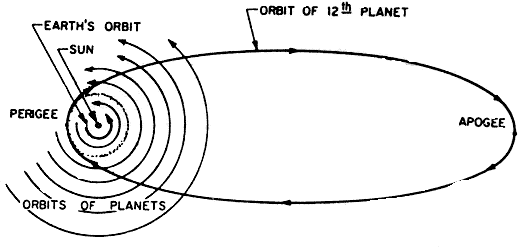
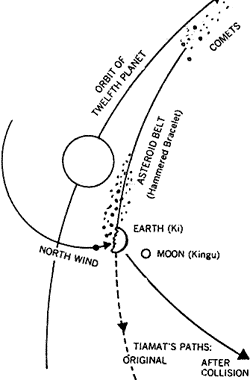 Nibiru stabilized into a clockwise orbit (equal to 3,600 orbits of Earth around the Sun).