The Good The Bad and The Ugly

Showing posts with label Corruption banks. Show all posts

Friday, September 7, 2018

Behold the Green Dragon, Red Dragon and the Black Dragon Family's Secret Society's: The Myth & Reality of an Asian Secret Society BY RICHARD SPENCE


History certainly has no shortage of enigmatic or controversial brotherhoods, orders, lodges, and societies. The Knights Templar, for instance, are a perennial object of fascination and speculation. Whether the Templars were the inspiration for the no less controversial Freemasons, a band of depraved heretics or the innocent victims of a conspiracy born of greed and envy remains a topic of lively debate.
What no one can contest, however, is that the Knights existed. The beginning and formal end of the Order can be dated with precision, and the names of its leaders are a matter of historical record. Even a dubious organization like the Priory of Sion can be shown to have had a genuine, if recent, existence, though its claims to centuries of tradition and hidden influence remain unsubstantiated. But there are other groups which seem to exist only in that gray zone between reality and imagination, ones whose origins, number, scope, and purpose remain maddeningly vague.

White Dragon Society, Gnostic Illuminati vesves Benjamin Fulford v. NWO


One such entity is the quasi-mythical Green Dragon Society (GDS), also known as the Order of the Green Dragon or simply the Green Dragon. It most often is mentioned as a Japanese secret society, but that is not necessarily the whole story. Other evidence, or at least allegation, argues that its true origins lay in China or Tibet and that its influence extended to the power centers of Tsarist Russia and Nazi Germany. Historical figures from Emperor Hirohito, to Adolf Hitler to Rasputin have been tied to the Green Dragon, legitimately or not. The waters have been further muddied by role-playing games which have combined the Society with H. P. Lovecraft’s Cthulhu Mythos and other fictional elements. Determining what is “real” and what is the playful figment of someone’s imagination can be tricky.
What follows will not solve the mystery of the Green Dragon, but it will try to separate fact from fiction and explain where claims and information came from. In doing so, it will offer a tantalizing glimpse into a mysterious organization that may have played a significant role in shaping modern history.

Enter the Black Dragon

The simplest explanation for the Green Dragon Society is that it is a muddled reference to the better known, and definitely real, Black Dragon Society (BDS) or Kokuryukai. The BDS first appeared about 1901 and was an offshoot of another, older Japanese secret society, the Black Ocean or Genyosha. Like its parent, the Black Dragon was a militant, “ultra-nationalist” body which worked to expand Imperial Japan’s influence on the Asian mainland. The BDS initially concentrated on combating Russian interests in the vast Chinese province of Manchuria. Indeed, the Society took its name from the “Black Dragon” or Amur River which separated Manchuria and Siberia. The Black Dragon’s network of spies and saboteurs took an active part in the subsequent Russo-Japanese War (1904-05) and the Black Dragons later expanded their operations and influence throughout Asia and Europe and even the Americas.
The nominal founder and leader of the Black Dragon were Ryohei Uchida, but the true master, or “dark side emperor,” was Uchida’s shadowy and sinister mentor, Mitsuru Toyama, also a founding member of Genyosha. He reputedly was steeped in “extreme Eastern religious beliefs.”1 That suggests the mysticism and occultism attributed the Green Dragon Society. Might the scheming and secretive Toyama has played a guiding role in both societies?
Were the Black and Green Dragons, if not one and the same, two sides of the same conspiratorial coin? For instance, just as the Black Dragon (Amur) River delineated the northern limit of Manchuria, further south the much smaller Qinglong or Green Dragon River roughly followed the dividing line between Manchuria and China proper. If the Black Dragon Society was primarily anti-Russian in its focus, might the Green Dragon have been anti-Chinese or anti-Western? While the Black Dragon focused on the political side, did the Green deal with the more secretive occult realm?
One obscure but important reference which clearly distinguishes between the Black and Green societies appears in the memoir of Chinese strongman Chiang Kai-shek’s “second wife,” Ch’en Chieh-ju.2 She recalls that her husband contemplated a “completely secret system of private investigators” and considered as models the “Green and Black Dragon Societies of Japan and the Triad societies of Shanghai.”3 Thus, in Chiang’s mind at least, the two Dragons were entirely separate (though not necessarily unrelated), Japanese, and appropriate models for secret intelligence gathering.
As noted, the Black Dragon Society was heavily involved in spying and the kindred spheres of propaganda and subversion. As such, it basically functioned as an extension of the Imperial Army’s “special organ,” the Tokumu Kikan. Not to be outdone in anything, the Japanese Imperial Navy maintained its own secret service, the Joho Kyoko. Just as the Army utilized the Black Dragon to augment or handle its “special needs,” might the Navy have used the Green Dragon in the same way?

Trevor Ravenscroft & Karl Haushofer

The identification of the Green Dragon as a fundamentally mystical order most evidently appears in Trevor Ravenscroft’s 1973 The Spear of Destiny. It is not insignificant that Ravenscroft was a follower of Anthroposophy and its founder Rudolf Steiner, and his book is a distinctly Anthroposophist take on the nefarious occult forces behind Hitler and his Nazi Regime. Ravenscroft firmly connects the Green Dragon to German geo-politician and mystic Karl Haushofer, one of Hitler’s presumed spiritual mentors. According to Ravenscroft, Professor Haushofer “gained… extraordinary gifts through membership of the Green Dragon Society of Japan in which the mastery of the Time Organism and the control of the life forces in the human body is the central aim of ascending degrees of initiation.” Ravenscroft adds that “one of the highest tests of this type of initiation in the Green Dragon Society demands the capacity to control and direct the life force in plants in a somewhat similar manner to the former powers of the Atlantean people.” “Only two other Europeans have been permitted to join this Japanese Order,” [and who, one wonders, were they?] continues Ravenscroft, “which demands oaths of secrecy and obedience of far more strict and uncompromising nature than similar secret societies in the Western world.”4
The major problem with all this is that Ravenscroft’s sources are hazy or non-existent. He likely took a cue from the 1960 work of Louis Pauwels and Jacques Bergier, The Morning of the Magicians. Those authors claim that Haushofer “is said [by whom?] to have been initiated into one of the most important secret Buddhist societies and to have been sworn, if he failed in his ‘mission,’ to commit suicide in accordance with the time-honored ceremonial.”5 Assuming this to be an allusion to the above GDS, we are still faced with the lack of any identifiable source for the authors’ information.
Ravenscroft goes on the claim that members of the Green Dragon Society set-up shop in 1920s Germany and there joined forces with a group of Tibetan monks called the “Society of Green Men.” The latter was, in fact, the “Adepts of Agharti and Schamballah” and their leader was a mysterious “Man with the Green Gloves.”6 It also turns out that the Green Dragons and the Green Men had “been in astral communication for hundreds of years.”7 The united brethren soon established communication with the rising Herr Hitler.

                 Rothchilds Surrender To White Dragons

Others have since elaborated on the above by turning the Green Dragons into an “inner cabal” of both Genyosha and the Black Dragon, and making them “but an outpost of a much larger conspiracy based on the even more secretive group known and the Green Men.”8 While fascinating, such assertions appear not to have any basis in hard fact.
But that is not to say they may not have a germ of truth. For instance, there was an occult figure in late Weimar Berlin sometimes referred to as the “Magician with the Green Gloves” who did become a short-lived soothsayer for Hitler and the Nazi Party. He was no Tibetan but, of all things, a Jew who went under the name of Erik Jan Hanussen. When he became inconvenient by accurately predicting the Reichstag Fire (or arranging it), his erstwhile Nazi pals killed him.9
Likewise, there could very well be something to a Green Dragon-Tibet connection. A green dragon, or Zhug, plays an important role in Tibetan mythology where it symbolizes the “God of Thunder… bravery and all-conquering force.”10 More to the point, perhaps, a Japanese Buddhist monk named Ekai Kawaguchi made two visits to Tibet in the years before World War I, around the same time Haushofer was in Tokyo. On the surface, Kawaguchi seemed a simple religious devotee, but he is known to have had contact with at least one Japanese secret agent while in the Land of Eternal Snows, Narita Yasuteru, as well as an operative of British Indian intelligence.11 Kawaguchi also had links to Annie Besant and her Theosophist sect, another group accused of subversion and general skullduggery.12 More significantly, Kawaguchi was a devotee of Zen Buddhism.
In his 1989 The Unknown Hitler, Wulf Schwarzwaller claims that Haushofer was a master of various Eastern mystical traditions and “had familiarised himself with the Zen teachings of the Japanese Society of the Green Dragon.”13 More recent sources emphasize the Green Dragon’s intimate association with Zen, specifically its Soto branch, and claim that the “Green Dragon has had a tradition of secret propagation,” whatever that means.14
The Buddhist connection may offer some important clues. Buddhism originated in India and spread to Tibet and China, and from there to Japan. Zen (Cha’an) doctrine also had its roots in China. One of the most revered Buddhist “saints” in Japan is Kukai, an 8th-9th-century mystic who spent years studying in China. Interestingly, his main place of enlightenment was the Green Dragon Temple in Xian where he was trained in the occult, tantric traditions originating in Tibet. Returning to Japan, Kukai incorporated these into his version of True Land (Shingon) Buddhism.15 The problem is that Shingon was and is quite distinct from Zen, so which, if either, is connected to the Green Dragon?
To further complicate the picture, there are numerous references to a Chinese Green Dragon Society. Most are linked to the martial arts. Green Dragon kung fu societies are active throughout the world, but most appear to be of fairly recent origin. Oddly enough, during the 1960s, the Chicago-based Green Dragon Society was locked in a bitter feud with the rival Black Dragon Society! One version of the Chinese Green Dragon’s history pegs it as a Taoist secret society formed in response to the 17th-century persecutions launched by the Jesuit-influenced Emperor Kiang Hsi. According to this, the secret society emerged from the Pure Thought Mystical School of Tao, and along with an implacable hatred for the Manchu Dynasty, it remained dedicated to the “practice of Taoist Alchemy and Immortalist Techniques.”16 That sounds a bit like what Ravenscroft described. The Green Dragon also reputedly operated under numerous aliases and disguises. A secretive and even sinister Green Dragon Society also shows up in at least two martial arts films: ‘The Deadly Sword’ (1978) and ‘Seven Promises’ (1980). Finally, a Green Society or Green Gang was (and arguably still is) a major force in the Chinese underworld.
So, could there be two Green Dragon Society’s, one Japanese and Buddhist and the other Chinese and Taoist? This much seems clear: the inter-pollination of Chinese and Japanese Buddhism, and the sects and secret societies they spawned, is centuries old. Within that context, just about anything is possible.
Other oddments, which may or may not mean anything, including the fact that during his marriage to another wife, Chiang Kai-shek paid a visit to a Green Dragon monastery. The late scholar Charles Rice, after sifting through everything he could find on the Green Dragon Society, wondered whether it might be nothing more than the karate club of the Japanese Emperor’s Imperial Guard!17 Strangest of all, perhaps, is a 2004 article from the South China Morning Post which describes the recent arrest of three members of the “Green Dragon Temple Cult” on charges of running a prostitution ring.18 The female victims have assured a place in heaven if they earned enough money for the cult.

Seven Heads of the Green Dragon

                What is the Dragon Family? | CLASSIC


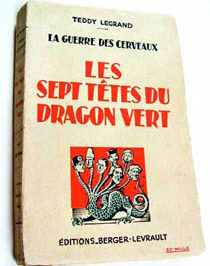
There is another, more involved, though no less mysterious, description of the Green Dragon Society that predates Ravenscroft by forty years and Pauwels and Bergier by almost thirty. It is almost certainly the source for much of what he and others have had to say about the GDS since. The work in question is the 1933 Les Sept Tetes du Dragon Vert [“The Seven Heads of the Green Dragon”] by Teddy Legrand. The title evokes the dragon with “seven heads, ten horns, and seven crowns upon his heads” mentioned in Revelations 12:3, although that beast is red, not green. At first glance, the book seems to be just an obscure piece of French pulp fiction, albeit one replete with real people and real events along with many invented ones.
Basically, the book presents the Green Dragon or, more simply, “The Greens,” a sinister international cabal bent on world domination. An interesting detail is that these secretive conspirators number precisely 72 and were, presumably, the “72 unknown superiors” of conspiratorial legend.19 To achieve its nefarious aim, the Green Dragon generates war, revolution and chaos, and its hand is the unseen common denominator in such seemingly disparate events as the assassination of Franz Ferdinand, the instigation of the Bolshevik Revolution, the murder of the Romanovs, the 1922 killing of German foreign minister Walther Rathenau, the abduction of White Russian general A. P. Kutepov and the apparent suicide of millionaire Swedish “Match King” Ivar Kreuger. All in all, the Green Dragon sounds like another version of the infamous Illuminati who haunts so many conspiracy theories.
At the time of the book’s action, 1929-30, the mysterious Greens are busy facilitating the rise of the “The Man of the Two Z’s” under whose “sharp spurs” Europe would soon tremble.20 The latter is a thinly-veiled and rather prophetic reference to Hitler who had barely come to power when the book was published. The “Two Z’s” were the interlocking arms of the Swastika.
The central figure of Les Sept Tetes… is a British secret agent, the ace of L’Intelligence Service, James Nobody, who may be the original literary inspiration for James Bond. He had already starred in a series of pot-boiler spy novels by French writer Charles Lucieto, and the latest was an effort to continue the franchise after Luciano's recent death. Interestingly, Lucieto was a retired spy, having served the French secret service in World War I. He liked to claim that his Nobody and similar yarns were roman-a-clefs which revealed true if hidden aspects of recent history and current events. His publishers later implied that this had something to do with his untimely demise.
To no great surprise, Lucieto’s successor, “Teddy Legrand,” was a pseudonym. In fact, the author was Pierre Mariel who turns out to be a rather interesting fellow. Nominally he was a journalist, but like Lucieto he had ties to French intelligence. That has led to the claim that the latter “inspired” or even directed his literary efforts as it had his predecessor’s.21 More importantly, perhaps, he was a self-proclaimed expert on the occult. Some years later, under the name Werner Gerson, he would author one of the first books on Nazi occultism.22 Mariel himself was a member of both the Freemasonic Martinist Order and a one-time French grand master of the Ancient and Mystical Order Rosae Crucis (AMORC).23Interestingly, in Les Sept Tetes… Mariel paints the Martinist Order as a conspiratorial sect which played a behind-the-scenes role in the French Revolution and later political upheavals, and which just might have links to the mysterious Green Dragon.24
In the book, brother spies Nobody and Legrand are inspired by their common curiosity about the fate of the Russian Imperial family. The chief object of fascination is an icon on St. Seraphim, supposedly found on the Tsarina Alexandra’s body, which bears a puzzling inscription, in English: “S.I.M.P. The Green Dragon. You were absolutely right. Too late.”25 They quickly determine that the first element, which is accompanied by a six-point “kabbalistic” symbol, stands for “Superieur Inconnu, Maitre Philippe” [Unknown Superior, Master Philippe], a French Martinist mystic who was an early guru to the Tsarina Alexandra.26 They also note the Tsarina’s predilection for the “Tibetan” Swastika as a good luck symbol. The rest of the story follows the duo’s efforts to discover who or what constitutes the Green Dragon.
Some interest inevitably falls on Maitre Philippe’s successor as the royal spiritual guide, Rasputin, who comes across as a tool of the Green Dragon, if not an outright member. Legrand/Mariel correctly observes that during World War I, the dissolute holy man maintained communication with mysterious “Greens,” or simply “The Green,” based in Stockholm in which Mariel portrays as another piece of a larger conspiracy.27 Interestingly, Colonel Stanislaus de Lazovert, one of the men later involved in the plot to kill the dissolute holy man, claimed that Rasputin was a member of the “Green Hand,” a secret order presumably backed by Russia’s Austrian enemies.28 Most recently and reliably, Russian investigator Oleg Shishkin linked Rasputin’s mysterious friends to a Berlin-inspired conspiracy which included German occult lodges and members of the ethnic-German Baltic nobility. Their secret brotherhood, Baltikum, used a green swastika as its symbol.
Coincidentally or not, one of the antagonists encountered by Nobody and Legrand is a Baltic Baron, Otto von Bautenas, whom they identify as no less than one of the “72 Verts.” Bautenas turns out to have been a very real person: an ex-adherent of Baltikum, a close ally of Lithuanian politico Augustine Valdemaras and leader of the fascistic Iron Wolf movement.
Mariel also implies that Anthroposophy kingpin Rudolf Steiner was mixed-up in all this skullduggery and “secret politics” through his connections to pan-German secret societies.29 He also drops Gurdjieff’s and Besant’s names in the same murky mess.
While the book’s action stays within the geographic confines of Europe, shifting from Constantinople, to Scandinavia, to Paris to Berlin, there are numerous references to the Orient, especially Tibet. Legrand and Nobody enlists the aid of one of their old antagonists, Jewish-born “international spy” I.T. Trebitsch-Lincoln, who has transformed himself into the Tibetan lama Dordji Den. Here again, there is at least a kernel of truth; in 1931 the chameleon-like Trebitsch has ordained a Buddhist monk and became “the Venerable Chao Kung.”30
The pair eventually finds themselves in Berlin, in the presence of The Man with the Green Gloves, an apparently Asian soothsayer who has set himself up much as the real Hanussen. They observed an eerie figure that seemed to have “complete mastery of his reflexes.”31 Was this the “control of the life forces” mentioned by Ravenscroft? Like a living statue, “not a muscle in his face moved” as the weird seer conversed in “excellent Oxford English.” Nobody and friend finally realize that they are standing face-to-face with “one of those famous Greens.” The description has led one recent author, Christian von Nidda, to conclude that the Greens were nothing less than “reptilian” beings!32
In the end, Mariel never clearly defines just what the Green Dragon Society is and is not. Doubtless, that was never his intention. Interestingly, there is no suggestion of any Japanese connection. However, as the episode with the Man with Green Gloves suggests, there is the specter of a powerful, mysterious Asiatic hand at work. The true purpose of the Russian Revolution, he believed, was to destroy Europe’s eastern barrier against Asiatic intrusion. Mariel sensed a kind of “permanent conspiracy against the white race – against Western Greco-Latin civilization – which seeks to sap, fracture and shake the edifice of already unstable Europe.”33 When the time came, the conspirators would “substitute him” [the Man of the Two Z’s] as a means of bringing about a New Order.
It also remains uncertain to what degree Mariel intended Les Sept Tetes… to be taken seriously. Clearly, that has not prevented some from doing so. Truth, fiction, or some strange amalgam of the two, Mariel’s little book is undoubtedly the inspiration for most of the claims about the Green Dragon Society which have sprung up since. We are still left to wonder whether, if all the exaggeration, obfuscation, superstitious dread and outright lies were cleared aside, there would be anything there at all. Maybe.
This article was published in New Dawn 112.

Footnotes:

1. “Japan’s Dark Background, 1881-1945.” www.fortunecity.com/tatooine/lieber/50/bds1.htm [15 Oct. 2008].
2. Chieh-ju Ch’en, Chiang Kai-shek’s Secret Past: The Memoir of His Second Wife, Westview Press: Boulder, 2000.
3. Ibid.
4. Trevor Ravenscroft, The Spear of Destiny: The Occult Power Behind the Spear which Pierced the Side of Christ, Weiser Books: Boston, 1982, 246-247.
5. Louis Pauwels and Jacques Bergier, The Morning of the Magicians, Avon Books: New York, 1960, 279.
6. Ravenscroft, 256.
7. Ibid.
8. Gil Trevizo, “The Order of the Green Dragons” (2003), odh.trevizo.org/green_dragons.html [15 Oct. 2008]. This and like articles are connected to the Delta Green role-playing games.
9. On Hanussen’s bizarre career, see Mel Gordon, Erik Jan Hanussen: Hitler’s Jewish Clairvoyant, Feral House: Los Angeles, 2001.
10. “Tibet’s Dragon Culture,” courtesy of Charles Rice, August 2006.
11. Alexander Berzin, “Russian and Japanese Involvement with Pre-Communist Tibet: The Role of the Shambhala Legend,” www.berzinarchives.com/web/en/archives/kalachakra/shambhala/russian_japanese_shambhala.html.[10 Sept. 2008]
12. Richard Spence, Secret Agent 666: Aleister Crowley, British Intelligence and the Occult, Feral House: Los Angeles, 2008, 184, 189.
13. Wulf Schwarz waller, The Unknown Hitler: Behind the Image of History’s Darkest Name, Berkley Books: New York, 1990, 100.
14. For a highly critical view of “Green Dragon Zen,” See groups.google.com/group/alt.philosophy.zen/browse_thread/thread/da7a81921050f728.
15. Trevor Corson, “The Magic of Buddhism,” Kyoto Journal (1 July 2000), www.scrawlingclaw.com/blogs/ArticleArchive/Entries/2000/7/1_The_Magic_of_Buddhism.html [10 Nov. 2008].
16. “The Green Dragon Society & Brotherhood, Chi Tao Ch’uan Gung Fu: A Recent History,” www.orientalherb.com/index.php?cPath=35 [1 Nov. 2008].
17. Charles Rice to the author, 3 July 2003.
18. Clifford Lo, “Sex Cult Might Have Lured 30 Women,” South China Morning Post (16 Jan. 2004).
19. Nolan Romy, Les Grandes Conspirations de Notre Temps, Bruxelles, 2002, 35-50.
20. Teddy Legrand, Les Sept Tetes du Dragon Vert, Berger-Levrault: Paris, 1933, 78.
21. Oleg Shishkin, Ubit’ Rasputina, Olma Press: Moscow, 2000, 36-37.
22. Werner Gerson, Le Nazisme: Societe Secrete, Productions de Paris: Paris, 1969.
23. Shishkin, 36.
24. Legrand, 32.
25. Legrand, 30-33.
26. True name: Nizier Anthelme Philippe.
27. Legrand, 39-40.
28. “Stanislaus Lazovert and the Assassination of Rasputin, 29 December 1916,” www.firstworldwar.com/source/rasputin_stanislaus.htm.
29. Legrand, 228-230.
30. Bernard Wasserstein, The Secret Lives of Trebitsch Lincoln, Penguin Books: New York, 1989, 274.
31. Legrand, 243-244.
32. Christian Von Nidda, Our Secret Planet, Lulu Publications, 124-125.
33. Legrand, 132

About the Author

Dr. Richard B. Spence is a Professor of History at the University of Idaho where he has taught since 1986. His interests include modern Russian, military, espionage and occult history. His published works include Boris Savinkov: Renegade on the Left (1991), Trust No One: The Secret World of Sidney Reilly (2002) and Secret Agent 666: Aleister Crowley, British Intelligence and the Occult (2008). With Walter Bosley, he co-authored Empire of the Wheel: Espionage, the Occult and Murder in Southern California (Corvos, 2011). He is the author of numerous articles in Revolutionary Russia, Intelligence and National Security, International Journal of Intelligence and CounterIntelligence, Journal for the Study of Anti-Semitism, American Communist History, New Dawn and other publications. He has been a guest on Coast to Coast, The Other Side of Midnight, Radio Liberty and many other programs.

Charles Wharry (Darkbird18):

The world is at a turning point and who will rule is about to be decided because this unseen war has been going on for 1000's years and the World Revolution Movement (WRM) which is the 13 Illuminati Family Bloodline and Power Elites (Old World Order) but they are fighting against the "Dragon" which is the true "Light" of the world. This article will be enlightening the facts on this war and who are the players.


Friday, July 1, 2016

Tragedy and Hope A History of Banking and Money by Carroll Quigley

WantToKnow.info

Tragedy and Hope
A History of Banking and Money by Carroll Quigley

Tragedy and Hope: Carroll Quigley.
"The powers of financial capitalism had [a] far-reaching aim, nothing less than to create a world system of financial control in private hands able to dominate the political system of each country and the economy of the world as a whole. This system was to be controlled in a feudalist fashion by the central banks of the world acting in concert by secret agreements arrived at in frequent private meetings and conferences."
  -- Quote from Caroll Quigley's Tragedy and HopeChapter 20

Jay on Tragedy & Hope 3: Stalin, Hitler, Illuminism & the Occult Empire (Half)


Carroll Quigley was a professor of history at Georgetown University from 1941 to 1976. He also taught at Princeton and at Harvard, and lectured at the Brookings Institution. He was a frequent lecturer at the U.S. Naval Weapons Laboratory, the Foreign Service Institute, and the Naval College at Norfolk, Virginia. In 1958, he served as a consultant to the Congressional Select Committee which set up the National Space Agency. Below are key excerpts on the history of money and banking from Prof. Quigley's masterpiece Tragedy and Hope: A History of the World in Our Time.
Note: The below excerpts are taken from chapters 5, 9, 20, 65, and 77 of Tragedy and Hope, with a focus on Prof. Quigley's excellent discussion of the role of money and banking in world history. This is a 10-page summary. To go directly to a more in-depth 40-page summary, click here.

Chapter 5—European Economic Developments
Commercial Capitalism
Western Civilization is the richest and most powerful social organization ever made by man. One reason for this success has been its economic organization, [which] has passed through six successive stages, of which at least four are called "capitalism." Each stage created the conditions which tended to bring about the next stage.
The [first stage] of self-sufficient agrarian units (manors) was in a society organized so that its upper ranks—the lords, lay and ecclesiastical—found their desires for necessities so well met that they sought to exchange their surpluses of necessities for luxuries of remote origin. This gave rise to a trade in foreign luxuries (spices, fine textiles, fine metals) which was the first evidence of the stage of commercial capitalism. In this second stage, mercantile profits and widening markets created a demand for textiles and other goods which could be met only by application of power to production.
This gave the third stage: industrial capitalism. The stage of industrial capitalism soon gave rise to such an insatiable demand for heavy fixed capital, like railroad lines, steel mills, shipyards, and so on, that these investments could not be financed from the profits and private fortunes of individual proprietors. New instruments for financing industry came into existence in the form of limited-liability corporations and investment banks. These were soon in a position to control the chief parts of the industrial system, since they provided capital to it.
This gave rise to financial capitalism. The control of financial capitalism was used to integrate the industrial system into ever-larger units with interlinking financial controls. This made possible a reduction of competition with a resulting increase in profits. As a result, the industrial system soon found that it was again able to finance its own expansion from its own profits, and, with this achievement, financial controls were weakened, and the stage of monopoly capitalism arrived.
In this fifth stage, great industrial units, working together either directly or through cartels and trade associations, were in a position to exploit the majority of the people. The result was a great economic crisis which soon developed into a struggle for control of the state—the minority hoping to use political power to defend their privileged position, the majority hoping to use the state to curtail the power and privileges of the minority. This dualist struggle dwindled with the rise of economic and social pluralism after 1945.

John Taylor Gatto discusses Carroll Quigley and Tragedy and Hope: A History of the World in Our Time


The Primary Goal of Capitalism
Capitalism provides very powerful motivations for economic activity because it associates economic motivations so closely with self-interest. But this same feature, which is a source of strength in providing economic motivation through the pursuit of profits, is also a source of weakness owing to the fact that so self-centered a motivation contributes very readily to a loss of economic coordination. Each individual, just because he is so powerfully motivated by self-interest, easily loses sight of the role which his own activities play in the economic system as a whole, and tends to act as if his activitieswere the whole, with inevitable injury to that whole.
Capitalism, because it seeks profits as its primary goal, is never primarily seeking to achieve prosperity, high production, high consumption, political power, patriotic improvement, or moral uplift. Any of these may be achieved under capitalism, and any (or all) of them may he sacrificed and lost under capitalism, depending on this relationship to the primary goal of capitalist activity—the pursuit of profits. During the nine-hundred-year history of capitalism, it has, at various times, contributed both to the achievement and to the destruction of these other social goals.
[The] stage of commercial capitalism became institutionalized into a restrictive system, sometimes called "mercantilism," in which merchants sought to gain profits, not from the movements of goods but from restricting the movements of goods. Thus the pursuit of profits, which had earlier led to increased prosperity by increasing trade and production, became a restriction on both trade and production, because profit became an end in itself rather than an accessory mechanism in the economic system as a whole.
In the course of time, however, some merchants began to shift their attention from the goods aspect of commercial interchange to the other, monetary, side of the exchange. They began to accumulate the profits of these transactions, and became increasingly concerned, not with the shipment and exchange of goods, but with the shipment and exchange of moneys. In time they became concerned with the lending of money to merchants to finance their ships and their activities, advancing money for both, at high interest rates, secured by claims on ships or goods as collateral for repayment.
The Operations of Banking Were Concealed So They Appeared Difficult to Master
In sum, specialization of economic activities, by breaking up the economic process, had made it possible for people to concentrate on one portion of the process and, by maximizing that portion, to jeopardize the rest. The process was not only broken up into producers, exchangers, and consumers but there were also two kinds of exchangers (one concerned with goods, the other with money), with almost antithetical, short-term, aims. The problems which inevitably arose could be solved and the system reformed only by reference to the system as a whole.
Unfortunately, however, three parts of the system, concerned with the production, transfer, and consumption of goods, were concrete and clearly visible so that almost anyone could grasp them simply by examining them, while the operations of banking and finance were concealed, scattered, and abstract so that they appeared to many to be difficult. To add to this, bankers themselves did everything they could to make their activities more secret and more esoteric. Their activities were reflected in mysterious marks in ledgers which were never opened to the curious outsider.
In the course of time the central fact of the developing economic system, the relationship between goods and money, became clear, at least to bankers. This relationship, the price system, depended upon five things: the supply and the demand for goods, the supply and the demand for money, and the speed of exchange between money and goods.
An increase in three of these (demand for goods, supply of money, speed of circulation) would move the prices of goods up and the value of money down. This inflation was objectionable to bankers, although desirable to producers and merchants. On the other hand, a decrease in the same three items would be deflationary and would please bankers, worry producers and merchants, and delight consumers (who obtained more goods for less money). The other factors worked in the opposite direction, so that an increase in them (supply of goods, demand for money, and slowness of circulation or exchange) would be deflationary [and vice versa].
Such changes of prices, either inflationary or deflationary, have been major forces in history for the last six centuries at least. Over that long period, their power to modify men's lives and human history has been increasing.
Bankers Obsessed With Maintaining Value of Money
Rising prices benefit debtors and injure creditors, while falling prices do the opposite. A debtor called upon to pay a debt at a time when prices are higher than when he contracted the debt must yield up less goods and services than he obtained at the earlier date, on a lower price level when he borrowed the money. A creditor, such as a bank, which has lent money—equivalent to a certain quantity of goods and services—on one price level, gets back the same amount of money—but a smaller quantity of goods and services—when repayment comes at a higher price level, because the money repaid is then less valuable.
This is why bankers, as creditors in money terms, have been obsessed with maintaining the value of money, although the reason they have traditionally given for this obsession—that "sound money" maintains "business confidence"—has been propagandist rather than accurate.
Hundreds of years ago, bankers began to specialize, with the richer and more influential ones associated increasingly with foreign trade and foreign-exchange transactions. Since these were richer and more cosmopolitan and increasingly concerned with questions of political significance, such as stability and debasement of currencies, war and peace, dynastic marriages, and worldwide trading monopolies, they became the financiers and financial advisers of governments.
Moreover, since their relationships with governments were always in monetary terms and not real terms, and since they were always obsessed with the stability of monetary exchanges between one country's money and another, they used their power and influence to do two things: (1) to get all money and debts expressed in terms of a strictly limited commodity—ultimately gold; and (2) to get all monetary matters out of the control of governments and political authority, on the ground that they would be handled better by private banking interests.
Bankers Create Money Out of Nothing
For generations men had sought to avoid the one drawback of gold, its heaviness, by using pieces of paper to represent specific pieces of gold. We call such pieces of paper gold certificates. Such a certificate entitles its bearer to exchange it for its piece of gold on demand, but in view of the convenience of paper, only a small fraction of certificate holders ever did make such demands.
It early became clear that gold need be held on hand only to the amount needed to cover the fraction of certificates likely to be presented for payment; accordingly, the rest of the gold could be used for business purposes, or, what amounts to the same thing, a volume of certificates could be issued greater than the volume of gold reserved for payment of demands against them. Such an excess volume of paper claims against reserves we now call bank notes.
In effect, this creation of paper claims greater than the reserves available means that bankers were creating money out of nothing. The same thing could be done in another way, not by note-issuing banks but by deposit banks. Deposit bankers discovered that orders and checks drawn against deposits by depositors and given to third persons were often not cashed by the latter but were deposited to their own accounts. Thus there were no actual movements of funds, and payments were made simply by bookkeeping transactions on the accounts.
Accordingly, it was necessary for the banker to keep on hand in actual money ... no more than the fraction of deposits likely to be drawn upon and cashed; the rest could be used for loans, and if these loans were made by creating a deposit for the borrower, who in turn would draw checks upon it rather than withdraw it in money, such "created deposits" or loans could also be covered adequately by retaining reserves to only a fraction of their value.
The Dynasties of International Bankers
The merchant bankers of London ... brought into their financial network the provincial banking centers, organized as commercial banks and savings banks, as well as insurance companies, to form all of these into a single financial system on an international scale which manipulated the quantity and flow of money so that they were able to influence, if not control, governments on one side and industries on the other.
The men who did this, looking backward toward the period of dynastic monarchy in which they had their own roots, aspired to establish dynasties of international bankers and were at least as successful at this as were many of the dynastic political rulers. The greatest of these dynasties, of course, were the descendants of Meyer Amschel Rothschild (1743-1812) of Frankfort, whose male descendants, for at least two generations, generally married first cousins or even nieces.
In concentrating, as we must, on the financial or economic activities of international bankers, we must not totally ignore their other attributes. They were, especially in later generations, cosmopolitan rather than nationalistic. They were usually highly civilized, cultured gentlemen, patrons of education and of the arts, so that today colleges, professorships, opera companies, symphonies, libraries, and museum collections still reflect their munificence. For these purposes they set a pattern of endowed foundations which still surround us today.


Friday, June 10, 2016

WantToKnow.info
Reliable, verifiable information on cover ups

Banking Corruption Facts and Information Center

Banking Corruption: Facts, Information
This page provides links to a variety of sources of reliable, verifiable facts and information dealing with banking and financial corruption. Our most basic material is listed first, followed by other resources which delve deeper for those interested in more. We recommend reading through this entire page before exploring the links provided. WantToKnow.info presents this banking corruption information as an opportunity for you to educate yourself and others, and to inspire us to work together to strengthen democracy and build a brighter future for us all.

           The Truth about Banks part 1. [ Wars & Corruption ]


Banking Corruption Facts and Information Summaries
For the best, most concise introduction to banking corruption information, explore the below financial and banking cover-up summaries. In the first summary you will learn that the U.S. Federal Reserve is neither truly federal nor a full reserve. You'll also be introduced to the "fractional reserve system," which allows bankers to create money out of thin air. The other two excellent summaries relate the history of banking and money, as excerpted from the landmark history text Tragedy and Hope: A History of the World in Our Time by esteemed professor Carroll Quigley. Dr. Quigley reveals the hidden agendas of powerful elite groups in the unfolding history of our world.
Three-page banking corruption facts and information summary
http://www.WantToKnow.info/financialbankingcoverup

Best Free Banking Corruption Facts and Information Videos

                 The Truth about Banks part 2. [ Wars & Corruption ]

Monopoly Men: Is there a secret history of the world suppressed by those who control the major media? Are there secret societies of greedy bankers whose agenda has been to manipulate every major war and economic depression? Is there a shadowy elite surreptitiously pulling the strings to bring about their own self-serving political agenda? This highly educational documentary from "The Phenomenon Archives" explores these intriguing questions and more.
Money, Power & Wall Street - A penetrating 2012 PBS video documentary revealing severe manipulations of Wall Street and the big bankers in regards to the financial meltdown of 2008 and beyond. Incredible interviews of top players show they did little to nothing to stop the global financial crisis. Deep insiders who saw it coming also blow the whistle on their former employers.
The Ascent of Money - An engaging PBS documentary on the power and influence of money and banking on global history. The Ascent of Money has four parts, each one hour in length. The first two parts are excellent in revealing the hidden history of money in our world, though the third and fourth parts on more recent history are much weaker.
The Money Masters – How International Bankers Gained Control of America: This 3 1/2 hour historical documentary traces the origins of the political power structure that now rules the nations of our world. The current global hierarchical power structure has its roots in the hidden manipulation and accumulation of gold and other forms of money. Though a bit pedantic at times and with a few errors in fact, this informative video still gives an excellent overall picture of how the truth about money's influence in history is kept well hidden.


Top Banking Corruption Facts and Information News Articles

             The Truth about Banks part 3. [ Wars & Corruption ]

We have collected and compiled key excerpts from some of the most important and underreported news articles published by highly respected media sources which contain eye-opening information exposing various aspects of banking and financial corruption. Key sentences are highlighted for those with limited time. Links are always provided to the original sources for verification.

Most Important Banking Corruption Information Document
How much do you know about the banking system and who issues the money you carry in your pocket? Considering the vital role money plays both in our individual lives and in the world, our educational system teaches us amazingly little about how money is created, how banks operate, and what causes the huge banking scandals and bankruptcies that have occurred. After reading the information below, you will understand why this critical information is kept quiet, and why we feel it is important to reveal what those in power don't seem to want us to know.

Banking Corruption Information Resources
These are the best, most reliable websites and information to learn more about the current banking situation and the far-reaching impacts banking corruption has on our economy and our politics.
Banking Corruption Information Resources
These are the best, most reliable websites and information to learn more about the current banking situation and the far-reaching impacts banking corruption has on our economy and our politics.

Best Online Lesson on Banking Corruption and Money
Money is a potent topic which offers incredible opportunities for change on both personal and global levels. Considering the huge role it plays in our lives, we are taught very little about money or the financial system in our many years of education. Very few schools, for instance, ever teach students the risk of going deep into credit card debt. Very few college graduates have been taught about the role of money and banking in the development of civilization or even in our current world. This online lesson teaches basic monetary history and inspires us to build a better world through transforming our relationship with money.
Transforming Our Relationship with Money http://www.insightcourse.net/lessons/18a_money_matters

Banking Corruption Facts and Information Subtopics
Confessions of an Economic Hit Man by John Perkins – A seven-page summary
http://www.WantToKnow.info/johnperkinseconomichitman
A Brief History of Banking by Nick Sandberg – An excellent five-page summary
http://www.WantToKnow.info/totalcontrol#one
A History of Banking and Money by Carroll Quigley – A ten-page summary
http://www.WantToKnow.info/articles/tragedy_hope_banking_money_history

What You Can Do About the Banking Corruption
  • We have no doubt that by working together we can and will build a brighter future. When we step out of fear, secrecy, and polarization, we choose to join with the ever increasing numbers of people dedicated to working together for the good of all in our world. You can make a difference right now by sharing the banking corruption facts and information here with your family, friends, and colleagues. Click on the "share" link at the top or bottom of this or any page on this website to help spread this valuable information far and wide.
  • Inform your media and political representatives of this crucial information. To contact those close to you, click here. Urge them to study and bring publicity to this important topic. Invite them to explore this page and the links included. All pages, especially our summaries, are also designed to print so that you can copy and share the information given.
  • Explore inspiring ideas on building a brighter future by reading this short essay.
Charles E. Wharry (Darkbird18);
 This is very good and detail information on how the banking system form all over the world. The system is setup for the Elites to grow rich on our blood and death of th spirit of the free will. This information will keep you in the know about what is really happen in our banking world.