"The Good The Bad and The Ugly Internet Information". The Information I research online also has this theme behind it and like the movie; I'm after the Gold of truth at the end. I also do Internet Online Research as a job. I syndicate UFO, Secret Societies, and Ancient Human History conspiracy theories as a hobby. I want everybody who came by this Blog to be enlightened on the world we live in and to come away with just a little bit more knowledge. Thanks for coming by.
Darkbird18
The Good The Bad and The Ugly
Showing posts with label ancient Egyptian. Show all posts
Showing posts with label ancient Egyptian. Show all posts
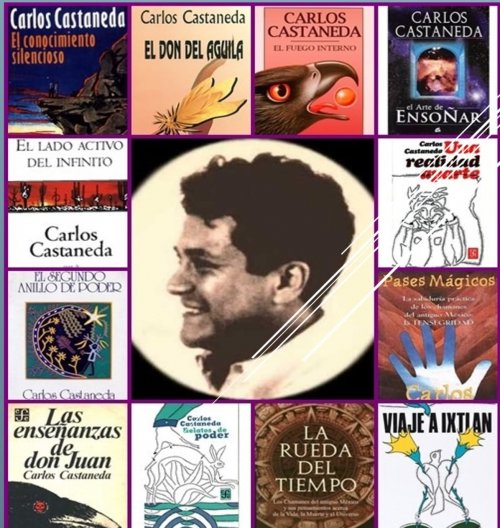
Carlos Castaneda was a peculiar man. In this article, discover more about his life and work.
Carlos Castaneda is a difficult man to classify. For some, he was virtuous, ahead of his time, and endowed with impressive lucidity. For others, he’s merely a charlatan who speculated on ancient beliefs and became a millionaire by selling books that basically said nothing.
His real name was Carlos César Salvador Arana Castañeda and he was born in Cajamarca, Peru, on December 25, 1925. Despite the fact that he claimed to be Brazilian, there are copies of his birth certificate in the Inca country. He was the son of a jeweler and a housewife. He first studied in his hometown and then finished high school in Lima, Peru. Later, he studied at a fine arts school and he traveled to the United States when his mother died.
The Tonal And The Nagual - The Sorcerer's Explanation - Carlos Castaneda
He took some creative writing and journalism courses in San Francisco. Then, he obtained a degree in Plastic Arts at UCLA and later a doctorate in anthropology. The details about his life are vague and imprecise since he erased his tracks when he began his spiritual transformation process.
What’s known is that he only kept his maternal last name and replaced the “ñ” with an “n” when he became a United States citizen. Since then, Carlos Castaneda is his official name.
Aspects of Carlos Castaneda’s life
At first, Carlos Castaneda didn’t have it easy in the United States. He sold hamburgers on the streets and worked as a taxi driver and hairdresser. Since 1960, before graduating as an anthropologist, he apparently met Juan Matus, a shaman from the Yaqui community in the Sonora desert in Mexico. They stayed in touch until 1973.
In 1960, Castaneda married Margaret Runyan, but a few months later he left her for another young woman named Mary Joan Barker. Carlos Castaneda admitted that he had a daughter named Marilyn Castañeda, whom he never recognized. Apparently, he did recognize other children even though they weren’t biological. He didn’t leave anything to his natural and biological daughter in his billionaire will.
Apparently, in his later years, Carlos Castaneda had several women as “acolytes”. According to Amy Wallace, daughter of the writer Irving Wallace, three of them were a part of his inner circle. All of them were his lovers and apparently agreed to a collective suicide upon his death.
Documental Carlos Castaneda BBC (2006) [ORIGINAL]
A spiritual transformation
Carlos Castaneda became world-famous after the publication of his book The Teachings of Don Juan: A Yaqui Way of Knowledge. The first edition had a foreword by Octavio Paz. The text is a collection of Castaneda’s conversations with Don Juan Matus, with whom he supposedly began a learning process to become a Toltec nagual shaman.
" GETTING CASTANEDA " UNDERSTANDING CARLOS
CASTANEDA - AUDIOBOOK - Peter Luce - Lomakayu
Carlos Castaneda - A Separate Reality Narrated by Peter Coyote
Carlos Castaneda Tales of Power Unabridged version narrated by
Luis Moreno
The Sorcerers' Crossing A Woman's Journey - Taisha Abelar - Audiobook
According to Castaneda, Don Juan was the leader of the last group of sorcerers of a long dynasty. In his books, however, Castaneda combines Yaqui wisdom with Toltec traditions and even aspects of martial arts. His work isn’t verifiable from an anthropological point of view, and, therefore, lacks validity.
One of the aspects that most attracted the attention of his work was the description of altered states of consciousness, induced by hallucinogens.Apparently, Don Juan introduced him to the use of peyote, colloquially called “Mescalito” (the teaching spirit), among others. Castaneda didn’t present thefield diariesof this experience, which is why many people think that Don Juan didn’t even exist. For them, the entire narrative is nothing more than literary fiction.
Carlos Castaneda has a story with many gaps
Carlos Castaneda wasn’t allowed to record or photograph. After making several publications along the same lines as the first, he announced that he would announce the “magic passes” around 1993. Thus, he created the Cleargreen Foundation to spread his new approach. He made several public appearances thereafter.
The work of Carlos Castaneda was controversial from the very beginning. He had followers around the world that were true fans of his work. John Lennon, Deepak Chopra, and Federico Fellini were among them. At the same time, his work was viewed with great suspicion in scientific circles. Even the FBI followed suit, suspecting that he was the leader of a dangerous cult.
There’s a great contradiction of dates in his work. Also, the data on Yaqui culture doesn’t coincide with the data collected by other scholars of the subject.Despite the strong doubts left by Castaneda’s work, he still has thousands of followers around the planet. He died of liver cancer in Los Angeles in 1998. However,the internal firethat he predicted would consume him from within outside, wrap him in light, and take him to another dimension didn’t happen.
The eleven books of Carlos Castaneda record his apprenticeship with a Yaqui Indian, Don Juan Matus, who plays Socratic mentor to Castaneda's skeptical anthropologist.
Over more than twenty years, Castaneda learned the theory and practice of a new discipline proposed by his mischievous and demanding teacher. The art of the "new seers" involves revising ancient secrets of Toltec sorcery transmitted to Don Juan through a late lineage dating from the 18th century.
Carlos Castaneda Stopping the World
"Sorcery" in this case means a path of experience that stands apart from the experiential habits of humanity (French sortir, "to leave, depart").
Through a long process of trial and error, Castaneda manages to alter the parameters of perception and explore other worlds. In the process of his adventures, he encounters certain alien inorganic beings who present an obstacle or test for the shaman. In Magical Passes, Castaneda wrote:
"Human beings are on a journey of awareness, which has momentarily been interrupted by extraneous forces."
Mud Shadows In Castaneda's final book, The Active Side of Infinity (1998), Don Juan challenges Castaneda to reconcile man's intelligence, demonstrated in so many achievements, with,
"the stupidity of his systems of beliefs... the stupidity of his contradictory behavior."
Don Juan relates this blatant contradiction in human intelligence to what he calls "the topic of topics," "the most serious topic in sorcery."
Our Rockefeller textbooks tell us that nobody in the ancient world had ever crossed the Atlantic before Columbus.
But the voyage of the Mayflower only took 60 days. Are we honestly to believe that no one had ever previously taken the 60 day trip in all of human history? The great civilizations of ancient Egypt, Babylon, Sumer, Greece, Rome, and the seafaring Phoenicians never wondered what was out West past 59 days sailing?
If we accept this improbability, we have to accept many more along with it, because the native American cultures of the “New World” and the Eurasian cultures of the “Old World” were already far too similar to have naturally evolved separately.
For instance, compare the Peruvians and Egyptians. The number of complex comparisons between the two peoples far surpasses serendipity. Both cultures believed in an immaterial soul which reincarnates through multiple physical existences.
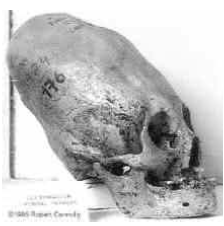
They both worshipped the Sun, Moon, and Stars, and held amazing astronomical knowledge, much of which has just recently been rediscovered. Both peoples built amazing stone pyramids, often containing boulders too heavy for modern cranes to lift, quarried from miles away. Both cultures embalmed/mummified their dead. Peruvian and Egyptian royalty both wrapped children’s heads in the practice of “skull elongation” (like trepanning) to attain higher consciousness.
They both divided the year into twelve months. Both peoples had a women’s order of vestal virgins vowed to celibacy, and violating their vows was punished on both continents by their being buried alive. Both cultures offered animal sacrifices and divined the future by examining the animal’s entrails. They both built huge arches and strewed the road with flowers for returning home triumphant warriors/heroes. At the beginning of each agricultural season during a big celebration, the Kings placed their hands to the plow and ploughed the first furrow.
Naked Science - Atlantis Jul 3, 2013
Are we to believe such incredibly specific practices developed completely independent of one another?
“When the Spanish missionaries first set foot upon the soil of America, in the fifteenth century, they were amazed to find the Cross was as devoutly worshipped by the red Indians as by themselves.”
Ancient symbols like the cross and the swastika already existed in the Americas long before the Europeans came. Egyptian symbols like the “Akeru” back to back lion gods hieroglyph are found in Olmec temples from ancient Mexico.
We have also found Mayan art and glyphs in Egypt.
Modern Mayans and tribal Egyptians both recognize the languages found in their countries as that of their ancestors and both can read much of it. We’ve discovered artwork 23000 years old clearly depicting negroes and Caucasians in Central America. The establishment remains silent on all these issues.
The similarities between Old World European and American peoples are vast and difficult to accept as mere coincidence.
The use of cement, bricks, arches, and advanced masonry/architecture is found on both sides of the Atlantic, as well as roads, stone and suspension bridges; Metallurgy, ore mining of copper, tin, bronze, gold, silver, and iron; Sculpture, painting, engraving, agriculture, navigation, large sailing vessels, pottery, glasswork, and music; both Old and New Worlders fashioned the same weapons like bows and arrows, spears, swords, battleaxes, darts, and slings; baptism, confession, penance all long existed on both continents.
“If we find on both sides of the Atlantic precisely the same arts, sciences, religious beliefs, habits, customs, and traditions, it is absurd to say that the peoples of the two continents arrived separately, by precisely the same steps, at precisely the same ends. When we consider the resemblance of the civilizations of the Mediterranean nations to one another, no man is silly enough to pretend that Rome, Greece, Egypt, Assyria, Phoenicia, each spontaneously and separately invented the arts, sciences, habits, and opinions in which they agreed; but we proceed to trace out the thread of descent or connection from one to another.
Why should a rule of interpretation prevail, as between the two sides of the Atlantic, different from that which holds good as to the two sides of the Mediterranean Sea? If, in the one case, similarity of origin has unquestionably produced similarity of arts, customs, and condition, why, in the other, should not similarity of arts, customs, and condition prove similarity of origin? Is there any instance in the world of two peoples, without knowledge of or intercourse with each other, happening upon the same invention, whether that invention be an arrowhead or a steam-engine?
If it required of mankind a lapse of at least six thousand years before it began anew the work of invention, and took up the thread of original thought where Atlantis dropped it, what probability is there of three or four separate nations all advancing at the same speed to precisely the same arts and opinions? The proposition is untenable. If, then, we prove that, on both sides of the Atlantic, have descended one from the other, or have radiated from some common source.”
Ignatius Donnelly, “Atlantis: The Antediluvian World”
Stubborn Egyptologists/Anthropologists and our Rockefeller textbooks also claim that the ancient Egyptian, Sumerian, and Babylonian cultures all somehow started at the height of their civilization and rapidly devolved as their empires fell.
This is standard accepted “fact” but how is it possible that such advanced cultures just magically appeared at the beginning of recorded history?
“The region of Mesopotamia (Sumeria), which seems to have suddenly appeared out of nowhere (according to Academia), had a high knowledge of astronomy, architecture, a pantheon of gods, agriculture, gourmet foods, and courts. It is considered to be the cradle of civilization. Mesopotamia, in the north, encompassed the rivers Tigris and Euphrates, which flowed from the Garden of Eden, in the Genesis stories.
The places known as Atlantis, Dilmun, and Lemuria are mentioned in the records of Sumeria. This is an obvious indication that these societies or cities predated the Sumerian era. Therefore, the Mesopotamian civilization did not suddenly appear out of nowhere. It was more likely a relocated ancient ‘Lost Civilization’”
James Arthur, “Mushrooms and Mankind” (37)
“One of the great mysteries that Egyptologists can never explain is this devolution, this retrograde. You look at the old kingdom, the pyramids, the type of hieroglyphs, the type of jewelry, the type of art produced, and then as it goes forward to the middle kingdom it devolves, it’s less advanced to the new kingdom when they didn’t even build in granite or limestone anymore but in sandstone a much softer stone, easier to work with.”
Egyptologist Stephen Mehler, “Egypt and the Ancients.” Coast 2 Coast interview, August, 2004
Are we honestly to believe that advanced mathematics, medicine, astronomy, architecture, art, writing, and a complex spirituality were already fully developed from the very beginning of human civilization?
“How does a complex civilization spring full-blown into being? Look at a 1905 automobile and compare it to a modern one. There is no mistaking the process of ‘development.’ But in Egypt there are no parallels. Everything is right there at the start.”
John Anthony West, Egyptologist
“The ancient civilization of the land we call Egypt has been pronounced by archaeologists as flawless of its type from the very first. It reveals none of the painful steps from primeval beginnings passing through the Paleolithic, Neolithic, and Bronze Age, to that of Iron. It apparently burst upon the scene into exotic radiance, its perfected civilization accordingly having been described as a miracle. Science cannot admit any such miracle and another explanation must be forthcoming.”
Comyns Beaumont
“What we call ‘Egypt’ lasted longer than the later Hellenic, Roman, Byzantine, Medieval, Renaissance, Enlightenment, Industrial, and modern ages put together and multiplied by three. The manipulators of history, therefore, purposely concentrate our attention on the latter days, in order to prevent us delving back into Egypt's past. They do so, understandably, for they have everything to lose once humankind becomes reintroduced to the archive of knowledge and wisdom that was common to our ancestors.”
Michael Tsarion, “Astrotheology and Sidereal Mythology”
“Why did the Sumerians spend thousands of man-years of effort to build and maintain hundreds of temples and ziggurats to their gods? The official explanation is that they invented their deities as an imaginative psychological response to a hostile, incomprehensible environment. The Sumerian beliefs are thus dismissed as a classic example of mankind’s need for religion. However, such facile solutions leave unexplained the origin of the Sumerians’ sophisticated scientific knowledge. Inventing gods is one thing, but inventing the technology to measure the movements of the planets and stars is another thing entirely!”
The Sumerians already knew of all the planets in the solar system and their relative sizes and distances from one another. They also built massive pyramids and ziggurats just like every other advanced ancient culture.
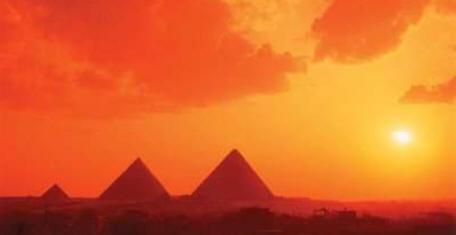
Today there are hundreds of pyramids still standing all over the world from India to Peru.
Cultures separated by the Atlantic, who supposedly never discovered each other’s existence, built these giant triangular structures, aligned them to cardinal directions, encoded within them sacred geometry/math, and used them as a sepulture.
“As Keel says in Disneyland of the Gods: We know that pyramid building was once a universal practice throughout the world. Over six thousand years ago unknown peoples were assembling great pyramids in Mexico. Gigantic manmade mounds were constructed in China, Great Britain, North America, and on remote Pacific islands while the Egyptians were still living in mud huts along the Nile. During World War II pilots flying ‘the hump’ reported seeing one or more massive pyramids standing silently in isolated Himalaya valleys.
Of the ubiquitousness and similarity of pyramids, David Hatcher Childress states: Mayan pyramids are found from Central America to as far away as the Indonesian island of Java. The pyramid of Sukuh, on the slopes of Mount Lawu near Surakarta in central Java is an amazing temple with stone stelae and a step pyramid that would match any in the jungles of Central America. The pyramid is in fact virtually identical to the pyramids found at the ancient Mayan site at Uaxactun, near Tikal.
In speaking of the global civilization, Keel elucidates the weaknesses of the current archaeological paradigm: All these things seem to be interrelated, as if they were once part of some great civilization—a common culture that spread throughout the world and then died …
We have a reasonably complete history of the past two thousand years, and a half-baked archaeological reconstruction of the past five thousand years. But there are so many gaps in our knowledge that most the popular archaeological theories really have very little merit. Indeed, we can’t even be sure that the Egyptians built the Great Pyramid …
In fact, the Great Pyramid is admittedly much more ancient than the Egyptians of history, as Hotema relates: When the most ancient Egyptians first saw the mysterious Sphinx and the great Pyramid of Gizeh, only their tops projected above the windblown sand of the desert. They knew no more about the purpose of these structures, their builders, or when they were built, than we do”
Acharya S., “The Christ Conspiracy” (279)
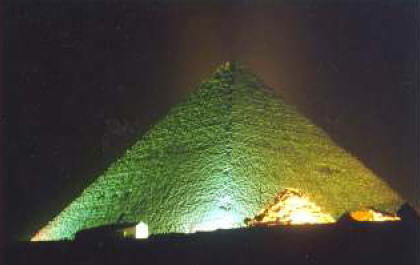
The Great Pyramids at Giza, even by today’s standards, are absolute miracles in architecture, masonry/construction, mathematics, and astronomy. The dimensions of the pyramids are extremely accurate and the site was leveled to within a fraction of an inch over the entire base.
This is comparable to the accuracy possible with modern construction/surveying methods and laser leveling.
“Beneath the now removed outer layer, the Pyramid’s construction consists of approximately 2,500,000 dressed stones, mostly yellow limestone, but with harder granite for certain interior features. The total mass of the Great Pyramid is estimated at around 90 million cubic feet, which would weigh between 67 million tons. To put this into proper perspective, the highest cathedral nave in Europe would fit three times into its height, and its mass exceeds that of all the cathedrals, churches and chapels built in England since the beginning of Christianity!
The Great Pyramid is often cited as the largest building on Earth, with twice the volume and thirty times the mass of New York’s famous Empire State Building. The Pyramid rests on an artificially leveled platform, which is less than 22 inches thick, yet is still almost perfectly level, with errors of less than an inch across its entire area, despite supporting such an enormous weight for thousands of years. The base of the Pyramid is set out perfectly square no mean feat of engineering in itself.”
Alan F. Alford, “Gods of the New Millennium – The Shattering Truth of Human Origins” (41)
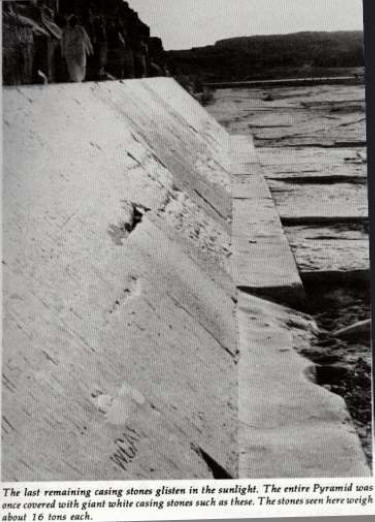
Up until the last millennium the pyramids were covered completely with smooth polished limestone casing blocks. In other words, the pyramids were not an irregular looking series of steps with a missing capstone like they are now.
They were covered with 115,000 10ton casing sheets of polished limestone fitted so perfectly that a razor’s edge couldn’t get between casings, less than 1/50th of an inch.
The Egyptians wrote how it reflected the sun like a mirror on all sides. Today there are still a few polished casings leftover at the base of one side.
“Our first example of twentieth century engineering in the Giza pyramids is the six sided limestone casing blocks, which were polished and precision, carved to fit perfectly with each other and the core stones, with joints measuring less than one fiftieth of an inch. As if this was not incredible enough, all of these stones were found to be joined together with an extremely fine but strong cement, which had been applied evenly on semi vertical faces across a surface expanse covering 21 acres on the Great pyramid alone! …
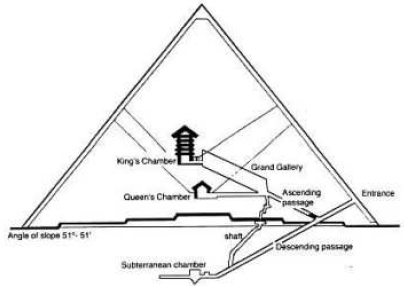
The second example is the internal passages of the Great Pyramid. These passages have been measured countless times and found to be perfectly straight, with a deviation, in the case of the Descending Passage, of less than one fiftieth of an inch along its masonry part. Over a length of 150 feet that is incredible. If one includes the further 200 feet of passage bored through the solid rock, the error is less than one quarter of an inch. Now this is engineering of the highest precision, comparable with twentieth century technology, but supposedly achieved 4,500 years ago: Our third example is the machining of granite within the pyramids.
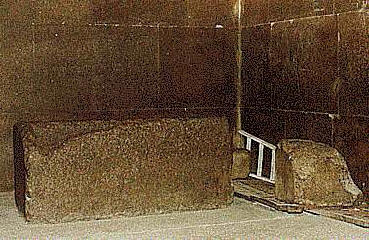
One of the first archaeologists to carry out a thorough survey of the Pyramid was Petrie, who was particularly struck by the granite coffer in the King’s Chamber. The precision with which the coffer had been carved out of a single block of extremely hard granite struck him as quite remarkable. Petrie estimated that diamond tipped drills would need to have been applied with a pressure of two tons, in order to hollow out the granite box.
It was not a serious suggestion as to the method actually used. but simply his way of expressing the impossibility of creating that artifact using nineteenth century technology. It is still a difficult challenge, even with twentieth century technology. And yet we are supposed to believe that Khufu achieved this at a time when the Egyptians possessed only the most basic copper hand tools.”
Alan F. Alford, “Gods of the New Millennium – The Shattering Truth of Human Origins” (434)
Under the pyramids are large tunnels hundreds of meters deep drilled into limestone bedrock with almost perfect 90-degree angles.
This kind of drilling technology has only existed (in our current paradigm) for under a century, so how were they drilling, chiseling and lifting all these megalithic structures? In a famous meeting with a panel of Egyptologists, author of “Giza Power Plant” Christopher Dunn brought a slab of granite, a hammer, and a copper chisel and asked for a demonstration of how Egyptians were supposed to have chiseled out thousand-ton granite obelisks using simple hand tools.
After a few whacks at it, the copper chisel had a deep indent and not a chip of granite was displaced.
“Chris Dunn found that many artifacts bore the same marks as conventional twentieth century machining methods sawing, lathe and milling practices He was particularly interested, however, in the evidence of a modern processing technique known as trepanning.
This process is used to excavate a hollow in a block of hard stone by first drilling, and then breaking out, the remaining “core” Petrie had studied both the hollows and the cores, and been astonished to find spiral grooves on the core which indicated a drill feed rate of 0.100 inch per revolution of the drill. This initially seemed to be impossible.
In 1983, Dunn had ascertained that industrial diamond drills could cut granite with a drill rotation speed of 900 revolutions per minute and a feed rate of 0.0002 inch per revolution. What these technicalities actually mean is that the ancient Egyptians were cutting their granite with a feed rate 500 times greater than 1983 technology!”
Alan F. Alford, “Gods of the New Millennium – The Shattering Truth of Human Origins” (44)
“On the granite core the spiral of the cut sinks 1 inch in the circumference of 6 inches, a rate of ploughing out which is astonishing … These rapid spiral grooves cannot be ascribed to anything but the descent of the drill into the granite under enormous pressure.”
W.M. Flinders Petrie, “The Pyramids and Temples at Gizeh”
“Wasn’t it peculiar that at the supposed dawn of human civilization, more than 4500 years ago, the ancient Egyptians had acquired what sounded like industrialage drills packing a ton or more of punch and capable of slicking through hard stones like hot knives through butter?”
“In the first and second pyramids at Giza there are granite portcullises in the lower passages which still baffle experts today. Firstly their complex designs suggest a use much more advanced than deterring robbers (the Egyptologist explanation). It would take about 50 men to lift the portcullis slabs into place, yet the narrow corridors they’re positioned into could have only been occupied by a few men at a time.”
W.M. Flinders Petrie, “The Pyramids and Temples at Gizeh,” (36)
The pyramids also encode high mathematics supposedly unknown to the simple ancient Egyptians. To begin with, the pyramids are located precisely on the 30th-degree latitude and aligned to within 3 arc minutes of true north.
These are beyond coincidence so it can be assumed that they could very accurately measure both latitude and longitude. The ratio of the great pyramid’s height to its base perimeter is exactly Pi (3.14). The “Kings Chamber” and other rooms are perfect “golden rectangles” expressing the mystical number Phi 1.618.
The ratio between successive numbers in the Fibonacci sequence increasingly approach Phi as you go on from 0,1,1,2,3,5,8,13,21,34… the resulting graph is known as the fractal “golden spiral” and looks like a conch shell. Establishment Egyptologists say these mathematical considerations are all coincidence maintaining that ancient Egyptians didn’t possess these concepts.
But the reality is, the ancient Egyptians did possess higher math and they purposely encoded it into their construction.
“Some routine mathematical games were built into the dimensions of the sarcophagus. For example, it had an internal volume of 1166.4 liters and an external volume of exactly twice that, 2332.8 liters. Such a precise coincidence could not have been arrived at accidentally: the walls of the coffer had been cut to machine-age tolerances by craftsmen of enormous skill and experience.”
Graham Hancock, “Fingerprints of the Gods”
In the Kings Chamber, the floor diagonal is precise twice the room’s height. W.M. Flinders Petrie says they managed to place the Kings Chamber perfectly,
“where the vertical section of the Pyramid was halved, where the area of the horizontal section was half that of the base, where the diagonal from corner to corner was equal to the length of the base, and where the width of the face was equal to half the diagonal of the base.”
Do you suppose these mathematics were accidental?
Egyptologists say that the Giza pyramids were built for three pharaohs over the course of a hundred years. There are over 2.5 million stones, so if you built 24 hours a day for 100 years that means fitting one (average 3.5 ton) stone into place every 8.5 minutes. Using current technology, multiple cranes and work crews, we still couldn’t make that kind of time, nor could we match the craftsmanship.
Six million tons of stone, underground tunnels, chambers, corridors, 45/90 degree shafts, pi and phi ratios, golden rectangles and other mathematical inclusions, perfect cardinal alignments, right angles, astrological considerations, and flawless masonry. How did ancient man the whole world over build these huge magnificent pyramids? They stacked stones so heavy, many of which cannot be lifted into place with the technology and machinery available today.
They quarried these stones from miles away and fitted them together so seamlessly that you can’t fit a blade between them.
Also in Egypt tens of thousands of diorite bowls have been found with hieroglyphs engraved.
Diorite is one of the hardest stones on the planet, harder than iron, yet intricate inscriptions have been made, not through the use of chisels or scraping but some unknown ancient technology. Whatever it was, was capable of etching lines 1/150th of an inch wide, often in sets of parallel lines separated by a mere 1/30th of an inch. The same kind of workmanship has been found in vases, urns, and other pottery unearthed at the Pyramid of Zoser.
It has come to our attention that some people are casting Aspersions on the veracity of our site. This because when they come upon pictures of ancient Black Egyptians, Europeans, Middle Easterners etc. they say "those are NOT Black people, Black people do NOT look like that". In a "Normal" world, that would be an extremely inane proposition. After all, the Black Man is the original Human, and from where all other Humans descend. And though duly noted in science, simple observation would indicate that the Black Man is the Earths most diverse creature. He possesses all of the known types and colors of Hair, Eyes, Noses, Mouths, Bodies, and even skin colors. But alas, in the White mans racist world that we all live in, the proposition is instead, very understandable. They have come expecting to see pictures of: (that which the White Man has Defined as the "True" Negro); and there are few to be found. To explain this seeming contradiction, we must first begin with a little history.
When the Prophet Muhammad allowed Whites, mostly Greeks, who had migrated south as a result of Alexander's victory over the Persians; then Romans, together with the latest migrants, the Turks from Asia, to join his army of conquest. He unknowingly was finalizing a process that began about 2,000 years earlier; when the first Whites from central Asia first entered southern Europe. First Greece fell to them, then Italy, then France and Spain, until finally, all of Europe was theirs.
DISCLAIMER: Please note, as the authentic "Real" artifacts plainly tell us, the ancient Greek and Roman societies were Black, Albino, and Mulatto - in other words - mixed race. As a matter of fact, Alexander the greats people, the Macedonians, are usually depicted in authentic artifacts as Mulattoes. And as we know, there are hundreds, maybe thousands, of Busts of Alexander as A white man. All of which are Albino Fakes, for the simple reason that the only authentic surviving image of Alexander, is the nondescript image of him in full armor on the Silver Decadrachm coin. As Persian artifacts clearly show us, the Central Asian Albino tribes like the Parthian's, Arian's, Bactrian's, and Scythian's, fought with the Black Persians against the Arab armies. For the sake of simplicity we here talk about Greeks and Romans as Albino entities exclusively, that is of course not accurate, as the Busts of Greeks and Romans as Whites are also not accurate. The world is flush with FAKE artifacts created by the Albino people showing themselves in historical roles, but very few artifacts of the actual People (Blacks) have survived Albino control. So we must make do with what we have available.
Later, Alexander's conquest of the Persian Empire gave Whites dominance over all that Persia had acquired, namely Egypt and Western Asia. The resurgent Sassanian Persians had later managed to take most of it back (except Egypt and the western Levant, which stayed in Greek, then Roman hands). But now Muhammad was determined to conquer all of it.
Which he did, but at the price of dooming all of the Black civilizations which still existed. Because as in Europe, Whites were not content with just being a part of the "New Order" they wanted to control and dominate it! Because of the meager population of Arabia, and also because of the Arab tribesman's resistance to his new religion, (he would later offer them the choice of conversion or Death!); Muhammad had no choice but to include Whites in his army. First the Greeks, then when the Romans quit the Western Levant in 639-640 A.D. (at Muhammads invitation), the Romans who remained behind, had no choice but to join him too. But the Caliphs still needed more men; therefore Turkish men were imported from Central Asia as Slave soldiers for the Caliphs army, and Turkish women were imported as Slaves for the Caliphs Harem (a practice that the Berbers (Moors) continued.
Click here for a short, but interesting, History of Slavery:Click >>>
With these Whites as the backbone of his army, Muhammads Islamic army was able to conquer parts of Eastern Europe, all of Western Asia, North Africa and Spain. But the fatal error by Blacks, came under Umayyad Caliph Umar II (reigned 717-720), it was by his decree that the now discontented "Mawali" Troops (Whites and non-Arab Muslims) were placed on the same footing with Arab Muslims, without respect to color or nationality. This decree allowed Greeks, Turks, Romans, and all other Eurasians to fully assimilate into the Muslim brotherhood.
At first it was the old-line Greeks and Romans who held sway. But as Turks kept coming in (first as Slave Soldiers), and as their population kept increasing, there could be no doubt as to who would triumph in the end.
The Turks first big break came in 868 A.D. It was during the rule of Abbasid Caliph Harun ar-Rashid (ruled 786-809), that the Caliphs began assigning Egypt to Turks rather than to Arabs. The first Turkish dynasty of Egypt was The Tulunid dynasty of Ibn Tulun, who entered Egypt in 868 A.D.
In Persia and Mesopotamia (which imported the first Turkish Slave Soldiers), the end came when Toghril Beg, the Turkish "Seljuq" Sultan, entered Baghdad in 1055 A.D, at which point, Buyid power was terminated, thus ending what Vladimir Minorsky, the great Persiaologist, called the “Persian intermezzo.”
In Anatolia, now called Turkey: In 1071 A.D. the Seljuq sultan Alp-Arslan defeated the Byzantine Empire at the Battle of Manzikert and thereby opened the way for several million Oguz tribesmen to settle in Anatolia. These Turks came to form the bulk of the population there, and one Oguz tribal chief, "Osman" founded the Ottoman dynasty (early 14th century): This dynasty would subsequently extend Turkish power throughout the eastern Mediterranean. The Oguz are the primary ancestors of the Turks of present-day Turkey.
In Egypt 1250 A.D. The Turkish Mamluk Slave Troops rebelled, and established their own dynasty in Egypt, independent of the Caliphs.
New History of Humanity - Astounding Scientific Discoveries
The White and "Mixed-race" people of the Middle East and North Africa, invariably identify themselves as Berber, Arab, or Persian - which of course, they are not, they are mainly Turkish. How refreshing then, to find a Middle Eastern organization that is comfortable acknowledging their true Turkish identity. Please visit the "Iran Chamber Society's" site page on the "Islamic Conquest". You will find that it is about the same as that contained in our own Persian history in the Elam section. Click here for the Iran Chamber Society site
On a wishful note: It would certainly be nice if the Chinese Government would also update their website history on the beginnings of Chinese civilization. As it stands now, if you don't already know Chinese history, you certainly won't learn it from their website. Their presentation is "mealy mouthed" confusing, and refuses to acknowledge the obvious influences of Blacks and Whites in China's beginnings. Luckily there are skeletons, Mummies, and scientific studies which do.
In Muhammads own homeland of Arabia, the end came late, but it came: In Arabia, the domination of Mecca and Medina by the resurgent Black Wahhabi Muslims, was a serious embarrassment to the Turkish Ottoman sultan - who was the titular overlord of the Arabian territory, and the leading Muslim sovereign. Therefore, at the invitation of Turkish Sultan Mahmud II (1808-39), Muhammad Ali Pasha (an Albanian Turk); sent an expedition to Arabia that between 1811 and 1813 expelled the Wahhabis from the Hejaz. In a further campaign (1816-18), Ibrahim Pasha, the viceroy's eldest son, defeated the Wahhabis in their homeland of Najd, and thus brought Central Arabia under Turkish Albanian control. With the taking of Arabia, Whites now had control over all of it - the territories and the Religions. And after each victory, they sought to insure that the Black man would never raise again in his former territories.
The White man found that to accomplish this, there was a weapon just as effective as the Sword or Gun - the Lie! With the lie, the White man was able to convince everyone that his own weakness, the Pale Albino like skin that he wore, was a strength and denoted superiority. Thus no meaning was to be given to the fact that unlike the Normal and Natural inhabitants of those lands, the White Man found it necessary to completely cover his body in clothing, from head to toe, in order to survive the Sunlight of those regions. There is no known record of what he told Blacks to convince them to wear the Total Body Robes that they now wear, but we know that it is not natural for them, as Black skin is natures natural protection against Sunburn and skin cancer, and because the Blacks of those regions wore light attractive clothing before the White mans conquest. The Black mans only consolation in all of this, is that even as he endures through hardship in those regions that were formerly his; Few "Pure Whites" still exist in the southern regions. They have been "Absorbed" and replaced by a "Mixed Race" people; who themselves have turned against the White Man. (The mainly "mixed-race" people of Turkey - keep petitioning to join the White European Community. But that has so-far not been forthcoming - the claim is that they are too "Different").
The Power of the Lie
The ancient Persians understood the power of the Lie: they were probably the first Middle Eastern Blacks to have day-to-day dealings with Whites; owing to the large numbers of Arian's immigrating across their Eastern borders. Perhaps it was these White people that Darius the Great (522-486 B.C.); had in mind when he inscribed the following on the south retaining wall of his palace at Persepolis.
Inscription:
3. (12-24.) Darius the King says: May Ahuramazda bear me aid, with the gods of the royal house; and may Ahuramazda protect this country from a (hostile) army, from famine, from the Lie! Upon this country may there not come an army, nor famine, nor the Lie; this I pray as a boon from Ahuramazda together with the gods of the royal house. This boon may Ahuramazda together with the gods of the royal house give to me!
In Darius the Great's "Behistun Inscription" the Lie is mentioned twenty one (21) times:
Inscription:
55. (4.36-40.). Darius the King says: You who shall be king hereafter, protect yourself vigorously from the Lie; the man who shall be a Lie-follower, him do you punish well, if thus you shall think, "May my country be secure!"
The Changing Face of Egyptian Rule
Egyptian
Greek
Roman
Turk
Modern
Somewhere along the way, the White man decided that it was not enough to proclaim himself superior, he must make Blacks "Inferior" (for reasons that will be explained). To this end, he instituted something that was not known to the world before, "Racism". No one knows exactly when it began, but it evolved into one of mans most vile creations. In the United States of America, it reached its zenith with the Dred Scott decision.
Dred Scott
In March 1857, the Supreme Court of the United States answered a question that Congress had evaded for decades: whether Congress had the power to prohibit slavery in the territories. The case originated in 1846, when a Missouri slave, Dred Scott, sued to gain his freedom. Scott argued that while he had been the slave of an army surgeon he had lived for four years in Illinois, a free state, and Wisconsin, a free territory, and that his residence on free soil had erased his slave status.
Dred Scott
Roger Brooke Taney
Chief Justice of the United States
Chief Justice Taney delivered the opinion of the Court....
In the opinion of the Court the legislation and histories of the times, and the language used in the Declaration of Independence, show that neither the class of persons who had been imported as slaves nor their descendants, whether they had become free or not, were then acknowledged as a part of the people nor intended to be included in the general words used in that memorable instrument....
They had for more than a century before been regarded as beings of an inferior order and altogether unfit to associate with the white race, either in social or political relations; and so far inferior that they had no rights which the white man was bound to respect; and that the Negro might justly and lawfully be reduced to slavery for his benefit. He was bought and sold and treated as an ordinary article of merchandise and traffic whenever a profit could be made by it. This opinion was at that time fixed and universal in the civilized portion of the white race....
No one, we presume, supposes that any change in public opinion or feeling, in relation to this unfortunate race, in the civilized nations of Europe or in this country should induce the Court to give to the words of the Constitution a more liberal construction in their favor than they were intended to bear when the instrument was framed and adopted....
And upon a full and careful consideration of the subject, the Court is of opinion that, upon the facts stated in the plea in abatement, Dred Scott was not a citizen of Missouri within the meaning of the Constitution of the United States and not entitled as such to sue in its courts.
The White man taught racism in his Schools and Universities; and since by now, he controlled most of the World and its media, everyone was taught racism!
The New Student's Reference Work (1914)
Negroes
Ne′groes, a name given to most of the races inhabiting Africa, though it does not include all the inhabitants. The inhabitants of northern Africa, as the Abyssinians or Nubians, and the Hottentots of the south do not belong to the negro race. The physical characteristics of the true negro are black skin, woolly hair, flat nose and thick lips. Their skin is soft, and in the infant is a dull red, becoming black very soon. The negroes of the Guinea coast, who are rude savages, have a deep-black color and ugly features. Other tribes of the interior are tall, well-formed and warlike, and have some ingenuity in making implements from iron. The skull is long and narrow, with low forehead, prominent jaws and retreating chin. As a rule they are of a low order of intelligence, mechanical in their work but capable of great endurance. They are of a less nervous disposition than whites, more frequently color-blind, have smaller lungs and larger livers. The negro has long been a prey to the slave-traffic, being captured in large numbers and sold as slaves in other countries. The first slaves were brought to the United States in 1619, and this traffic was not discontinued until 1794, when it was prohibited by act of congress. The Spaniards began the trade, and King James and Queen Elizabeth both issued patents to companies. Between 1794 and 1840 the trade was confined mostly from the African coast to the West Indies and Brazil. The coast of Guinea was the largest slave-market, but inasmuch as they sold none of their own people but relied on those captured in war or by strategem, most of the slaves sent to the United States were of the pure negro type of the interior; while most of those taken to Brazil and the West Indies were closely allied to the Kafir and Zulu stock of the eastern coast. The mortality among the negroes is greater than the whites, attributed in the south much to the fact of their low condition and inattention to the laws of health, in the north to their inability to withstand the cold and variable weather, as the diseases from which they suffer are mostly those of the respiratory organs. Therefore the publication, at frequent intervals, of accounts of long-lived negroes may be ascribed to the ignorance of their ages, and not to any exceptional tenacity of life. In disposition the negro, as a rule, is cheerful and peaceable, unconcerned for the future, inclined to live in colonies and of emotionally religious instincts. Common among them even to the present day is the exercise of a certain form of witchcraft, called voodooism, prosecuted by means of charms, philters and fetiches.
But not content with the lie of speech, the White man in the 19th. and 20th. centuries, created scientific lies to bolster his claim.
Samuel George Morton (1799-1851), one of the inspirers of physical anthropology, collected hundreds of human skulls from all over the world and started trying to find a way to classify them according to some logical criterion. Influenced by the common theories of his time, he claimed that he could judge the intellectual capacity of a race by the cranial capacity (the measure of the volume of the interior of the skull). A large skull meant a large brain and high intellectual capacity, and a small skull indicated a small brain and decreased intellectual capacity. By studying these skulls he decided at what point Caucasians stopped being Caucasians, and at what point Negroes began. Morton had many skulls from ancient Egypt, and concluded that the ancient Egyptians were not African, but were White.
Morton's big mistake here was evidence (there were just too many Egyptian statues hanging around, which clearly showed that Egyptians were of course Black people). Thus, this was too big a lie, even for the White man; so Morton and his theories quickly fell into disrepute. But an indication of just how pathetic some Whites are as regards to race - Some still believe that Egyptians were White people (You really really have to WANT to believe it, for that to make any sense at all).
Has anyone noticed the virulence of the words used above? Those were not words of description, or even words of criticism, they were words of hatred and Damnation! What could it be that compels the White man to use such hateful words against another Human being? More follows:



 resemblance of the civilizations of the Mediterranean nations to one another, no man is silly enough to pretend that Rome, Greece, Egypt, Assyria, Phoenicia, each spontaneously and separately invented the arts, sciences, habits, and opinions in which they agreed; but we proceed to trace out the thread of descent or connection from one to another.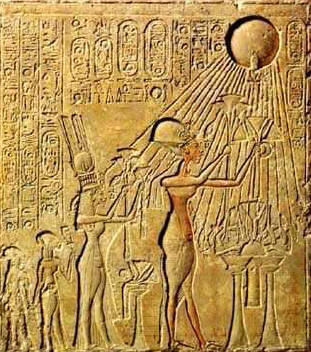
 hump’ reported seeing one or more massive pyramids standing silently in isolated Himalaya valleys.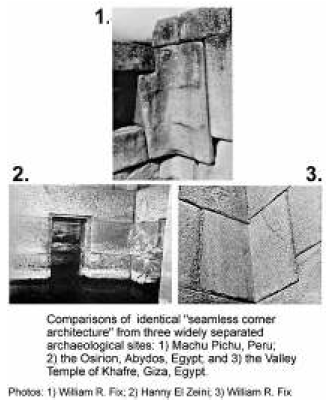
 The pyramids also encode high mathematics supposedly unknown to the simple ancient Egyptians. To begin with, the pyramids are located precisely on the 30th-degree latitude and aligned to within 3 arc minutes of true north.