
SECRET ILLUMINATI - Eye of The Phoenix; The Secret Destiny of America by Manly Palmer Hall and Nicholas Roerich "Chintamani Stone,"
Secret Societies ( Documentary )
The SECRET BOOK of the ILLUMINATI | Do You Have the Eyes to See? Here we are? Explore the hidden books of the Pythagorean Illuminati. There is more to the Illuminati but
what is the real and whole truth? This new Youtube from Morgue is to watch with a very open eye because he is very strange.

This high-quality documentary proves the following points about the two Seals on the back of the One Dollar Bill with clarity and precision:
The Masons have been steadfastly determined since 1782 to seize control of the Temple Mount so they could resurrect Solomon's Temple for use by their Masonic Christ!
Since this was the plan in 1782 when the Seals were created, the Masons made sure that the symbolism of the unfinished pyramid directly tied into their plan to rebuild Solomon's Temple.
When the Masonic Christ (Antichrist) is planned to be the "Living Stone" to top off the unfinished pyramid! You will be amazed at this simple, but profound, symbolism linkage and by the thorough degree to which this plan fulfills Bible prophecy exactly!
You will be shocked to realize that the stage for the fulfillment of this End of the Age prophecy was set all the way back to 1782!
SECRET ILLUMINATI - Eye of The Phoenix - FEATURE FILM
from conspiracy central Website
The film "Eye of the Phoenix" is nearly 3 hours long and it was very long.
What do I think of it?
It is one of the greatest documentaries I've ever seen in my life. It focused not only on the Great Seal but other subjects like the Illuminati, and the Theosophical Society (whose co-founder was, of course, Madame H.P. Blavatsky. She followed the Gnostic lie that the Devil in the Bible offering Adam the fruit of knowledge was the good guy, while Jehovah was the bad guy. That is one definition of the creed of Gnosticism), the Philosopher Stone, and other issues.
The film made known that certain occultists want to create their utopian new world order (and involved in that goal is the re-establishment of Solomon's Temple. Freemasonry explicitly wants this goal as quotes exist of this). It outlined information that I knew about and it presented information that I didn't know about.
The film made known that certain occultists want to create their utopian new world order (and involved in that goal is the re-establishment of Solomon's Temple. Freemasonry explicitly wants this goal as quotes exist of this). It outlined information that I knew about and it presented information that I didn't know about.
One of the major parts of the film was about the Phoenix bird.
The Phoenix bird in legend would die and burn plus it would reappear later. In ancient cultures, it represented the false sun-god (even a peacock or a strange feathered bird) or even Lucifer. That is why occult Secret Societies to this day outline worship of Lucifer (or Satan). One of the old names for the Phoenix is FENEX in the Greek language, which equals 666 in the Greek gematria calculation.
The Phoenix was caused by the shining one, which is an old name for Lucifer ironically.
The occult groups believe that ancient knowledge didn't just exist in ancient Babylon, but in Ancient Atlantis (where objects like The Emerald Tablets of Thoth and the lapis exillis. These objects were lusted after by Rosicrucian Nicholas Roerich and his temporary ally 32nd Degree Freemason Henry Wallace).
Myths claim that the lapis exillis was the stone from Lucifer's crown that broke after Lucifer fought the archangel, Michael. This story is found in Manly P. Hall's literature. Masonic apologists may deny that the Great Seal is of Masonic origin (even though Masonic symbols are on them), but the one Dollar Bill is definitely of Masonic origin.
People certainly will compare it to Riddles and Stone. In my opinion, the Eye of the Phoenix is a level above Riddles and Stone in terms of the information describing America's secret history. What was particularly great about the film was how it described the Jacobite Rebellions in a simplistic fashion. The Jacobites supported the pro-Catholic King James II of England. He was forced out of the throne via the Glorious Revolution of 1688.
The Jacobites in large numbers went into America and their Scottish descendants influenced the American Revolution (with Masons like Hugh Mercer).
The Eye of the Phoenix is an excellent film that delves into higher levels of information revolving around the agenda of Secret Societies. Nicholas Roerich, as the documentary proves, wanted to create the global government system (even an Asian Union first).
The Eye of the Phoenix is an excellent film that delves into higher levels of information revolving around the agenda of Secret Societies. Nicholas Roerich, as the documentary proves, wanted to create the global government system (even an Asian Union first).
The film is like information overload since it reaches into more facts than elaborates on other levels of concepts.
Read the rest on A Review of the Eye of the Phoenix film.
| The Secret Destiny of America by Manly Palmer Hall Philosophical Research Society 3341 Griffith Park Boulevard, Los Angeles 27, California 1944 from Yamaguchi Website |
World democracy was the secret dream of the great clas貞ical philosophers. ...
Thousands of years before Columbus they were aware of the existence of our
Western Hemi貞phere and selected it to be the site of the philosophic empire. ...
The brilliant plan of the Ancients has survived to our time, and it will continue to
function until the great work is accomplished. ...
The American nation des計erately needs a vision of its own purpose.
AMERICA cannot refuse the challenge of leadership in the postwar world. Mere physical reconstruction of ravaged countries and the reorganization of political, economic, and social sys負ems is the lesser task we will face. The larger problem and the great chal衍enge is in how to set up a new order of world ethics firmly established on a foundation of demo苞ratic idealism.
Experts in various fields have already submitted programs designed to meet the needs of those na負ions whose way of life has been disrupted by war. But with the failing common to specially trained minds, these planners incline to think mostly in the terms of their own particular interests. As yet, no one has touched the fundamentals of inter要ational ethics. No one has advanced a working plan securely based upon a broad, deep, and sym計athetic understanding of the human being and his problems. The thinking has been in the dual fields of power politics and material economics, with remedies expressed in terms of charts, blue計rints, patterns, and industrial programs.
But, there is one new and encouraging element present in most of the recommendations of today's experts. They are recognizing the necessity of con苞eiving the world as one inter-dependent structure. Yet, even as they recognize the need for a unity of human interests, their recommendations are for the perpetuation of highly competitive economic policies, which, if they are consistently applied, must lead the end to war and discord.
It is not an easy task to unite the efforts of the human race toward the accomplishment of any common good. Mankind in the majority is selfish, provincial in attitude, and concerned primarily with personal success and acquiring creature comforts. It will not be possible to build an enduring peace until the average man has been convinced that per貞onal selfishness is detrimental to personal happiness and personal success. It must be shown that self-seeking has gone out of fashion and that the world is moving on to a larger conception of living.
The postwar planners have more of idealism in their programs than has ever before been expressed in the problem of the relationships of nations. But it still is not enough. A clear and complete state衫ent of a world purpose is required--a world dreams great enough to inspire unity of world effort.
These are the days of America's opportunity to lead a still troubled mankind toward a better way of life. If we meet this challenge, we will ensure the not only survival of our nation for centuries to come, but we shall gain the enduring gratitude of our fellowmen and Americans will be remembered to the end of time as a great enlightened people.
It is not enough that we solve particular prob衍ems. We must solve the very cause of the problem itself. Wars, depressions, crime, dictators and their oppression, are the symptoms giving clear indica負ion of a greater ailment. To examine each prob衍em solely in terms of the problem itself, without recognition of its true relationship to a larger and more universal necessity, is to fail in the broader implications of an enduring peace and prosperity.
Experience should have taught us long ago that policies which have originated from material con貞iderations and attitudes have proved inadequate. The whole story of civilization and the records of history tell us that all such adjustments hold no hope of lasting peace or security. But, here we are again preparing ourselves to be satisfied with tem計orary solutions for permanent problems.
The recognition is long overdue that we over貞implify the problem of world peace when we think that process is one of breaking the task down for examination of its materialistic parts, and then hopefully devising an applicable remedy for each of these. The physical conditions of human existence are not the whole of the human problem. We could adjust all material considerations to the point of supremest equity, and yet accomplish vir負ually nothing solutional.
The greatest of known problems is the human problem. And not until the all-embracing examination is made into every phase of human needs can there be an adequate reconstruction policy for a postwar world. That man is physical is obvious, but he is also mental, and emotional; he is spiritual, and he has a soul. These latter factors are not so obvious.
What to do about them is not so easy; for they are difficult to understand, and even more difficult to classify and reduce to a working pattern. We as builders of a civilization will have to learn that only when equal consideration is given to each of these elements of man's nature will we arrive at the solutions for the disasters into which men and nations precipitate themselves.
Our postwar reconstructors--ours, if not by our selection, at least with our consent--are not out貞tandingly qualified for this broader task. Few indeed are the statesmen and politicians who have any conception of man as a spiritual being. And as for military leaders, they are primarily disci計linarians, invaluable as such in times of war, but not at all emotionally geared to problems of indi赳idualistic peacetime character. And world plan要ers recruited from among our industrial leaders, it must be admitted, are not generally informed on the workings of the human psyche. Those who have made the study of human conduct their life work, the sociologists, have little scientific knowl苟dge of the hidden springs that animate that very conduct into its amazing diversity of manifesta負ions. And if a word is to be said for bringing in the clergy, it might be that the theologian planner who will be truly useful will be one who acquires at least some knowledge of the science of biology.
We are displaying a woeful lack of vision in the way we fumble with the eternal laws of life. It is not enough that we now hopefully create a setup permitting men to give allegiance with their minds or to serve faithfully with their bodies. We must someday face the truth that man is inevitably and incurably an idealist; for this is the truth that will set us free. Man's need is for the idealistic content of his nature to be properly nourished; then his whole consciousness will impel him to right action -and then no more will our laws fail, treaties be broken, and the rights of man stand violated.
The American nation desperately needs a vision of its own purpose. It must conceive it in a gen苟rous idealism, great and strong enough to bind thoughtless and selfish persons to something bigger than themselves. It must recognize that it is in the intangible ideal that the foundations are laid for all seeable good, must know that the truly prac負ical course and the course of hard realism for America is the one that is laid basically in a generous idealism.
This is more than an indicated course. It is one that we inevitably must follow, guided by the hand of destiny.
Believing this to be so, I dedicate this book to the proposition that American Democracy is part of a Universal Plan.
Our world is ruled by inflexible laws which con負rol not only the motions of the heavenly bodies but the consequences of human conduct. These Uni赳ersal motions, interpreted politically, are impelling human society out of a state of autocracy and tyran要y to democracy and freedom. This motion is inevitable, for the growth of humans is a gradual development of mind over matter, and the motion itself represents the natural and reasonable unfold衫ent of the potentials within human character.
Those who attempt to resist this motion destroy themselves. To cooperate with this motion, and to assist Nature in every possible way to the accom計lishment of its inevitable purpose, is to survive.
Thousands of years before the beginning of the Christian era many enlightened thinkers discov苟red the will of God as expressed through Nature in the affairs of men. They made known their discoveries in terms of religions, philosophies, sciences, arts, and political systems. These first statements are now the admired monuments of ancient learning. Available to men of today, they are generally ignored.
Years of research among the records of olden peoples available in libraries, museums, and shrines of ancient cultures, has convinced me that there exists in the world today and has existed for thou貞ands of years, a body of enlightened humans un虹ted in what might be termed, an Order of the Quest. It is composed of those whose intellectual and spiritual perceptions have revealed to them that civilization has a Secret Destiny--secret, I say, because this high purpose is not realized by the many; the great masses of peoples still live along without any knowledge whatsoever that they are part of a Universal Motion in time and space.
Pythagoras, Plato, Aristotle, Buddha, Jesus, and Mohammed are among the greatest names re苞orded in history; but it is not customary to re茆ard the men who bore these names as statesmen or sociologists. They are thought of as philos觔phers, sages, seers, and mystics, whose doctrines have no application to the political needs of an industrial civilization. Yet it is men like Plato and Buddha who still exercise the most powerful force in mortal affairs toward the perpetuation and pre貞ervation of a civilized state among all nations.
All of the great leaders of ancient times realized and taught that the establishment of a state of per衫anent peace among the nations depended upon the release of human ideals, but through properly trained and disciplined minds capable of interpret虹ng these ideas in terms of the common good.
World democracy was the secret dream of the great classical philosophers. Toward the accom計lishment of this greatest of all human ends, they outlined programs of education, religion, and so苞ial conduct directed to the ultimate achievement of a practical and universal brotherhood. And in order to accomplish their purposes more effectively, these ancient scholars bound themselves with cer負ain mystic ties into a broad confraternity. In Egypt, Greece, India, and China, the State Mys負eries came into existence. Orders of initiated priest計hilosophers were formed as a sovereign body to instruct, advise, and direct the rulers of the States.
Thousands of years ago, in Egypt, these mystical orders were aware of the existence of the western hemisphere and the great continent which we call America. The bold resolution was made that this western continent should become the site of the philosophic empire. Just when this was done it is impossible now to say, but certainly, the decision was reached prior to the time of Plato, for a thinly veiled statement of this resolution is the substance of his treatise on the Atlantic Islands.
One of the most ancient of man's constructive ideas is the dream of a universal democracy and a cooperation of all nations in a commonwealth of States. The mechanism for the accomplishment of this ideal was set in motion in the ancient temples of Greece, Egypt, and India. So brilliant was the plan and so well was it administrated that it has survived to our time, and it will continue to function until the great work is accomplished.
Philosophy set up its house in the world to free men by freeing them of their own inordinate de貞ires and ambitions. It saw selfishness as the greatest crime against the common good, for selfishness is natural to all who are untutored. It recognized that the mind has to be trained in the laws of thinking before men can be capable of self-ruler貞hip. And it knew that the democratic common趴ealth can be a reality only when our world is a world of self-ruling men.
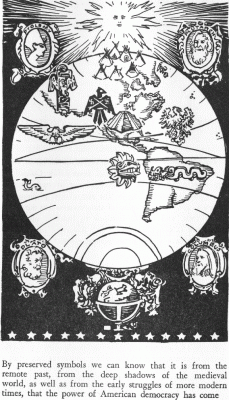
And so it is from the remote past, from the deep shadows of the medieval world as well as from the early struggles of more modern times, that the power of American democracy has come. But we are only on the threshold of the democratic state. Not only must we preserve that which we have gained through ages of striving, we must also per苯ect the plan of the ages, setting up here the ma苞hinery for a world brotherhood of nations and races.
This is our duty and our glorious opportunity.
It seems to me that the basic plan for the post趴ar world should be one solidly founded in this great dream of Universal Brotherhood. It is not enough to work on the problem solely in terms of politics and industry. The formula must express a broad idealism, one which appeals to the finest intuitions of man, and one universally understand苔ble by all who have lived, dreamed, and suffered on this mortal sphere.
2. THE WORLD'S FIRST DEMOCRAT
The leader who had the first social consciousness in the administration of a nation
was a Pharaoh of Egypt, Akhnaton. ... Born several thousand years too soon,
he was the first realist in democracy, the first humanitarian, the first internationalist. ...
He saw that the duty of the ruler is to protect for all the right to live well, to think, to dream, to hope, and to aspire. ...
For his dream of the Brotherhood of Man, he cheerfully gave his life.
The leader who had the first social consciousness in the administration of a nation
was a Pharaoh of Egypt, Akhnaton. ... Born several thousand years too soon,
he was the first realist in democracy, the first humanitarian, the first internationalist. ...
He saw that the duty of the ruler is to protect for all the right to live well, to think, to dream, to hope, and to aspire. ...
For his dream of the Brotherhood of Man, he cheerfully gave his life.
MAN has passed out of the state of savagery and be苞ome a civilized creature with the development of social consciousness. Civi衍ization is a collective state. In our collective type of life, the isolationist is a detriment to himself and a menace to all others.
There is a great difference between isolationism and intellectualism. Development of the mind re衍eases the individual from mob psychology, but it does not set him apart from the common respons虹bilities of his kind. A true thinker becomes a force for good within the group life. If his intel衍ectual powers lure him away from the practical problems and values of his world, he can no longer make his contribution to the social unity.
Political reforms are not accomplished by the people but through the people. Behind all collec負ive progress stands the enlightened individual's leadership. His superiority does not free him from common responsibility; he is the obligation to assume the greater burden of directing his vision to the well being of all his people.
Let us see how this works. We'll go far back to ancient times.
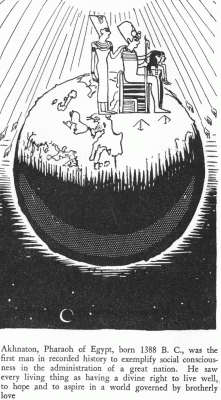
Akhnaton, Pharaoh of Egypt, throned under the title Amen-Hotep IV, is often referred to as the first civilized human being. While this may not be literally true, he was definitely the first man in recorded history to exemplify social consciousness in the administration of a great nation.
Akhnaton, the beloved child of the Aton, was born at Thebes about 1388 B.C. Like most of the princes of his house, he was extremely delicate as a child, and it was feared that he would not live to reach the throne; as the last of his line, the dynasty would end with him if he died without issue. For this reason, he was married in his twelfth year to a ten-year-old Egyptian girl of noble birth, named Nefertiti.
During the childhood of the young king, the Queen mother, Tiy, ruled as regent of the double empire. She is believed to have been of Syrian origin, which would account for the many strange and un-Egyptian ideas in religion, government, and art which were developed during the reign of Akhnaton. Queen Tiy, brilliant and capable, had recognized before her son reached his majority that in him were qualities more divine than human. The son became the actual ruler of his country in his eighteenth year; his reign extended for seventeen years.
Akhnaton had been the ruler of Egypt only about two years when he opposed his will to the priest虐ood of Amon-Ra. By attacking the oldest and most firmly established of all Egyptian institutions, the young Pharaoh created legions of enemies and brought down upon himself the wrath of the reli茆ion of the State. He could scarcely have chosen a surer way of complicating the problems of his life.
In the midst of this conflict, he proclaimed a new spiritual dispensation, and to escape his enemies built a new capital city, one hundred and sixty miles up the Nile from Cairo. His new faith was Atonism; and he named his city Khut-en-Aton--the Horizon of the Aton--and dedicated the city with these words: "Ye behold the City of the Ho訃izon of Aton, which the Aton has desired me to make for Him as a monument, in the great name of My Majesty forever. For it was Aton, my Father, that brought me to this City of the Horizon."
As High Priest of his new religion, Amen-Hotep IV changed his name to Akhnaton, because the older name included the word Amen, whose faith he had rejected.
Charles F. Potter, in his History of Religion, says of Akhnaton that he was, "the first pacifist, the first realist, the first monotheist, the first Democrat, the first heretic, the first humanitarian, the first internationalist, and the first person known to at負empt to found a religion. He was born out of due time, several thousand years too soon."
From his twenty-sixth year to his thirty-first year, Akhnaton devoted his life to the perfection of his mystical doctrine in the city which he had built for the Ever-Living God. Here he taught the mystery of the Divine Father and wrote the simple and beautiful poems which have endured and survived time. To Akhnaton, God was not a mighty warrior ruling over Egypt, speaking through the oracles of his priests; he was not a Supreme Being flying through the air in a war chariot leading armies of destruction. Aton was the gentle father who loved all his children, of every race and nation; and desired for them that they should live together in peace and comradeship.
Even more, God, the Aton, had created all the lesser creatures, whether birds that nested in the papyrus reeds along the banks of the Nile or dragonflies with many colored wings that hovered over quiet pools and the lotus blooms. The Aton was the father of all beasts, and fishes, and flowers, and insects. He had fashioned them in his wisdom and preserved them with his love and tenderness.
Akhnaton, seated in the garden of his palace, spent many hours watching the flight of birds and listening to the voices of little creatures. He tells us that he found the Aton in all of them and that his heart went out to them, and he gave thanks for the goodness in everything that lived.
This was a Pharaoh who traveled alone through the countryside, meeting the peasants, conversing with slaves, and sharing the simple food of the poor. To the most ignorant man, he listened with profound respect, for in each of his subjects he sought and found the life of the Aton. He saw the Universal God shining through the eyes of little children, beheld the beauty of the Aton in the bodies of the men who worked in the fields. He could not understand why others did not see God in everything, as he did.
Like most of the great religious leaders, Akhn苔ton accepted the social problem of life as part of religion. He could not accept the inequalities of birth, wealth, or physical estate as a justification for men persecuting each other or exploiting one another. He saw every living thing has a divine right--a right to live well, to think, to dream, to hope, and to aspire. He saw it the duty of the ruler to protect this beauty in the hearts of his peo計le, to nourish it, and to give every possible oppor負unity for its expression and perfection.
Religious intolerance was impossible among those who worshipped the Atan, and there was no room for political intolerance in a world governed by the laws of brotherly love. Each man became the protector and comforter of all other men, cherish虹ng the dreams of others equally with his own.
In his personal life, Akhnaton emerges as the first man in history to bring dignity and gentle beauty to the management of his home. He was the father of seven daughters, to whom he was completely devoted, and in his speeches and public pronouncements he always referred to Queen Ne苯ertiti as "my beloved wife."
It was usual for the Pharaohs to cause themselves to be depicted in great stone carvings upon the walls of their palaces. They were represented as majestic figures, crowned and sceptered; they were shown either seated on their thrones or wielding their weapons against their foes. Akhnaton was the only Pharaoh in the history of Egypt who chose to be depicted with his arm about his wife, with his little daughters playing about and seated on his lap
As with the passing years the health of the Pharaoh grew worse, the opposition of the priest虐ood of Amon-Ra grew greater; and his reign was complicated by invasions by the Hittite nations. The governors of various provinces pleaded with him for help, but Akhnaton would not send armies.
The dreamer king saw his lands pillaged and his cities conquered; but he would not kill his ene衫ies; they, too, were children of the Aton.
Akhnaton died in his thirty-sixth year, at the altar of the Aton in the temple of the faith he had created. When his mummy case was found, the follow虹ng prayer to the Aton was discovered inscribed on golden foil beneath his feet. "I breathe the sweet breath which comes forth from Thy mouth. I behold Thy beauty every day .... Give me Thy hands, holding Thy spirit, that I may receive it and may be lifted by it. Call Thou upon my name unto eternity, and it shall never fail."
In the words of the great Egyptologist, Professor Breasted, "There died with him such a spirit as the world had never seen before."
Akhnaton was the first man in history who dared to dream of the Brotherhood of Men, and he cheer苯ully gave his life and his empire for that dream.
He is indeed, "The beautiful child of the Living Aton, whose name shall live forever and ever."

