MYSTERY, BABYLON THE GREAT, THE MOTHER OF HARLOTS AND ABOMINATIONS OF THE EARTH.


And the woman was arrayed in purple and scarlet color, and decked with gold and precious stones and pearls, having a golden cup in her hand full of abominations and filthiness of her fornication: And upon her forehead was a name written, MYSTERY, BABYLON THE GREAT, THE MOTHER OF HARLOTS AND ABOMINATIONS OF THE EARTH.Revelation 17:4-5

As a rule, theories of a “Jewish conspiracy” for world domination condemn all Jews as megalomaniac conspirators and the enemies of mankind.
However, any treatment of a Jewish conspiracy must take into account the ancient schism that divided the nation of Israel in Biblical times. This division was precipitated by the apostasy of King Solomon, whose idolatry was afterward carried on by the northern tribes. This ancient schism has profoundly affected the subsequent history of the Jews and is the dynamic of the alleged “Jewish conspiracy” of the present day.
Following the death of King Solomon, the tribes of Israel separated into two independent kingdoms. The ten northern tribes formed the northern kingdom of Israel and the southern tribes of Judah and Benjamin were thereafter called the kingdom of Judah.
The schism between Judah and Israel, from which the Israelites never recovered, is recorded in 1 Kings. The Daily Bible Study gives a brief overview:
“One of the most misunderstood subjects of Bible study involves the total political division of ‘Israel’ and ‘Judah’ that occurred at the time of King Rehoboam. Before then, all twelve tribes of Israelites were a united kingdom through the reigns of David and Solomon, but after Solomon’s death they split into two completely separate and independent kingdoms - the southern kingdom of ‘Judah,’ consisting of the tribes of Judah and Benjamin, with part of Levi since the Levites were distributed among the other tribes (1 Kings 12:23) with their capital at Jerusalem, and the northern kingdom of ‘Israel,’ consisting of the other ten tribes (Reuben, Simeon, Dan, Naphtali, Gad, Asher, Issachar, Zebulun, Ephraim and Manasseh (Joseph was divided into Ephraim and Manasseh), with part of Levi since the Levites were distributed among the other tribes), with their capital up in Samaria.
“Israel and Judah were never united again... Surprisingly, they even fought wars against each other from time to time... A very important fact that many do not realize is that Judah, that is, the Jewish people of today, are only one of the tribes of Israel - while all Jews are Israelites, not all Israelites are Jews.
“Because of their forsaking of Him, God permitted the two kingdoms to be destroyed. First, the northern kingdom of Israel was gradually conquered by the Assyrians,… and by 721 B.C. they had practically all been taken into exile to Assyria (2 Kings 17:1-23). The vast majority of them never returned, and have become known as the ‘Lost Ten Tribes of Israel.’
“Then, about 135 years later, by 586 B.C., the southern kingdom of Judah was completely conquered by the Babylonians,... and the people of Judah were taken into captivity to Babylon. The original Temple of God in Jerusalem was destroyed at that time... The people of the southern kingdom of Judah however did return after the Babylonians fell to the Persians..., and their descendants have become the Jewish people of today - but that return in the time of Nehemiah, or the founding of the modern state of Israel in 1948, were not the fulfillment of the many prophecies dealing with the future (as the context of the prophecies clearly show) gathering of all of Israel, Israel and Judah.”
“Israel and Judah were never united again... Surprisingly, they even fought wars against each other from time to time... A very important fact that many do not realize is that Judah, that is, the Jewish people of today, are only one of the tribes of Israel - while all Jews are Israelites, not all Israelites are Jews.
“Because of their forsaking of Him, God permitted the two kingdoms to be destroyed. First, the northern kingdom of Israel was gradually conquered by the Assyrians,… and by 721 B.C. they had practically all been taken into exile to Assyria (2 Kings 17:1-23). The vast majority of them never returned, and have become known as the ‘Lost Ten Tribes of Israel.’
“Then, about 135 years later, by 586 B.C., the southern kingdom of Judah was completely conquered by the Babylonians,... and the people of Judah were taken into captivity to Babylon. The original Temple of God in Jerusalem was destroyed at that time... The people of the southern kingdom of Judah however did return after the Babylonians fell to the Persians..., and their descendants have become the Jewish people of today - but that return in the time of Nehemiah, or the founding of the modern state of Israel in 1948, were not the fulfillment of the many prophecies dealing with the future (as the context of the prophecies clearly show) gathering of all of Israel, Israel and Judah.”
The designation “Jew” belonged exclusively to the southern kingdom of Judah, the very word “Jew” having been derived from “Judah.”
And so technically, only the kingdom of Judah was “Jewish” and the other tribes of Israel have no right to call themselves Jews. That this distinction was understood in the Old Testament is seen in II Kings 16:5-6 (KJV) where the people of Israel and the King of Syria fought against the “Jews” of the southern kingdom.
In the New Testament, in His message to the Church at Smyrna, the Lord Jesus Christ referred to a “synagogue of Satan” as “them which say they are Jews, and are not.”
In other words, there was a synagogue of Israel that was not Jewish:
“I know thy works, and tribulation, and poverty, (but thou art rich) and I know the blasphemy of them which say they are Jews, and are not, but are the synagogue of Satan. I know thy works, and tribulation, and poverty, (but thou art rich) and I know the blasphemy of them which say they are Jews, and are not, but are the synagogue of Satan.
Fear none of those things which thou shalt suffer: behold, the devil shall cast some of you into prison, that ye may be tried; and ye shall have tribulation ten days: be thou faithful unto death, and I will give thee a crown of life.”
(Rev. 2:9-10)

The “Synagogue of Satan” which is the subject of this series must not be confused with the “Remnant” of Jews, who will receive the Lord Jesus Christ at his second coming and be saved by him.
The Synagogue of Satan are an occult power elite which, having rejected Jesus Christ as the Messiah of Israel, conspire to substitute another messiah made in the image of their master, Satan, and to establish a world kingdom under Satan.
The Synagogue of Satan claims Jewish descent, but does not fit God's definition of a Jew, either in the Old Testament or the New:
“But he is a Jew, which is one inwardly; and circumcision is that of the heart, in the spirit, and not in the letter; whose praise is not of men, but of God.”(Romans 2:29)
The Synagogue of Satan have contempt, not only for Jesus Christ, his Church and the Gentile masses, but for the Jewish “Remnant” who are Torah-observant and anti-Zionist are, therefore, awaiting the kingdom of Israel to be restored when the Messiah appears, and not before.
As well, the Synagogue of Satan have conspired to eliminate all people, whether Jew or Gentile, who stand in the way of their world kingdom. To this end they have developed a staggering number of fronts, as well as the capacity to create blinds and diversions, to obscure the fact that they are Cabalist Jews with an anti-Christ agenda.
Through the centuries, the Synagogue of Satan have, by means of false identities, infiltrated Gentile institutions where they act as agents provocateurs - undercover agents who provoke violence and beget scandals, which are used to bring reproach upon Jesus Christ and his church.
The division within Jewry is no longer neatly delineated along tribal boundaries; rather the lines have been spiritually drawn between the Synagogue of Satan and the Remnant of Israel
I will surely assemble, O Jacob, all of thee; I will surely gather the remnant of Israel; I will put them together as the sheep of Bozrah, as the flock in the midst of their fold: they shall make great noise by reason of the multitude of men.”
(Micah 2:12)
“The remnant of Israel shall not do iniquity, nor speak lies; neither shall a deceitful tongue be found in their mouth: for they shall feed and lie down, and none shall make them afraid.”
(Zeph. 3:13; see also 2 Chron. 34:9, Isaiah 10:20, Jer. 6:9, 31:7, Ezek. 11:13)
Scripture is clear that the plans of the Synagogue of Satan shall utterly fail, and that they will ultimately be destroyed. What fraction of all Israel does the Synagogue of Satan represent?
The Old Testament prophets foretold their proportions at the time they attack Jerusalem, whose rescue and restoration will be accomplished by the Lord himself:
“The LORD also shall save the tents of Judah first, that the glory of the house of David and the glory of the inhabitants of Jerusalem do not magnify themselves against Judah. In that day shall the LORD defend the inhabitants of Jerusalem; and he that is feeble among them at that day shall be as David; and the house of David shall be as God, as the angel of the LORD before them. And it shall come to pass in that day, that I will seek to destroy all the nations that come against Jerusalem...
“And it shall come to pass, that in all the land, saith the LORD, two parts therein shall be cut off and die; but the third shall be left therein. And I will bring the third part through the fire, and will refine them as silver is refined, and will try them as gold is tried: they shall call on my name, and I will hear them: I will say, It is my people: and they shall say, The LORD is my God.”
(Zech. 12:7-10; 13:8,9)
“In that day, saith the LORD, will I assemble her that halteth, and I will gather her that is driven out, and her that I have afflicted; And I will make her that halted a remnant, and her that was cast far off a strong nation: and the LORD shall reign over them in mount Zion from henceforth, even for ever. And thou, O tower of the flock, the strong hold of the daughter of Zion, unto thee shall it come, even the first dominion; the kingdom shall come to the daughter of Jerusalem.”
(Mic. 4:1,2,6-8)
PART I
Following the division of Israel and the Assyrian captivity of the northern tribes, the southern kingdom of Judah adopted the pagan traditions of the heathen nation of ancient Babylon.
These traditions, with their associated rituals which included human sacrifice, provoked God to judge the southern kingdom, which judgment the prophet Jeremiah forewarned the Jews for a period of forty years, to no avail. The Babylonians destroyed Jerusalem in three stages, from 605 to 586 B.C., in which year the Temple of Solomon was demolished and the remaining Jews were carried into captivity. During the Babylonian captivity, the prophet Ezekiel continued to reprove Judah for its apostasy from the God of Israel and their love affair with Babylon.
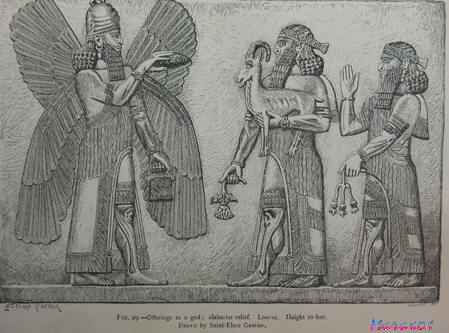
Note, in the following passage, the Jews’ admiration for the images of rich, brightly attired Babylonian princes, which evoke visual images of the elegant processions of the princes of the Roman Catholic Church attired in their rich and colorful vestments:
“...[Jerusalem] increased her whoredoms: for when she saw men pourtrayed upon the wall, the images of the Chaldeans pourtrayed with vermilion, Girded with girdles upon their loins, exceeding in dyed attire upon their heads, all of them princes to look to, after the manner of the Babylonians of Chaldea, the land of their nativity: And as soon as she saw them with her eyes, she doted upon them, and sent messengers unto them into Chaldea. And the Babylonians came to her into the bed of love, and they defiled her with their whoredom, and she was polluted with them, and her mind was alienated from them. So she discovered her whoredoms, and discovered her nakedness: then my mind was alienated from her...” (Ezek.23:14-18)
Moreover, as Matthew Henry noted in his commentary on this passage, the kingdom of Judah patterned its own worship after the pomp and pageantry of the Babylonians with whom they had become enamored:
“Thus she increased her whoredoms; she fell in love, fell in league, with the Chaldeans. Hezekiah himself was faulty this way when he was proud of the court which the king of Babylon made to him and complimented his ambassadors with the sight of all his treasures, Isa. 39:2. And the humour increased (v. 14); she doted upon the pictures of the Babylonian captains (v. 15, 16), joined in alliance with that kingdom, invited them to come and settle in Jerusalem, that they might refine the genius of the Jewish nation and make it more polite; nay, they sent for patterns of their images, altars, and temples, and made use of them in their worship. Thus was she polluted with her whoredoms (v. 17), and thereby she discovered her own whoredom (v. 18), her own strong inclination to idolatry.”
According to two authoritative sources, H.P. Blavatsky and the Jewish Encyclopedia, the Jews also acquired from the Chaldeans their doctrines of Eastern mysticism.
These were later developed into a written compendium of esoteric literature known as the Jewish Qabbalah or Kabalah, and in the Middle Ages as the Latin Cabala.
“Kabalah (Heb.) The hidden wisdom of the Hebrew Rabbis of the middle ages derived from the older secret doctrines concerning divine things and cosmogony, which were combined into a theology after the time of the captivity of the Jews in Babylon. All the works that fall under the esoteric category are termed Kabalistic.” (Blavatsky, Theosophical Glossary, p. 168)
“The Pythagorean idea of the creative powers of numbers and letters, upon which the ‘Sefer Yetzirah’ is founded, and which was known in tannaitic times…is here proved to be an old cabalistic conception. In fact, the belief in the magic power of the letters of the Tetragrammaton and other names of the Deity…seems to have originated in Chaldea (see Lenormant, ‘Chaldean Magic,’ pp. 29, 43). Whatever, then, the theurgic Cabala was …, the very fact that Abraham, and not a Talmudical hero like Akiba, is introduced in the ‘Sefer Yetzirah,’ at the close, as possessor of the Wisdom of the Alphabet, indicates an old tradition, if not the antiquity of the book itself…
“The whole dualistic system of good and of evil powers, which goes back to Zoroastrianism and ultimately to old Chaldea, can be traced through Gnosticism; having influenced the cosmology of the ancient Cabala before it reached the medieval one…
“The gradual condensation of a primal substance into visible matter, a fundamental doctrine of the Cabala, … is the ancient Semitic conception of the ‘primal ocean,’ known to the Babylonians as ‘Apsu’ (compare Jastrow, ‘Religion of Babylonia’), and called by the Gnostics βύθος = (Anz, ‘Die Frage nach dem Ursprung des Gnostizismus,’ p. 98).”
The Chaldean religious tradition that was embraced by apostate Jews during their captivity in Babylon was delivered to subsequent generations by word of mouth.
According to Blavatsky, these disseminators of the Chaldean tradition in the few centuries before Christ were known as Tanaim:
“Kabalist. From Q B L H, Kabala, an unwritten or oral tradition. The kabalist is a student of ‘secret science’, one who interprets the hidden meaning of the Scriptures with the help of the symbolical Kabala… The Tanaim were the first kabalists among the Jews; they appeared at Jerusalem about the beginning of the third century before the Christian era… This secret doctrine is identical with the Persian wisdom, or ‘magic’.” (Ibid. p.167)
The dictionary defines the Medieval Latin cabala as derived from the Hebrew word “qabb lâ” which means “received doctrine, tradition, from qibbl, to receive.”
lâ” which means “received doctrine, tradition, from qibbl, to receive.”
According to the Jewish Encyclopedia, Cabalists claimed to have received these oral traditions, not from ancient Chaldeans, but from the Patriarchs and Prophets “by the power of the Holy Spirit.”
“Cabala comprised originally the entire traditional lore, in contradistinction to the written law (Torah), and therefore included the prophetic and hagiographic books of the Bible, which were supposed to have been ‘received’ by the power of the Holy Spirit rather than as writings from God’s hand... Each ‘received’ doctrine was claimed as tradition from the Fathers...to be traced back to the Prophets or to Moses on Sinai... The chief characteristic of the Cabala is that, unlike the Scriptures, it was entrusted only to the few elect ones;…’”
Because of its heretical nature, the Cabala was not generally promulgated among the Jews but remained the “secret doctrine” of “elect” Jews.
That is to say, certain Jews who were deemed worthy could comprehend hidden teachings in the written Torah and, through mystical techniques, make direct contact with “God.” Among these practices are rapid recitation of the “Holy Name of God” (YHVH, or Tetragrammaton), meditation on the 11 Sephiroth of the Tree of Life which are believed to be emanations of God, learning to use the 22 letters of the Hebrew alphabet as force-carrying energy patterns which serve as the building blocks of the cosmos, and, finally, transcending the space/time limitations of the physical world to realize one’s “inner divinity.”
Ancient Babylon - The Bible's Buried Secrets Documentary
This “secret doctrine” has been preserved throughout the ages to the present time by a spiritual brotherhood who progress individually to various stages of enlightenment and proficiency in the hidden wisdom - from “elect” to “adepts” to “wise men” to “adepts in grace”:
“Cabala... The specific term for the esoteric or mystic doctrine concerning God and the universe, asserted to have come down as a revelation to elect saints from a remote past, and preserved only by a privileged few. At first consisting only of empirical lore, it assumed, under the influence of Neoplatonic and Neopythagorean philosophy, a speculative character. In the geonic period it is connected with a Mishnah-like text-book, the ‘Sefer Yetzirah,’ and forms the object of the systematic study of the elect, called ‘mekubbalim’ or ‘ba’ale ha-kabbalah’ (possessors of, or adepts in, the Cabala). These receive afterward the name of ‘maskilim’ (the wise), after Dan. xii. 10; and because the Cabala is called (‘Hokmah nistarah’ = the hidden wisdom), the initials of which are , they receive also the name of (‘adepts in grace’) (Eccl. ix. 11, Hebr.).” (Ibid.)
The “Tanaim,” which meant “teacher of the law,” were the Scribes, the rabbis whom Blavatsky identified as the first Kabalists.
From the ranks of the Scribes evolved the sect of the Pharisees. According to Occult Theocrasy, by Edith Starr Miller, the creators of the Cabala were the Pharisees, who had formed their sect in Babylon during the captivity and functioned as a secret society after the Jews returned to Israel.
The ‘secret doctrine’ of Babylon remained the oral tradition of the Pharisees until they committed it to written form:
“In his book Nicholas II et les Juifs, Netchvolodow explains that ‘the Chaldean science acquired by many of the Jewish priests, during the captivity of Babylon, gave birth to the sect of the Pharisees whose name only appears in the Holy Scriptures and in the writings of the Jewish historians after the captivity (606 B.C.). The works of the celebrated scientist Munk leaves no doubt on the point that the sect appeared during the period of the captivity.
“‘From then dates the Cabala or Tradition of the Pharisees. For a long time their precepts were only transmitted orally but later they formed the Talmud and received their final form in the book called the Sepher ha Zohar.’
“The Pharisees were, as it were, a class whose tendency was to form a kind of intellectual aristocracy among the Jews. At first, they formed a sort of brotherhood, a haburah, the members being called haburim or brothers. They were a subversive element, aiming at the overthrow of the Sadducean High-priesthood, whose members prided themselves on their aristocracy of blood and birth, to which the Pharisees opposed an aristocracy of learning. The war raged by the latter extends over a long period of time, and the rivalry was bitter...
“The power of the Sadducees fell with the destruction of the Temple by Titus and thenceforth the Pharisaic element held supremacy among the Jews. Quoting an acknowledged authority on Judaism, Mr. Flavien Brenier, Lt. Gen. Netchvolodow further describes the policy of the sect as follows:
“‘Before appearing proudly as the expression of Jewish aspirations, The Tradition of the Pharisees had serious difficulties to surmount, the chief of which was the revival of the orthodox faith stimulated in the Jewish people by the Captivity. To the exiles, bemoaning the fall of the Temple of Jerusalem and begging Jehovah to end the misfortunes of their homeland, the revelation that Jehovah was only a phantom, entailed not only a certain defeat, but also their own exposure to perils the least of which would have been the loss of all authority over Israel.
“‘The Pharisees, then, judging it wiser to capture the confidence of their compatriots by taking the lead in the religious movement, affected a scrupulous observance of the slightest prescriptions of the law and instituted the practice of complicated rituals, simultaneously however cultivating the new doctrine [i.e. secret doctrine] in their secret sanctuaries. These were regular secret societies, composed during the captivity of a few hundred adepts. At the time of Flavius Josephus which was that of their greatest prosperity, they numbered only some 6,000 members.” (Occult Theocrasy, pp. 76-78)
To these hypocrites, Jesus reserved His most scathing condemnations:
“Woe unto you, scribes and Pharisees, hypocrites! for ye are like unto whited sepulchres, which indeed appear beautiful outward, but are within full of dead men's bones, and of all uncleanness. Even so ye also outwardly appear righteous unto men, but within ye are full of hypocrisy and iniquity.” (Matt. 23:27-28)
“And he said unto them, Full well ye reject the commandment of God, that ye may keep your own tradition... Making the word of God of none effect through your tradition, which ye have delivered: and many such like things do ye.” (Mark 7:9,13)
According to Occult Theocrasy, the Pharisees assumed the outward appearance of religious scrupulosity all the while they were conducting pagan rites in secret, as did their antecedents, the elders of Judah, in the Temple of Solomon, as the Lord revealed to the prophet Ezekiel.
“Then said he unto me, Son of man, lift up thine eyes now the way toward the north. So I lifted up mine eyes the way toward the north, and behold northward at the gate of the altar this image of jealousy in the entry. He said furthermore unto me, Son of man, seest thou what they do? even the great abominations that the house of Israel committeth here, that I should go far off from my sanctuary? but turn thee yet again, and thou shalt see greater abominations. And he brought me to the door of the court; and when I looked, behold a hole in the wall. Then said he unto me, Son of man, dig now in the wall: and when I had digged in the wall, behold a door. And he said unto me, Go in, and behold the wicked abominations that they do here. So I went in and saw; and behold every form of creeping things, and abominable beasts, and all the idols of the house of Israel, pourtrayed upon the wall round about. And there stood before them seventy men of the ancients of the house of Israel, and in the midst of them stood Jaazaniah the son of Shaphan, with every man his censer in his hand; and a thick cloud of incense went up. Then said he unto me, Son of man, hast thou seen what the ancients of the house of Israel do in the dark, every man in the chambers of his imagery? for they say, The LORD seeth us not; the LORD hath forsaken the earth. He said also unto me, Turn thee yet again, and thou shalt see greater abominations that they do. Then he brought me to the door of the gate of the LORD'S house which was toward the north; and, behold, there sat women weeping for Tammuz.” (Ezekiel 8: 5-14)
Netchvolodow likens the Pharisees to our modern Freemasons, whose Gnostic and dominionist agenda were subversive of society.
Compare Netchvolodow’s characterization of the Pharisees to our modern Zionists, i.e. the Judeo-Freemasons, who are secret practitioners of the Kabalah, while affecting to hold to the traditional beliefs of Judaism as set forth in the Old Testament.
“‘This group of intellectual pantheists was soon to acquire a directing influence over the Jewish nation. Nothing, moreover, likely to offend national sentiment ever appeared in their doctrines. However saturated with pantheistic Chaldeism they might have been, the Pharisees preserved their ethnic pride intact. This religion of Man divinised, which they had absorbed at Babylon, they conceived solely as applying to the profit of the Jew, the superior and predestined being. The promises of universal dominion which the orthodox Jew found in the Law, the Pharisees did not interpret in the sense of the reign of the God of Moses over the nations, but in that of a material domination to be imposed on the universe by the Jews. The awaited Messiah was no longer the Redeemer of original Sin, a spiritual victor who would lead the world, it was a temporal king, bloody with battle, who would make Israel master of the world and ‘drag all peoples under the wheels of his chariot’. The Pharisees did not ask this enslavement of the nations of a mystical Jehovah, which they continued worshipping in public, only as a concession to popular opinion, for they expected its eventual consummation to be achieved by the secular patience of Israel and the use of human means.
“‘Monstrously different from the ancient law were such principles as these, but they had nothing one could see, which might have rendered unpopular those who let them filter, drop by drop, among the Jews.
“The admirably conceived organization of the Pharisees did not fail soon to bear fruit.
“‘One cannot better define its action in the midst of Jewish society before Jesus Christ,’ said Mr. Flavien Brenier, ‘than in comparing it with that of the Freemasons in modern society.
“‘A carefully restricted membership tightly bound, imposing on their members the religion of ‘the secret’, the Pharisees pursued relentlessly their double aim which was: -
“‘1. The seizure of political power, by the possession of the great political offices (the influence of which was tremendous in the reconstituted Jewish nation) and the conquest of the Sanhedrin (Jewish parliament).
“‘2. To modify gradually the conceptions of the people in the direction of their secret doctrine...
“The second of these aims and its method of attainment is exposed in the so-called Protocols of the Wise Men of Zion so loudly denounced by the descendants of those who devised The Secret Doctrine in Israel, Israel here meaning the Jews as a religious community, most of whom remain quite ignorant of the intricate subversive schemes imputed to them.
“The attitude of Jesus Christ to this sect is definitely expressed in the New Testament (see Luke XI and John VIII’” (Ibid. pp.76-80)
“Woe unto you, scribes and Pharisees, hypocrites, for ye are as graves which appear not, and the men that walk over them are not aware of them.” (Luke 11:44)
“Ye are of your father the devil, and the lusts of your father ye will do. He was a murderer from the beginning, and abode not in the truth because there is no truth in him…” (John 8:44)