M.S. Can you briefly outline how you were recruited for UFO crash retrievals and the principal military departments involved?
C.S. Well, I joined the Army, and outside of that I can’t say any other organization. It was just that you were brought into it. There was another organization that had nothing to do with the army, I know that because when 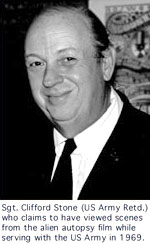 I put in my retirement, my retirement was approved until this other organization found out [Ed. the ‘organization’ is the ‘control group’ for UFO related affairs]. Then I was attached to Fort Bliss pending approval of my retirement, and I can prove that my retirement was already approved. I have documentation on that, but the less you knew the more comfortable they felt.
Also, what a lot of people overlook is if we use the word ‘recruited’ into this field, was they need certain talents certain people have. What happens is that they have control of it. You have no control whatsoever. I don’t know if that makes any sense or not but they really do. And I am sure it started when I was a child. Initially when I tried to enlist in the army I was … rejected from military service, that was in December, 1967. And I was permanently rejected from military service. I was classified as 4F, and I would assume that the Draft Board has a record of that.
M.S. Can you confirm whether you did any training as ‘typist’ which is on your military record and how this related to the actual training you did for the specialized activities you performed? …
C.S. Which needs clarification because no one has ever gotten that straight. OK, I went into the military and when I enlisted, I enlisted for MOS, Military Occupational Specialty 71B, which is clerk typist. I was then and am to this very day a lousy clerk typist. I can’t type worth heck, but the situation is I tried for other MOS’s but they said “don’t rock the boat because you were . . . rejected from military service so let’s just take it easy, admin., not a problem.” Well, I went into that, going through Basic [Training], had some situations with UFO’s while I was in Basic that made it clear that somebody already knew that prior to getting into the service I had an interest in UFO’s.
It didn’t all start to click together until I got to AIT [Advanced Individual Training]. At AIT I went ahead and I was supposed to be trained as a clerk typist, but when you first get to AIT there are a couple of days you don’t go into training. Normally they started on a Monday and I got there one day during the week, other than Monday, so my training didn’t start until the following Monday, so they put me on ‘Detail’. And initially I was handing out medical records at the hospital there, when people came in. That went for two or three days.
When I was supposed to start training they had me up on a cleaning detail and sent me to the post headquarters which also housed the G2 office, which was military intelligence. There was a person there who was on special duty to Ozarks in South Carolina and he went ahead and was very interested in what I knew about UFO’s, up to and including the point where he was showing me things that were highly classified. I knew what Top Secret meant. I didn’t know what the letters meant after Top Secret at that time. Now I do know what they stand for . . . and I was a little concerned because I didn’t have a clearance at that time. After I got through Basic and got through AIT which he told me he would keep in touch when he left.
I went to my first permanent duty station after leave, and that was 36 Civil Affairs Company, part of the 96 Civil Affairs Group at Fort Lee, Virginia. I announced to them immediately that I did not know anything about typing, so the First Sergeant went ahead and said: “not only do you not know anything about typing you are color blind too.” And I said, ‘Pardon me’, so he said: “I’ll be right back.” And he goes into the company commander and tells the company commander something and the company commander comes out.
The company commander asks me what branch of service did I enlist into, and I said “Sir, I enlisted into the United States Army, it should be obvious on here”. He said: “do you know the difference between blue and green”, and I found the question kind of ridiculous, but I said “yes sir, I do”, and he said, “Ok”.
So they told me 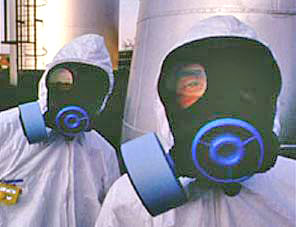 at that time, OK you say you can’t type, would you mind being the unit NBC [Nuclear, Biological, and Chemical] communications non-commissioned officer? And I said “sure, what does that encompass?” Well, we have to send you to school, so it wasn’t no more than a month of so later that I ended up going to school at Fort MacCallum, Alabama.
It was a three week course in the unit NBC, non-commissioned officer. Upon completion of that I came back to my unit and when I came back to my unit it was just taking care of the protective masks, the protective NBC protective equipment. I have the communications equipment which also consisted of several quick 25’s, which are field radios, little more than a hundred 312’s which were filled telephones and switchboard that we had, which was an SP22 switchboard.
A month after that I was assigned to be on the quick reaction group in the event there was an NBC incident that was to occur, then we would move out. Now under that guise I was used on at least three occasions while I was there dealing with UFOs.
M.S. You say that you participated in a training program for UFO crash retrieval teams under the rubric of Nuclear, Biological and Chemical Weapons Crisis Response Team. Is this training generic for all types of NBC crises including UFO crash retrievals, or was your training specifically for UFO crash retrievals and associated NBC problems?
C.S. It was generic for all NBC situations. When it came to UFO’s the general stance was they didn’t exist so they didn’t go out of there way to make believers out of people who were involved in that. You were hand picked by somebody, and that somebody wasn’t army officials. That somebody’s personal opinion [was] in the Alphabet Soup of the intelligence community of the United States.
I can’s say CIA, DIA or who. They hand picked you. And when you went there and there was a UFO incident, and you knew it was a UFO incident, the protocol went basically the same. And you were always debriefed being told it was a Soviet space craft, it was a Stealth aircraft, it was one of our aircraft. If you saw the craft you knew better.
M.S. Were NBC units used for normal duties in addition to specialized crash retrieval duties?
C.S. Oh absolutely. Like rule number one, don’t use an NBC unit when it comes to UFO’s. Don’t use an NBC unit on a quick reaction call on a UFO more than one time. Because what happens is that the people … normally have clearances between confidential and secret, mostly secret. But if you’re involved in a recovery of even debris of a UFO, then what happens is now its top secret/SCI, meaning that Top Secret Sensitive Compartmented Information, which requires more than a Top Secret clearance to view the material.
And that would be on a one time basis; however, they would have people in there that they hand picked that would be involved throughout their career dealing with UFO’s. And they would also go ahead and make the determination on assignment where those people go to try and have them in pre-position in locations where they anticipated there would be some kind of UFO related activity.
M.S. Did you speak to others participating in the NBC Crisis training and were they also involved in UFO crash retrieval duties?
C.S. Oh absolutely. The one thing that people have a problem with and is hard for them to understand is that the best protection is to have situations where you have real life, every day events that can occur and have contingency plans for life for them. Now if a UFO crashes, those thing’s [UFOs] contingency plan works very good for the recovery of items. Of course where they go is entirely different and the protocol is a little different, not much but a little different. For example, not everything is classified if you have an NBC accident, a nuclear, biological, chemical accident.

 CONSPIRACIES.NET
