
The Atlantis Conspiracy

 Our Rockefeller textbooks tell us that nobody in the ancient world had ever crossed the Atlantic before Columbus.
But the voyage of the Mayflower only took 60 days. Are we honestly to believe that no one had ever previously taken the 60 day trip in all of human history? The great civilizations of ancient Egypt, Babylon, Sumer, Greece, Rome, and the seafaring Phoenicians never wondered what was out West past 59 days sailing?
If we accept this improbability, we have to accept many more along with it, because the native American cultures of the “New World” and the Eurasian cultures of the “Old World” were already far too similar to have naturally evolved separately.
If we accept this improbability, we have to accept many more along with it, because the native American cultures of the “New World” and the Eurasian cultures of the “Old World” were already far too similar to have naturally evolved separately.

For instance, compare the Peruvians and Egyptians. The number of complex comparisons between the two peoples far surpasses serendipity. Both cultures believed in an immaterial soul which reincarnates through multiple physical existences.
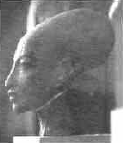
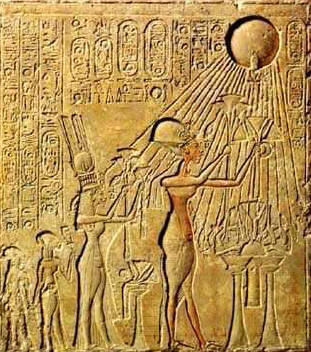
They both worshipped the Sun, Moon, and Stars, and held amazing astronomical knowledge, much of which has just recently been rediscovered. Both peoples built amazing stone pyramids, often containing boulders too heavy for modern cranes to lift, quarried from miles away. Both cultures embalmed/mummified their dead. Peruvian and Egyptian royalty both wrapped children’s heads in the practice of “skull elongation” (like trepanning) to attain higher consciousness.
They both divided the year into twelve months. Both peoples had a women’s order of vestal virgins vowed to celibacy, and violating their vows was punished on both continents by their being buried alive. Both cultures offered animal sacrifices and divined the future by examining the animal’s entrails. They both built huge arches and strewed the road with flowers for returning home triumphant warriors/heroes. At the beginning of each agricultural season during a big celebration, the Kings placed their hands to the plow and ploughed the first furrow.
Naked Science - Atlantis Jul 3, 2013
Are we to believe such incredibly specific practices developed completely independent of one another?
“When the Spanish missionaries first set foot upon the soil of America, in the fifteenth century, they were amazed to find the Cross was as devoutly worshipped by the red Indians as by themselves.”Ignatius Donnelly, “Atlantis: The Antediluvian World”
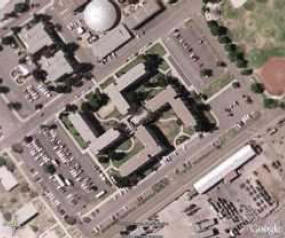
Ancient symbols like the cross and the swastika already existed in the Americas long before the Europeans came. Egyptian symbols like the “Akeru” back to back lion gods hieroglyph are found in Olmec temples from ancient Mexico.
We have also found Mayan art and glyphs in Egypt.
Modern Mayans and tribal Egyptians both recognize the languages found in their countries as that of their ancestors and both can read much of it. We’ve discovered artwork 23000 years old clearly depicting negroes and Caucasians in Central America. The establishment remains silent on all these issues.
The similarities between Old World European and American peoples are vast and difficult to accept as mere coincidence.
The similarities between Old World European and American peoples are vast and difficult to accept as mere coincidence.
The use of cement, bricks, arches, and advanced masonry/architecture is found on both sides of the Atlantic, as well as roads, stone and suspension bridges; Metallurgy, ore mining of copper, tin, bronze, gold, silver, and iron; Sculpture, painting, engraving, agriculture, navigation, large sailing vessels, pottery, glasswork, and music; both Old and New Worlders fashioned the same weapons like bows and arrows, spears, swords, battleaxes, darts, and slings; baptism, confession, penance all long existed on both continents.
“If we find on both sides of the Atlantic precisely the same arts, sciences, religious beliefs, habits, customs, and traditions, it is absurd to say that the peoples of the two continents arrived separately, by precisely the same steps, at precisely the same ends. When we consider theresemblance of the civilizations of the Mediterranean nations to one another, no man is silly enough to pretend that Rome, Greece, Egypt, Assyria, Phoenicia, each spontaneously and separately invented the arts, sciences, habits, and opinions in which they agreed; but we proceed to trace out the thread of descent or connection from one to another.
Why should a rule of interpretation prevail, as between the two sides of the Atlantic, different from that which holds good as to the two sides of the Mediterranean Sea? If, in the one case, similarity of origin has unquestionably produced similarity of arts, customs, and condition, why, in the other, should not similarity of arts, customs, and condition prove similarity of origin? Is there any instance in the world of two peoples, without knowledge of or intercourse with each other, happening upon the same invention, whether that invention be an arrowhead or a steam-engine?If it required of mankind a lapse of at least six thousand years before it began anew the work of invention, and took up the thread of original thought where Atlantis dropped it, what probability is there of three or four separate nations all advancing at the same speed to precisely the same arts and opinions? The proposition is untenable. If, then, we prove that, on both sides of the Atlantic, have descended one from the other, or have radiated from some common source.”Ignatius Donnelly, “Atlantis: The Antediluvian World”
Stubborn Egyptologists/Anthropologists and our Rockefeller textbooks also claim that the ancient Egyptian, Sumerian, and Babylonian cultures all somehow started at the height of their civilization and rapidly devolved as their empires fell.
This is standard accepted “fact” but how is it possible that such advanced cultures just magically appeared at the beginning of recorded history?
“The region of Mesopotamia (Sumeria), which seems to have suddenly appeared out of nowhere (according to Academia), had a high knowledge of astronomy, architecture, a pantheon of gods, agriculture, gourmet foods, and courts. It is considered to be the cradle of civilization. Mesopotamia, in the north, encompassed the rivers Tigris and Euphrates, which flowed from the Garden of Eden, in the Genesis stories.The places known as Atlantis, Dilmun, and Lemuria are mentioned in the records of Sumeria. This is an obvious indication that these societies or cities predated the Sumerian era. Therefore, the Mesopotamian civilization did not suddenly appear out of nowhere. It was more likely a relocated ancient ‘Lost Civilization’”James Arthur, “Mushrooms and Mankind” (37)
“One of the great mysteries that Egyptologists can never explain is this devolution, this retrograde. You look at the old kingdom, the pyramids, the type of hieroglyphs, the type of jewelry, the type of art produced, and then as it goes forward to the middle kingdom it devolves, it’s less advanced to the new kingdom when they didn’t even build in granite or limestone anymore but in sandstone a much softer stone, easier to work with.”Egyptologist Stephen Mehler, “Egypt and the Ancients.” Coast 2 Coast interview, August, 2004
Are we honestly to believe that advanced mathematics, medicine, astronomy, architecture, art, writing, and a complex spirituality were already fully developed from the very beginning of human civilization?
“How does a complex civilization spring full-blown into being? Look at a 1905 automobile and compare it to a modern one. There is no mistaking the process of ‘development.’ But in Egypt there are no parallels. Everything is right there at the start.”John Anthony West, Egyptologist
“The ancient civilization of the land we call Egypt has been pronounced by archaeologists as flawless of its type from the very first. It reveals none of the painful steps from primeval beginnings passing through the Paleolithic, Neolithic, and Bronze Age, to that of Iron. It apparently burst upon the scene into exotic radiance, its perfected civilization accordingly having been described as a miracle. Science cannot admit any such miracle and another explanation must be forthcoming.”Comyns Beaumont
“What we call ‘Egypt’ lasted longer than the later Hellenic, Roman, Byzantine, Medieval, Renaissance, Enlightenment, Industrial, and modern ages put together and multiplied by three. The manipulators of history, therefore, purposely concentrate our attention on the latter days, in order to prevent us delving back into Egypt's past. They do so, understandably, for they have everything to lose once humankind becomes reintroduced to the archive of knowledge and wisdom that was common to our ancestors.”Michael Tsarion, “Astrotheology and Sidereal Mythology”
“Why did the Sumerians spend thousands of man-years of effort to build and maintain hundreds of temples and ziggurats to their gods? The official explanation is that they invented their deities as an imaginative psychological response to a hostile, incomprehensible environment. The Sumerian beliefs are thus dismissed as a classic example of mankind’s need for religion. However, such facile solutions leave unexplained the origin of the Sumerians’ sophisticated scientific knowledge. Inventing gods is one thing, but inventing the technology to measure the movements of the planets and stars is another thing entirely!”Alan F. Alford, “Gods of the New Millennium – The Shattering Truth of Human Origins” 64

The Sumerians already knew of all the planets in the solar system and their relative sizes and distances from one another. They also built massive pyramids and ziggurats just like every other advanced ancient culture.
Today there are hundreds of pyramids still standing all over the world from India to Peru.
Cultures separated by the Atlantic, who supposedly never discovered each other’s existence, built these giant triangular structures, aligned them to cardinal directions, encoded within them sacred geometry/math, and used them as a sepulture.
“As Keel says in Disneyland of the Gods: We know that pyramid building was once a universal practice throughout the world. Over six thousand years ago unknown peoples were assembling great pyramids in Mexico. Gigantic manmade mounds were constructed in China, Great Britain, North America, and on remote Pacific islands while the Egyptians were still living in mud huts along the Nile. During World War II pilots flying ‘thehump’ reported seeing one or more massive pyramids standing silently in isolated Himalaya valleys.
Of the ubiquitousness and similarity of pyramids, David Hatcher Childress states: Mayan pyramids are found from Central America to as far away as the Indonesian island of Java. The pyramid of Sukuh, on the slopes of Mount Lawu near Surakarta in central Java is an amazing temple with stone stelae and a step pyramid that would match any in the jungles of Central America. The pyramid is in fact virtually identical to the pyramids found at the ancient Mayan site at Uaxactun, near Tikal.In speaking of the global civilization, Keel elucidates the weaknesses of the current archaeological paradigm: All these things seem to be interrelated, as if they were once part of some great civilization—a common culture that spread throughout the world and then died …We have a reasonably complete history of the past two thousand years, and a half-baked archaeological reconstruction of the past five thousand years. But there are so many gaps in our knowledge that most the popular archaeological theories really have very little merit. Indeed, we can’t even be sure that the Egyptians built the Great Pyramid …In fact, the Great Pyramid is admittedly much more ancient than the Egyptians of history, as Hotema relates: When the most ancient Egyptians first saw the mysterious Sphinx and the great Pyramid of Gizeh, only their tops projected above the windblown sand of the desert. They knew no more about the purpose of these structures, their builders, or when they were built, than we do”Acharya S., “The Christ Conspiracy” (279)
The Great Pyramids at Giza, even by today’s standards, are absolute miracles in architecture, masonry/construction, mathematics, and astronomy. The dimensions of the pyramids are extremely accurate and the site was leveled to within a fraction of an inch over the entire base.
This is comparable to the accuracy possible with modern construction/surveying methods and laser leveling.
“Beneath the now removed outer layer, the Pyramid’s construction consists of approximately 2,500,000 dressed stones, mostly yellow limestone, but with harder granite for certain interior features. The total mass of the Great Pyramid is estimated at around 90 million cubic feet, which would weigh between 67 million tons. To put this into proper perspective, the highest cathedral nave in Europe would fit three times into its height, and its mass exceeds that of all the cathedrals, churches and chapels built in England since the beginning of Christianity!The Great Pyramid is often cited as the largest building on Earth, with twice the volume and thirty times the mass of New York’s famous Empire State Building. The Pyramid rests on an artificially leveled platform, which is less than 22 inches thick, yet is still almost perfectly level, with errors of less than an inch across its entire area, despite supporting such an enormous weight for thousands of years. The base of the Pyramid is set out perfectly square no mean feat of engineering in itself.”Alan F. Alford, “Gods of the New Millennium – The Shattering Truth of Human Origins” (41)
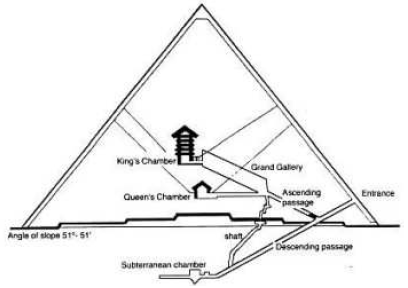
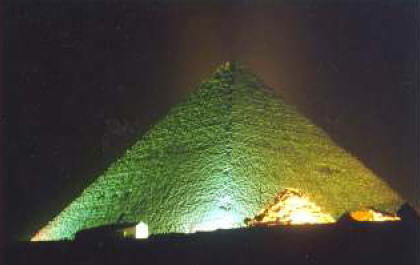
Up until the last millennium the pyramids were covered completely with smooth polished limestone casing blocks. In other words, the pyramids were not an irregular looking series of steps with a missing capstone like they are now.
They were covered with 115,000 10ton casing sheets of polished limestone fitted so perfectly that a razor’s edge couldn’t get between casings, less than 1/50th of an inch.
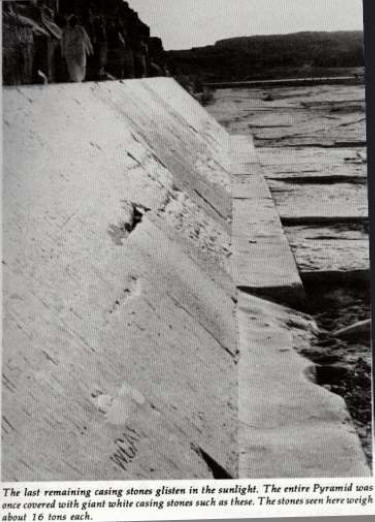
The Egyptians wrote how it reflected the sun like a mirror on all sides. Today there are still a few polished casings leftover at the base of one side.
“Our first example of twentieth century engineering in the Giza pyramids is the six sided limestone casing blocks, which were polished and precision, carved to fit perfectly with each other and the core stones, with joints measuring less than one fiftieth of an inch. As if this was not incredible enough, all of these stones were found to be joined together with an extremely fine but strong cement, which had been applied evenly on semi vertical faces across a surface expanse covering 21 acres on the Great pyramid alone! …The second example is the internal passages of the Great Pyramid. These passages have been measured countless times and found to be perfectly straight, with a deviation, in the case of the Descending Passage, of less than one fiftieth of an inch along its masonry part. Over a length of 150 feet that is incredible. If one includes the further 200 feet of passage bored through the solid rock, the error is less than one quarter of an inch. Now this is engineering of the highest precision, comparable with twentieth century technology, but supposedly achieved 4,500 years ago: Our third example is the machining of granite within the pyramids.
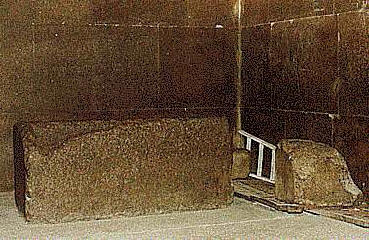
One of the first archaeologists to carry out a thorough survey of the Pyramid was Petrie, who was particularly struck by the granite coffer in the King’s Chamber. The precision with which the coffer had been carved out of a single block of extremely hard granite struck him as quite remarkable. Petrie estimated that diamond tipped drills would need to have been applied with a pressure of two tons, in order to hollow out the granite box.It was not a serious suggestion as to the method actually used. but simply his way of expressing the impossibility of creating that artifact using nineteenth century technology. It is still a difficult challenge, even with twentieth century technology. And yet we are supposed to believe that Khufu achieved this at a time when the Egyptians possessed only the most basic copper hand tools.”Alan F. Alford, “Gods of the New Millennium – The Shattering Truth of Human Origins” (434)
Under the pyramids are large tunnels hundreds of meters deep drilled into limestone bedrock with almost perfect 90-degree angles.
This kind of drilling technology has only existed (in our current paradigm) for under a century, so how were they drilling, chiseling and lifting all these megalithic structures? In a famous meeting with a panel of Egyptologists, author of “Giza Power Plant” Christopher Dunn brought a slab of granite, a hammer, and a copper chisel and asked for a demonstration of how Egyptians were supposed to have chiseled out thousand-ton granite obelisks using simple hand tools.
After a few whacks at it, the copper chisel had a deep indent and not a chip of granite was displaced.
“Chris Dunn found that many artifacts bore the same marks as conventional twentieth century machining methods sawing, lathe and milling practices He was particularly interested, however, in the evidence of a modern processing technique known as trepanning.This process is used to excavate a hollow in a block of hard stone by first drilling, and then breaking out, the remaining “core” Petrie had studied both the hollows and the cores, and been astonished to find spiral grooves on the core which indicated a drill feed rate of 0.100 inch per revolution of the drill. This initially seemed to be impossible.In 1983, Dunn had ascertained that industrial diamond drills could cut granite with a drill rotation speed of 900 revolutions per minute and a feed rate of 0.0002 inch per revolution. What these technicalities actually mean is that the ancient Egyptians were cutting their granite with a feed rate 500 times greater than 1983 technology!”Alan F. Alford, “Gods of the New Millennium – The Shattering Truth of Human Origins” (44)“On the granite core the spiral of the cut sinks 1 inch in the circumference of 6 inches, a rate of ploughing out which is astonishing … These rapid spiral grooves cannot be ascribed to anything but the descent of the drill into the granite under enormous pressure.”W.M. Flinders Petrie, “The Pyramids and Temples at Gizeh”
“Wasn’t it peculiar that at the supposed dawn of human civilization, more than 4500 years ago, the ancient Egyptians had acquired what sounded like industrialage drills packing a ton or more of punch and capable of slicking through hard stones like hot knives through butter?”Graham Hancock, “Fingerprints of the Gods”
“In the first and second pyramids at Giza there are granite portcullises in the lower passages which still baffle experts today. Firstly their complex designs suggest a use much more advanced than deterring robbers (the Egyptologist explanation). It would take about 50 men to lift the portcullis slabs into place, yet the narrow corridors they’re positioned into could have only been occupied by a few men at a time.”W.M. Flinders Petrie, “The Pyramids and Temples at Gizeh,” (36)
 The pyramids also encode high mathematics supposedly unknown to the simple ancient Egyptians. To begin with, the pyramids are located precisely on the 30th-degree latitude and aligned to within 3 arc minutes of true north.
These are beyond coincidence so it can be assumed that they could very accurately measure both latitude and longitude. The ratio of the great pyramid’s height to its base perimeter is exactly Pi (3.14). The “Kings Chamber” and other rooms are perfect “golden rectangles” expressing the mystical number Phi 1.618.
The ratio between successive numbers in the Fibonacci sequence increasingly approach Phi as you go on from 0,1,1,2,3,5,8,13,21,34… the resulting graph is known as the fractal “golden spiral” and looks like a conch shell. Establishment Egyptologists say these mathematical considerations are all coincidence maintaining that ancient Egyptians didn’t possess these concepts.
But the reality is, the ancient Egyptians did possess higher math and they purposely encoded it into their construction.
“Some routine mathematical games were built into the dimensions of the sarcophagus. For example, it had an internal volume of 1166.4 liters and an external volume of exactly twice that, 2332.8 liters. Such a precise coincidence could not have been arrived at accidentally: the walls of the coffer had been cut to machine-age tolerances by craftsmen of enormous skill and experience.”Graham Hancock, “Fingerprints of the Gods”
In the Kings Chamber, the floor diagonal is precise twice the room’s height. W.M. Flinders Petrie says they managed to place the Kings Chamber perfectly,
“where the vertical section of the Pyramid was halved, where the area of the horizontal section was half that of the base, where the diagonal from corner to corner was equal to the length of the base, and where the width of the face was equal to half the diagonal of the base.”
Do you suppose these mathematics were accidental?
Egyptologists say that the Giza pyramids were built for three pharaohs over the course of a hundred years. There are over 2.5 million stones, so if you built 24 hours a day for 100 years that means fitting one (average 3.5 ton) stone into place every 8.5 minutes. Using current technology, multiple cranes and work crews, we still couldn’t make that kind of time, nor could we match the craftsmanship.
Six million tons of stone, underground tunnels, chambers, corridors, 45/90 degree shafts, pi and phi ratios, golden rectangles and other mathematical inclusions, perfect cardinal alignments, right angles, astrological considerations, and flawless masonry. How did ancient man the whole world over build these huge magnificent pyramids? They stacked stones so heavy, many of which cannot be lifted into place with the technology and machinery available today.
Egyptologists say that the Giza pyramids were built for three pharaohs over the course of a hundred years. There are over 2.5 million stones, so if you built 24 hours a day for 100 years that means fitting one (average 3.5 ton) stone into place every 8.5 minutes. Using current technology, multiple cranes and work crews, we still couldn’t make that kind of time, nor could we match the craftsmanship.
Six million tons of stone, underground tunnels, chambers, corridors, 45/90 degree shafts, pi and phi ratios, golden rectangles and other mathematical inclusions, perfect cardinal alignments, right angles, astrological considerations, and flawless masonry. How did ancient man the whole world over build these huge magnificent pyramids? They stacked stones so heavy, many of which cannot be lifted into place with the technology and machinery available today.
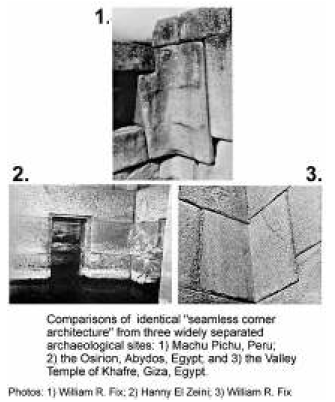
They quarried these stones from miles away and fitted them together so seamlessly that you can’t fit a blade between them.
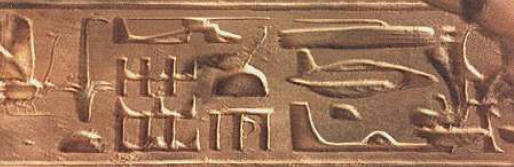
Also in Egypt tens of thousands of diorite bowls have been found with hieroglyphs engraved.
Diorite is one of the hardest stones on the planet, harder than iron, yet intricate inscriptions have been made, not through the use of chisels or scraping but some unknown ancient technology. Whatever it was, was capable of etching lines 1/150th of an inch wide, often in sets of parallel lines separated by a mere 1/30th of an inch. The same kind of workmanship has been found in vases, urns, and other pottery unearthed at the Pyramid of Zoser.





 lâ” which means “received doctrine, tradition, from qibb