

by John Burrows
Secrets Of The Ancient World - Ancient Aliens - UFO Documentary
India, according to Dr.V. Raghavan, retired head of the Sanskrit department of India's prestigious University of Madras, was alone in playing host to extraterrestrials in prehistory. Dr. Raghavan contends that centuries-old documents in Sanskrit (the classical language of India and Hinduism) prove that aliens from outer space visited his nation.
 "Fifty years of researching this ancient works convinces me that there are livings beings on other planets and that they visited earth as far back as4,000 B.C.", the scholar says.
"There is a just a mass of fascinating information about flying machines, even fantastic science fiction weapons, that can be found in translations of the Vedas (scriptures), Indian epics, and other ancient Sanskrit text".
In the Mahabharata (writings), there is a notion of divine lighting and ray weapons, even a kind of hypnotic weapon.
And in the Ramayana (writings), there is a description of Vimanas, or flying machines, that navigated at great heights with the aid of quicksilver and a great propulsive wind.
"These were space vehicles similar to the so-called flying saucers reported throughout the world today. The Ramayana even describes a beautiful chariot which 'arrived shining, a wonderful divine car that sped through the air'. In another passage, there is mention of a chariot being seen 'sailing overhead like a moon' ".
The references in the Mahabharata are no less astounding:
- At Rama`s behest, the magnificent chariot rose up to a mountain of cloud with a tremendous din. Another passage reads: Bhima flew with his Vimana on an enormous ray which was as brilliant as the sun and made a noise like the thunder of a storm.- In the ancient Vymanka-Shastra (science of aeronautics), there is a description of a Vimana: "An apparatus which can go by its own force, from one place to place or globe to globe".- Dr. Raghavan points out, "The text's revelations become even more astounding. Thirty-one parts-of which the machine consists-are described, including a photographing mirror underneath. The text also enumerates 16 kinds of metal that are needed to construct the flying vehicle: `Metals suitable, lighare 16 kinds`. But only three of them are known to us today. The rest remain untranslatable."- Another authority who agrees with Dr. Raghavan`s interpretations is Dr. A.V. Krishna Murty, professor of aeronautics at the Indian Institute of Science in Bangalore. "It is true," Dr. Krishna Murty says, "that the ancient Indian Vedas and other text refer to aeronautics, spaceships, flying machines, ancient astronauts. "A study of the Sanskrit texts has convinced me that ancient India did know the secret of building flying machines-and that those machines were patterned after spaceships coming from other planets."
The Vedic traditions of India tell us that we are now in the Fourth Age of mankind. The Vedas call them the "The Golden Age", "The Silver Age", and "The Bronze Age" and we are now, according to their scriptures in the "The Iron Age". As we approach the end of the 20th century both Native Americans, Mayans, and Incans, prophecies claim that we are coming to the end of an age. Sanskrit texts are filled with references to Gods who fought battles in the sky using Vimanas equipped with weapons as deadly as any we can deploy in these more enlightened times.
For example, there is a passage in the Ramayana which reads:
For example, there is a passage in the Ramayana which reads:
The Puspaka car that resembles the Sun and belongs to my brother was brought by the powerful Ravan; that aerial and excellent car going everywhere at will.... that car resembling a bright cloud in the sky. ".. and the King [Rama] got in, and the excellent car at the command of the Raghira, rose up into the higher atmosphere."
an In the Mahabharata, an ancient Indian poem of enormous length, we learn that an individual named Asura Maya had Vimana assuring twelve cubits in circumference, with four strong wheels. The poem is a veritable goldmine of information relating to conflicts between gods who settled their differences apparently using weapons as lethal as the ones we are capable of deploying.
Apart from 'blazing missiles', the poem records the use of other deadly weapons. 'Indra's Dart' operated via a circular 'reflector'. When switched on, it produced a 'shaft of light' which, when focused on any target, immediately 'consumed it with its power'. In one particular exchange, the hero, Krishna, is pursuing his enemy, Salva, in the sky, when Salva's Vimana, the Saubha is made invisible in some way. Undeterred, Krishna immediately fires off a special weapon: 'I quickly laid on an arrow, which killed by seeking out sound'.
Many other terrible weapons are described, quite matter of fact, in the Mahabharata, but the most fearsome of all is the one used against the Vrishis. The narrative records:
Gurkha flying in his swift and powerful Vimana hurled against the three cities of the Vrishis and Andhakas a single projectile charged with all the power of the Universe. An incandescent column of smoke and fire, as brilliant as ten thousands suns, rose in all its splendor. It was the unknown weapon, the Iron Thunderbolt, a gigantic messenger of death which reduced to ashes the entire race of the Vrishnis and Andhakas.
It is important to note, that these kinds of records are not isolated. They can be cross-correlated with similar reports in other ancient civilizations.
The after-effects of this Iron Thunderbolt have anonymously recognizable ring. Apparently, those killed by it were so burnt that their corpses were unidentifiable. The survivors fared little ether, as it caused their hair and nails to fall out. Perhaps the most disturbing and challenging, information about these allegedly mythical Vimanas in the ancient records is that there are some matter-of-fact records, describing how to build one. In their way, the instructions are quite precise. In the Sanskrit Samaraanganasutraadhaara it is written:
The after-effects of this Iron Thunderbolt have anonymously recognizable ring. Apparently, those killed by it were so burnt that their corpses were unidentifiable. The survivors fared little ether, as it caused their hair and nails to fall out. Perhaps the most disturbing and challenging, information about these allegedly mythical Vimanas in the ancient records is that there are some matter-of-fact records, describing how to build one. In their way, the instructions are quite precise. In the Sanskrit Samaraanganasutraadhaara it is written:
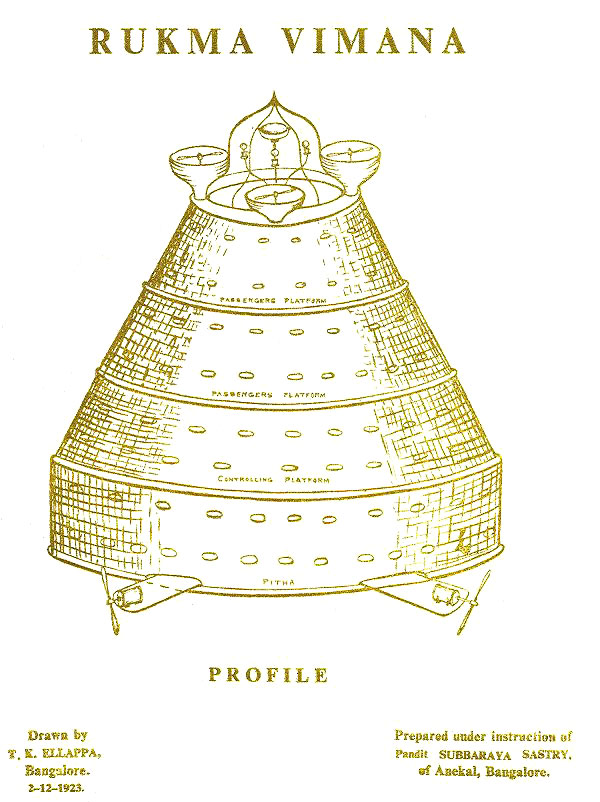
Strong and durable must the body of the Vimana be made, like a great flying bird of light material. Inside one must put the mercury engine with its iron heating apparatus underneath. By means of the power latent in the mercury which sets the driving whirlwind in motion, a man sitting inside may travel a great distance in the sky. The movements of the Vimana are such that it can vertically ascend, vertically descend, move slanting forwards and backwards. With the help of the machines human beings can fly in the air and heavenly beings can come down to earth.

The Hakatha (Laws of the Babylonians) states quite unambiguously: The privilege of operating a flying machine is great. The knowledge of flight is among the most ancient of our inheritances. A gift from 'those from upon high'. We received it from them as a means of saving many lives.
More fantastic still is the information is given in the ancient Chaldean work, The Sifrala, which contains over one hundred pages of technical details on building a flying machine. It contains words which translate as graphite rod, copper coils, crystal indicator, vibrating spheres, stable angles, etc.
More fantastic still is the information is given in the ancient Chaldean work, The Sifrala, which contains over one hundred pages of technical details on building a flying machine. It contains words which translate as graphite rod, copper coils, crystal indicator, vibrating spheres, stable angles, etc.
('Ancient Indian Aircraft Technology' From The Anti-Gravity Handbook by D. Hatcher Childress).
Many researchers into the UFO enigma tend to overlook a very important fact. While it assumed that most flying saucers are of alien, or perhaps Governmental Military origin, another possible origin of UFOs is ancient India and Atlantis. What we know about ancient Indian flying vehicles comes from ancient Indian sources; written texts that have come down to us through the centuries. There is no doubt that most of these texts are authentic; many are the well known ancient Indian Epics themselves, and there are literally hundreds of them. Most of them have not even been translated into English yet from the old Sanskrit.
The Indian Emperor Ashoka started a "Secret Society of the Nine Unknown Men": great Indian scientists who were supposed to catalogue the many sciences. Ashoka kept their work secret because he was afraid that the advanced science cataloged by these men, culled from ancient Indian sources, would be used for the evil purpose of war, which Ashoka was strongly against, having been converted to Buddhism after defeating a rival army in a bloody battle. The "Nine Unknown Men" wrote a total of nine books, presumably one each. Book number was "The Secrets of Gravitation!". This book, known to historians, but not actually seen by them dealt chiefly with "gravity control." It is presumably still around somewhere, kept in a secret library in India, Tibet or elsewhere (perhaps even in North America somewhere). One can certainly understand Ashoka's reasoning for wanting to keep such knowledge a secret, assuming it exists. Ashoka was also aware of devastating wars using such advanced vehicles and other "futuristic weapons" that had destroyed the ancient Indian "Rama Empire" several thousand years before.
Only a few years ago, the Chinese discovered some Sanskrit documents in Lhasa, Tibet and sent them to the University of Chandrigarh to be translated. Dr. Ruth Reyna of the University said recently that the documents contain directions for building interstellar spaceships! Their method of propulsion, she said, was "anti-gravitational" and was based upon a system analogous to that of "laghima," the unknown power of the ego existing in man's physiological makeup, "a centrifugal force strong enough to counteract all gravitational pull."
According to Hindu Yogis, it is this "laghima" which enables a person to levitate. Dr. Reyna said that on board these machines, which were called "Astras" by the text, the ancient Indians could have sent a detachment of men onto any planet, according to the document, which is thought to be thousands of years old. The manuscripts were also said to reveal the secret of "antima", "the cap of invisibility" and "garima", "how to become as heavy as a mountain of lead". Naturally, Indian scientists did not take the texts very seriously, but then became more positive about the value of them when the Chinese announced that they were including certain parts of the data for study in their space program!. This was one of the first instances of a government admitting to being researching anti-gravity. The manuscripts did not say definitely that interplanetary travel was ever made but did mention, of all things, a planned trip to the Moon, though it is not clear whether this trip was actually carried out.

