Illuminati Conspiracy Part Two: Sniffing out Jesuits
- by Terry Melanson, Sept. 12th, 2008
 NB: My apologies to those who've been waiting three years for this "Part Two." As many of you know, since the posting of my "Illuminati Conspiracy Part One: Exegesis on the Available Evidence" in August 2005, I have been hard at work on a book about the Bavarian Illuminati. So, necessarily, I had to put on hold the planned three part series. As the book is finished and scheduled for a November 2008 release, I am free to proceed. (Part two is not what I had originally planned on writing, but nonetheless, it is original and distinct from the book.) - TM
Orientation: The Bavarian Illuminati were the antagonists of the Jesuits, and vice versa
I have chosen to critique parts of | this webpage | as a means to inform the reader on certain facts essential to a proper understanding of the 18th Century Bavarian Order of Illuminati. The other reason is this: a particularly rabid and extremely annoying "Jesuits-rule-the-world" theorist who spams many YahooGroups (always in the customary all-caps shouting mode), had deigned this "Religious Counterfeits" webpage as the proper authority - I am not sure why - on the following theories: 1) that Adam Weishaupt was a Jesuit - not just Jesuit-trained, but a Jesuit priest; and 2) that the Illuminati, therefore, are synonymous with the Jesuits and, in fact, the two are the same (that is, the former was merely the organ of the latter, and the proof of said assertion is the fact that Weishaupt was supposedly a Jesuit himself). To someone who has even a modicum of familiarity with the 18th-Century European Enlightenment, this is indeed a preposterous claim; it's based upon a falsehood - Weishaupt being a Jesuit - and displays ignorance of the history of the period to which we speak.
What follows is a quote/rebuttal format which will hopefully put to rest certain erroneous assertions being claimed by the Jesuits=Illuminati theorists.
Quote: There have always been Occultists who practiced the process of Illumination, but the term "Illuminati" was used first in the 15th Century by enthusiasts in the Occult Arts, signifying those who claimed to possess "light" directly communicated from some higher source, through mysticism.
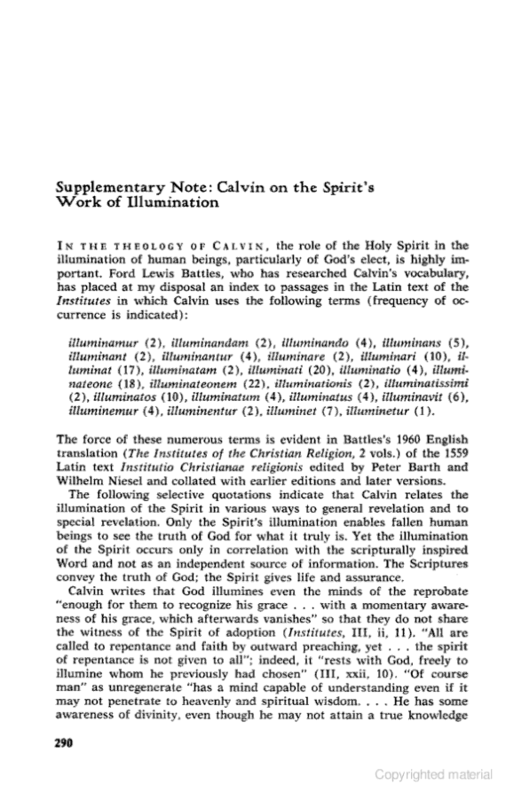
The first occurrence of "Illuminati" was not in the 15th century. "Illuminati" has been used by followers of Mani, or Manes (Manichaeism; the apostles of light) - they called him the supreme illuminator. The Virgin Mary, too, was given the appellation "Maria Illuminatrix" and the "illuminated/illuminator." Jewish Kabbalists were called Illuminati. And lest the reader get the impression it is only used in the occult or by the Roman Catholic Church, be reminded that in Calvin's Institutes, the theologian mentions twenty times the word Illuminati and Illuminatus, four times (see Carl F. H. Henry, God, Revelation and Authority (Vol. IV), Good News Publishers, 1999, p. 290; the statistical calculation of the words was compiled by the first editor of the magazine Christianity Today, Carl. F. H. Henry, and presented at the above-cited page, along with other keywords in Calvin's Latin texts such as "Illuminated" and "Illuminate.")
Quote: We find the name "Illuminati" in Spain about the end of the 15th Century. The Founder of the Jesuit Order, Ignatius Loyola classed himself as a member of the Illuminati. And, from time to time, here and there, small bodies of those called "The Illuminati", sometimes known as Rosicrucians" rose into publicity for a short period.
Yes, the Alumbrados (or Aluminados) literally means Illuminati - dubbed so because of their Gnostic, Kabbalistic (some were Jewish conversos), mystical, almost Quietist tendencies. But Loyola didn't, as is dishonestly claimed, class "himself as a member." In fact, just the opposite - he denied it outright. He was questioned on a couple of occasions by the Inquisition on exactly this point, and each time he vehemently refuted the charges. (I don't believe him, myself. But I would be lying if I claimed Loyola had "classed himself a member.")
These Alumbrados have no relation whatsoever to the Illuminatenorden of the 18th Century. The former were mystically inclined ascetics, while the latter was a child, through and through, of the rationalist philosophes of the Enlightenment and the "Aufklärung" popularphilosophen in German speaking lands.
Quote: Weishaupt was a Jesuit Priest who was involved in "Illumination" or Witchcraft.
Not true, on both counts. As I had written before, in the notes to "Illuminati Conspiracy Part One: Exegesis on the Available Evidence" in 2005, "Weishaupt was indeed taught by the Jesuits, though he himself wasn't one of them. Many prominent thinkers - such as Voltaire, Descartes, and Diderot - were trained by Jesuits, but I've yet to see the same inaccuracy applied to them." Don't take my word for it, though. Feel free to consult real historians on the Bavarian Illuminati: René Le Forestier, Les Illuminés de Bavière et la franc-maçonnerie allemande (1914; PhD dissertation); Leopold Engel, Geschichte des Illuminaten-ordens (1906); Peggy Pawlowski, Der Beitrag Johann Adam Weishaupts zur Pädagogik des Illuminatismus (2004; PhD dissertation). Also, in addition to Peggy Pawlowski, see the work of the three living experts on the Illuminati: Dr. Hermann Schüttler, Reinhard Markner, and Dr. Monika Neugebauer-Wölk.
None of the foregoing historians repeat the falsehood that Weishaupt was a Jesuit; and neither do Barruel (1798) or Robison (1798), even Vernon Stauffer (1916). There's no need to argue the point further. The Illuminati contemporaries, and the later experts on the subject, are unanimous. They get it right that Weishaupt was only educated by the Jesuits, had never been one himself, and was in fact pathologically hostile toward the Jesuits or Jesuitism - anything to do with monasticism, religious absolutism, or "superstitious folly" and obscurantism. Before and after the suppression of the Society of Jesus in 1773, his quarrels with the Jesuit staff at the University of Ingolstadt were legendary. Another interesting fact - as opposed to the made up ones - is that the feeling was mutual. So much so, that the real persecuting hand behind the suppression of the Illuminati in Bavaria descended from the fanatic "ex"-Jesuit and court confessor, Ignaz Franck. The latter also happened to be the head of the Munich Circle of the Golden and Rosy Cross (Gold- und Rosenkreuzer) - thus the rumours of a joint Rosicrucian-Jesuit plot to destroy the Illuminati doesn't seem so far fetched.* The Rosicrucians at that time had adhered to a zealous type of mystical conservatism. Hence the basic dialectic of the Enlightenment was this: Philosophes + Freemasonry + Illuminati (opposing) Jesuits + the Church + Rosicrucians. Anything challenging this basic analysis - easily apprehended even to a newbie of 18th century European history - and you'd better come armed with incredibly persuasive evidence.
* More details can be found in my forthcoming book, Perfectibilists: The 18th Century Bavarian Order of the Illuminati; but if you'd like a head-start, consult René Le Forestier, Les Illuminés de Bavière et la Franc-Maçonnerie Allemande [Paris: 1914], Archè reprint, 2001; and Klaus Epstein, The Genesis of German Conservatism, Princeton University Press, 1966.
As far as Religious Counterfeits' wishful charge of "witchcraft," one only need consult the Original Writings of Adam Weishaupt himself to realize that he had nothing but contempt for such things. The letters between members of the Order were confiscated by force, so the opinions expressed therein were genuine, candid and real. In letters to his subordinates, Weishaupt reveals himself as an extreme rationalist; a worshipper of "reason," as it was defined by the radical anti-obscurantist philosophers of the Enlightenment (viz. Montesquieu, Rousseau, d'Holbach, Helvétius, even Hume, Adam Ferguson and Adam Smith).
Quote: Ingolstadt University in Bavaria had been a Jesuit Institution for many years. Weishaupt was professor of Canon Law there at Ingolstadt. He wanted to see the Jesuit Order come back into power, and eventually, he published a Plan to help the Jesuits take over the world.
Weishaupt was an enemy of the Jesuits, as was the whole of the Illuminati itself. One can even faithfully describe the entire enterprise as a well-oiled propaganda machine intent on influencing public opinion against the Jesuit Order, and everything it stood for. They even had their own printers churning out copies of anti-Jesuit classics;* and their greatest recruits for the Order were those who'd already been known as master Jesuit hunters extraordinaire - Bode, Nicolai and Knigge.
* See Einige Originalschriften des Illuminatenordens, p. 221; cf. Augustin Barruel, Memoirs Illustrating the History of Jacobinism [1798], Real-View-Books Classics Reprint, 2002, p. 586.
Weishaupt didn't publish "a plan to help the Jesuits take over the World," either. Nonsense! Weishaupt had a plan alright, but it was for the Illuminati (after having vanquished the Jesuits completely and utterly) to be the sole arbitrator over the direction of the entire Enlightenment: an anarchistic, Rousseauian-primitivist, Archimedean lever for social reorganization. Weishaupt was a narcissistic megalomaniac, and this was the main reason why his second in command, Baron von Knigge, had finally quit in a huff. Furthermore, Weishaupt's plan wasn't published by him; it was published by the Bavarian authorities after raids into the domiciles of von Zwack (1786) and de Bassus (1787), respectively: Einige Originalschriften des Illuminatenordens (1787), and Nachtrag von weitern Originalschriften, welche die Illuminatensekte (1787).
Quote: This Plan is laid out in a book called "Proofs of a Conspiracy" by John Robison, in 1798, and is discussed in other books as well: "Weishaupt had long been scheming the establishment of an Association or Order, which in time, should govern the world! In his first fervor and high expectations, he hinted to several ex-Jesuits the probability of their recovering, under a new name, the influence which they formerly possessed, and of being again of great service to society, by directing the education of youth of distinction, now emancipated from all civil and religious prejudices." -Proofs of a Conspiracy, John Robison, pg. 59
This reveals the author's dishonesty. The quote is taken out of context. Here's what should have been cited, pp. 58-9 (the short excerpt above italicized, and with my own bold emphasis).
... the emancipation of his young hearers from the terrors of superstition. I suppose also that this was the more agreeable to him, as it procured him the triumph over the Jesuits, with whom he had long struggled for the direction of the university.
This was in 1777. Weishaupt had long been scheming the establishment of an Association or Order, which, in time, should govern the world. In his first fervour and high expectations, he hinted to several Ex-Jesuits the probability of their recovering, under a new name, the influence which they formerly possessed, and of being again of great service to society, by directing the education of youth of distinction, now emancipated from all civil and religious prejudices. He prevailed on some to join him, but they all retracted but two. After this disappointment Weishaupt became the implacable enemy of the Jesuits; and his sanguine temper made him frequently lay himself open to their piercing eye, and drew on him their keenest resentment, and at last made him the victim of their enmity.
Now, with the quote fully contextualized, the meaning is clear. Robison basically reiterated what I have already said herein. Robison's points are thus: 1) there was a struggle with the Jesuits at the University of Ingolstadt; 2) Weishaupt's liberal teaching methods had gained him the upper-hand as far as the indoctrination of young minds; 3) he instituted his Illuminati as a means to maintain supremacy - though, unbelievably, as has already been pointed out by many, Robison gets the date wrong of when the Illuminati had actually been instituted (1777, as opposed to 1776); 4) he had solicited some "ex"-Jesuits, enticing them with a promise of gaining a semblance of the power which they had previously held; 5) in the end most didn't fall for it - except for two; and 6) this caused more acute anti-Jesuitism ("became the implacable enemy of the Jesuits") on the part of Weishaupt, and ditto for the Jesuits.
It is not clear who the Jesuits were that Weishaupt had tried to recruit, but one thing is for sure: his greatest mistake was allowing the likes of Johann Sulpitius Marquis de Cosandey (Xenophon=alias), Joseph von Utzschneider (Hellanicus Lesbius/Seneca), Georg Grünberger (Archytas), Vitus Renner (Anaximander) and Georg Maximilian Johann von Dillis (Timagoras) to join - all of whom had extensive connections with the Jesuits and/or were priests (such as the first and the last), and were, in the end, as defectors and denunciators, the cause of the persecutions of the Order in Bavaria.
Another quote from Robison (a letter from Zwack to Weishaupt) which "Religious Counterfeits" neglected to show its readers, is: "By the activity of our Brethren [the Illuminati], the Jesuits have been kept out of all the professorial chairs at Ingolstadt, and our friends [the Illuminati and Masons] prevail … We have been very successful against the Jesuits, and brought things to such a bearing, that their revenues, such as the Mission, the Golden Alms, the Exercises, and the Conversion Box, are now under the management of our friends" (Robison, op. cit., p. 114; emphasis mine). And this: "Philo [Baron von Knigge] had gained his good opinion by the violent attack which he had published on the Jesuits and Rosycrucians [sic] by the orders of Spartacus [Weishaupt]" (Ibid., p. 161; emphasis mine).
It doesn't get any more straightforward than this. The mutual antagonism was palpable, and had achieved legendary status by the time Robison wrote those words more than ten years later.
***
What we have just learned is that the real facts about the Illuminati were the exact opposite of what the Jesuits=Illuminati purveyors would have you believe. By selective quoting and convenient omission, the Religious Counterfeits' have deprived their readers of the fact that Robison had an opinion (based upon primary documents and contemporary knowledge) which was in complete contradiction to that of their own. This is a favorite tactic of the really bad conspiracy theorists; whole volumes - an entire house of cards - are built upon this ruse.
Eric Jon Phelps utilizes the same technique. In his Vatican Assassins (p. 225), for instance, he ostensibly quotes from Nesta Webster. However, the excerpt omits some crucial remarks, which, if they had been left in, would have challenged his theories, even to the point of having the opposite desired effect.
What follows is a side-by-side comparison of the relevant material. On the left as it appears in Webster's Secret Societies & Subversive Movements, and on the right as Phelps has quoted it.
Secret Societies & Subversive Movements [1924], A&B Publishers Group, 1998, pp. 196-7:
Vatican Assassins, Second Edition, 2004, p. 225:
That Weishaupt was not the originator of the system he named Illuminism will be already apparent to every reader of the present work… How did these Oriental methods penetrate to the Bavarian professor? According to certain writers, through the Jesuits. The fact that Weishaupt had been brought up by this Order has provided the enemies of the Jesuits with the argument that they were the secret inspirers of the Illuminati. Mr. Gould, indeed, has attributed most of the errors of the latter to this source; Weishaupt, he writes, incurred "the implacable enmity of the Jesuits, to whose intrigues he was incessantly exposed." In reality precisely the opposite was the case, for, as we shall see, it was Weishaupt who perpetually intrigued against the Jesuits. That Weishaupt did, however, draw to a certain extent on Jesuit methods of training is recognized even by Barruel, himself a Jesuit, who, quoting Mirabeau, says that Weishaupt "admired above all those laws, that régime of the Jesuits, which, under one head, made men dispersed over the universe tend towards the same goal; he felt that one could imitate their methods whilst holding views diametrically opposed." [Emphasis mine]
"That Weishaupt was not the originator of the system he named 'Illuminism' will be already apparent to every reader of the present work . . . How did these Oriental methods penetrate to the Bavarian professor? According to certain writers, through the Jesuits. The fact that Weishaupt had been brought up by this Order has provided the enemies of the Jesuits with the argument that they were the secret inspirers of the Illuminati . . . That Weishaupt did, however, draw to a certain extent on Jesuit methods of training is recognized even by Barruel, himself a Jesuit [and the most influential historian of the French Revolution], who, quoting Mirabeau, says that Weishaupt, 'admired above all those laws, that regime of the Jesuits, which, under one head [the Jesuit General], made men dispersed over the universe tend towards the same goal . . . ' " [Emphasis added (by Phelps)]
What a candid writer would do in a situation like this would be to quote the entirety of the excerpt. If the author's theory is really all it's cracked up to be, they should easily be able to reason away the appearance of these contradictory views. Instead, Phelps twists the quote to suit his own agenda: Webster was saying the exact opposite to what Phelps had attempted to insinuate.
Further, Webster was no fool. She intelligently and correctly assessed the situation:
The fact is that the accusation of Jesuit intrigue behind secret societies has emanated principally from the secret societies themselves and would appear to have been a device adopted by them to cover their own tracks. No good evidence has ever been brought forward in support of their contention. ... The Marquis de Luchet, who was no friend of the Jesuits, shows the absurdity of confounding their aims with those of either the Freemasons or the Illuminati, and describes all three as animated by wholly different purposes.
In all these questions it is necessary to seek a motive. I have no personal interest in defending the Jesuits, but I ask: what motive could the Jesuits have in forming or supporting a conspiracy directed against all thrones and altars? It has been answered me that the Jesuits at this period cared nothing for thrones and altars, but only for temporal power; yet--even accepting this unwarrantable hypothesis--how was this power to be exercised except through thrones and altars? Was it not through princes and the Church that the Jesuits had been able to bring their influence to bear on affairs of state? In an irreligious Republic, as events afterwards proved, the power of the whole clergy was bound to be destroyed. The truth is then, that, far from abetting the Illuminati, the Jesuits were their most formidable opponents, the only body of men sufficiently learned, astute, and well organized to outwit the schemes of Weishaupt. In suppressing the Jesuits it is possible that the Old Régime removed the only barrier capable of resisting the tide of revolution.
Weishaupt indeed, as we know, detested the Jesuits, and took from them only certain methods of discipline, of ensuring obedience or of acquiring influence over the minds of his disciples; his aims were entirely different. (Webster, op. cit., pp. 198-9; emphasis mine)
This is what you call a measured and rational summation. It conforms to the historical facts in every conceivable way. Unlike the "Religious Counterfeits" and Phelps, Webster had read the Original Writings of the Illuminati. And, as I've said before, these writings - confiscated against their will - make it clear that Illuminati intrigue was constantly being directed against the, incalculably-hated, Sons of Loyola. Ironically, in this respect, Phelps et al. are brothers in arms with Weishaupt, the Illuminati, radical Freemasonry, and especially the later 19th century occult movement of Theosophy. (Madame Blavatsky's modus operandi was in keeping with the tradition of her antecedents. Her fear and hatred of the Jesuits bordered on the pathological: see, for instance, "Theosophy of Jesuitism," "Jesuitry and Masonry (1 of 6)," "Jesuitry and Masonry (2 of 6)," "Jesuitry and Masonry (3 of 6)," "Jesuitry and Masonry (4 of 6)," "Jesuitry and Masonry (5 of 6)," "Jesuitry and Masonry (6 of 6)," and "Was Cagliostro a 'Charlatan'?")
***
The Stratagems of Weishaupt, Knigge, Nicolai, and Bode
Anti-Jesuits alleged that Jesuits were engaged in a vast conspiracy aimed to destroy the new revolutionary order. Jesuits were for the first time accused of having infiltrated Freemasonry, apparently with the purpose of restoring Catholicism to its former glories. Similarities in ritual forms, the hierarchy of membership, and the notion of blind obedience to superiors, as well as claims that the Masons derived from the Catholic Knights Templar and were linked to the Stuart pretender, made such claims plausible. Anti-Jesuits, as before, included both Protestants hostile to Catholicism, led by the publicists, Friedrich Nicolai and Johann Joachim Christoph Bode, and Enlightened Catholics, especially associated with the Illuminati, a secret society that promoted secularism.
- Roisin Healy, The Jesuit Specter in Imperial Germany (BRILL, 2003), p. 32.
Opposition to the Jesuits was a central issue for many of the Masonic subgroupings; the Rosicrucians had arisen "almost as a mirror image of the Jesuit Order"; and Adam Weishaupt had conceived the Order of Illuminati as an anti-Jesuit organization modeled upon Jesuitical methods and organizational forms. The Jesuits responded in kind: it was widely believed that the suppression of the Illuminati in Bavaria was instigated by them.
- Maynard Solomon, Mozart: A Life (HarperPerennial, 1996), p. 328.
On 13 March, 1778, Adam Weishaupt (Spartacus) wrote a letter to Maximilian Balthasar Ludwig Edler von Merz (Tiberius), one of the five original members of the Illuminati and an Areopagite. One section reads: "We have … in Munich our own printer. It is from there that you'll soon receive, printed at our expense, the Relatio de strategmatis et sophismatis Polchis S. I. by Alphonsus de Vargas" (Einige Originalschriften des Illuminatenordens, p. 221). That is, Relatio ad Reges et Principes Christianos De Stratagematis et Sophismatis politicis Societatis Jesu ad Monarchiam orbis terrarum sibi confirmandam [A Report to the Christian Kings and Princes on the Stratagems and Political Sophisms of the Jesuits For World Domination]; or, as Juan Antonio Llorente has translated its title, An Exposition made by Alphonsa de Vargas to the Christian Kings and Princes, of the Stratagems and political Artifices which the Members of the Society of Jesus employ to establish a universal Monarchy in their favour, a Work which proves the deceit of the Jesuits towards the Kings and Nations who have received them favourably; their Perfidy and Disobedience, even to the Pope, and the immoderate Desire of Innovation which they have always shewn in Matters of Religion (see The History of the Inquisition of Spain, from the Time of Its Establishment to the Reign of Ferdinand VII, London: G. B. Whittaker, 1826, p. 280).
First printed at Rome in 1636, Alphonsus de Vargas was one of the pseudonyms of Caspar Schoppe [or Gaspar Scioppius] (1576-1649); and his above mentioned work was recommended reading for all Illuminati initiates. By 1778, Schoppe's Stratagems and Political Sophisms of the Jesuits was a classic and a much sought-after work of anti-Jesuitism. Weishaupt, by printing a new edition at the expense of the Illuminati, had put into motion one of the Illuminati's own Strategmatis: the Jesuits must be discredited, exposed, hunted and driven out. Weishaupt's personal war with the Society of Jesus had already begun at Ingolstadt University. Now, with the Illuminati in full operation, the growing assets of the Order could be put to use.
![The Kassel Strict Observance Lodge 'Zum gekrönten Löwen' [of the Crowned Lion]](http://www.conspiracyarchive.com/images/Illuminati2/CrownedLion.jpg "Crowned Lion")
The Kassel Strict Observance Lodge 'Zum gekrönten Löwen' [of the Crowned Lion] medallion 1743
In July, 1780, the Illuminati had managed to insinuate its most zealous initiate thus far: Adolph Franz Friedrich Ludwig Baron von Knigge (1752 Bredenbeck, Germany - 1796 Bremen, Germany). Knigge (Philo Judaeus), having been extremely fascinated with secret societies and occultism, applied for membership in Freemasonry at the earliest possible age. The Kassel Strict Observance Lodge 'Zum gekrönten Löwen' [of the Crowned Lion] accepted him into the fold in 1772, and in 1779 he became a knight of the rite of Strict Observance (alias, 'Eques a Cygno' [Knight of the Swan]).
During his formative Masonic years before joining the Illuminati, Knigge had become acquainted with Mason and alchemist, Marburg professor Friedrich Joseph Wilhelm Schröder (1733-78). Schröder imbued him with enthusiasm for the occult sciences. On Schröder, Knigge had said: "What man would not have been fired with zeal for theosophy, magic, and alchymy, in the company of Scroeder [sic]? These were the mysteries of the Strict Observance, in which I was a firm believer, and practised all the evocations of spirits, and other occult ceremonies of the Order!" (In George Oliver, The Historical Landmarks and Other Evidences of Freemasonry: Explained in a Series of Practical Lectures, with Copious Notes, Vol. II (New York: Masonic Publishing and Manufacturing, 1867), p. 53 n. 79; cf. Le Forestier, op. cit., p. 210 and Augustin Barruel, op.cit., p. 621.)
Through his correspondences with Johann Georg Wendelstadt - a future high-ranking member of the Illuminati himself,* and also a member of the Strict Observance - it is clear that in 1778/79 Knigge was obsessed with research into alchemy and was dedicated to chasing down old manuscripts in hopes of finding the key to transmuting dross into gold - an apprentice of the Great Work. Having no luck on his own, in August 1778 he decided upon applying for membership into the Golden and Rosy Cross. Schröder was well-connected with the Rosicrucian Order (probably a member) and served as a liaison. Knigge was given a list of preliminary questions for potential candidates. Schröder had assured his friend that, soon, at the proper place and time, Knigge would meet with a member and take the required entry exam. The Golden and Rosy Cross, however, rejected his application and, according to Le Forestier, "he would have to be content with remaining a member of the Strict Observance" (p. 211).
* In Hermann Schüttler, Die Mitglieder des Illuminatenordens 1776-1787/93 (Munich: Ars Una 1991), p. 164.

Baron von Knigge
Knigge resented the deception of the Rosicrucians, renounced his foolish reveries in alchemy, and was thenceforth determined to radically reform Freemasonry. He condemned the occult sciences to his brother Masons, loudly protested against would-be gold-makers, and attempted to have any mention of alchemy banned within the Strict Observance. Seeking another route - as far away from the occult arts as he could - it was at this time that he developed a primitivist Utopian (socialist) worldview, which, unbeknownst to him at the time, was similar to the ideology of Adam Weishaupt. As historian G. P. Gooch had put it: "The dream of founding a new Order had taken root in his mind; but when he was told that such an Order was already in existence, he asked to be initiated, and brought a number of disillusioned Masons with him" (Studies in German History, London, 1948, p. 66).
Knigge's insinuator was Constantin Marchese di Costanzo (Diomedes), a member of the Illuminati's Areopagites. Weishaupt was well-pleased with the recruitment of Knigge, who had plenty of connections not only in Freemasonry but within the Hanau court as well. Soon, Weishaupt was personally corresponding with his rising star, even getting a lesson or two on the intrigues and rituals of modern Freemasonry (Knigge subsequently restructured the higher grades of the Illuminati to better incorporate certain features of Masonic nomenclature).
In wasn't long after that Weishaupt encouraged Knigge - and supplied him with the materials - to publish a series of articles on the intrigues of the Jesuits. In March 1781, three articles by Knigge were printed in the journal of the respected Göttingen professor August Ludwig Schlözer (1735-1809). Volumes 8 and 9 of A.L. Schlözer's Briefwechsel meist historischen und politischen Inhalts included the articles from Knigge; the most important of which, from the standpoint of Weishaupt, was Tentatives des ex-Jésuites pour rétablir en Bavière la barbarie et l'Ordre des Jésuites [The ex-Jesuits' attempts to return barbarity and the Order of the Jesuits to Bavaria]. It admonished the Elector of Bavaria, Karl Theodor to open his eyes toward the machinations of the Jesuits, especially the intrigue at Ingolstadt University. Three extensive documents were included as proof. There was a report signed by four Ingolstadt professors in the faculty of theology, protesting against the pretensions of ex-Jesuit Benedict Stattler (1728-97), who, by then, was already an outspoken enemy of the Illuminati. The professors decried the fact that Stattler, who should have been thrown out after the suppression of the Jesuits in 1773, was soon after appointed repetitor and in 1780, actually promoted to professor of dogmatics; that the ex-Jesuits now had a total of seven professors on the Ingolstadt faculty when before the suppression of the Order, they had had only three! The next attached-document contained another sharp attack against the Jesuitism of Stattler, specifically mentioning the efforts of Weishaupt and professor Stehler to combat and maneuver against it. And the last document claimed that the "Jesuits sought to reestablish their Novitiate under another name and have propagandized in the monasteries" (Le Forestier, p. 222-3).
At the behest of Weishaupt and the Illuminati, Knigge wrote two more pamphlets which were published in 1781: Avertissement aux princes allemands, pour les mettre en garde contre l'esprit et le poignard des Jésuites [A Warning to the German Princes to guard against the spirit and dagger of the Jesuits] and Ueber Jesuiten, Freymaurer und deutsche Rosencreutzer [The Jesuits, Freemasons and the German Rosicrucians]. In order to give the writings more weight, in the latter publication Knigge had used a pseudonym: Joseph Aloys Maier, a supposed ex-member of the Jesuits. Ueber Jesuiten, Freymaurer was composed of three chapters. The first contained "remarks on the perverse and dangerous principles of the former Society of Jesus," including a sketch of its history and an outline of its members. The second chapter contained a letter on the profane teachings of the Freemasons, and attributed to a former member. The last contained research on the veracity and supposed authenticity of the German Golden and Rosy Cross. The chapter on the Jesuits was culled from documents provided to Knigge by the Illuminati; eleven pamphlets in all, one of which was Louis-René de Caradeuc de La Chalotais' 1762 report to the Parlement de Rennes which was the catalyst for the 1764 expulsion of the Jesuits in France.
Knigge was being used by the hierarchy of the Illuminati. He had significant skills as a writer already, and was thus the perfect choice to pen and publish the anti-Jesuitical screeds: for if he wanted to gain the trust of his new "brotherhood," he'd better do as he was told.
Not only had Knigge written against the enemies of the Illuminati, but he blossomed into the greatest recruiter for the Order (some 500 members, by his own account), while personally reorganizing the system of degrees. For all his efforts - a veritable superstar compared to everyone else - Weishaupt's only reward was to constantly talk about him behind his back. Weishaupt was obviously threatened by Knigge's popularity within the Order, and by 1783 their mutual disdain had finally come to a head.
Two months before Knigge resigned in disgust, he wrote a letter to Illuminatus Franz Xaver von Zwack (Cato) on February 25, 1783. His frustration is palpable; his threats serious:
At the behest of Spartacus, I wrote against the ex-Jesuits and the Rosicrucians; I hounded men who had done me no harm; I caused disarray in the Strict Observance and drew the best of them to us; I gave them a great idea of the dignity of the Order, its power, its age, the excellence of its leaders, of the perfect fit for [Strict Observance's] senior members, the importance of the knowledge they possessed and its righteous intentions; these people, who now show so much activity in our favour, but remain very committed to religiosity, feared that we intended to spread deism: I have therefore tried to convince them that the Grand Chiefs [of the Illuminati] had no such intention. However, little by little, I do what I please. Let us suppose, then:
- That I let the Jesuits and the Rosicrucians know who is persecuting them;
- That I reveal, if only to a few people, the small, insignificant origin of the Order;
- That I prove to them, by my designs, that I have established part of the degrees myself;
- That I tell them how, after what I have done for the cause, I must endure mistreatment;
- That I make known to them the Jesuitical character of the man who perhaps leads us all by the nose, makes use of us for his ambitious schemes, while we sacrifice all the time as often as his obstinacy requires; perhaps what is to fear from such a man, and such a machine that may or may not be hiding Jesuits;
- That I give assurance to those searching for secrets to expect nothing;
- That I reveal the secret principles of the General [Weishaupt] to whom religion is overrated;
- That I discovered how much this work is new and the weak bases upon which it relies;
- That I draw the attention of the Lodges to a hidden Association behind which lies the Illuminati;
- That I align myself anew with Princes and Freemasons;
- Furthermore, that I find a more solid plan, less selfish, more enlightened, based entirely upon honesty and liberty; that I initiate the best minds with whom I am still acquainted; that in every area I'll secretly initiate recruits [already] insinuated by the Illuminati, so that thereafter I would be well-informed;
- That even in Greece [Bavaria] I would give information to certain people, in addition to disclosing the founder and all the rest;
- That I sound the alarm in Rome [Vienna] through the intermediaries of Princes, to Numenius and the Rosicrucians!
Nachtrag von weitern Originalschriften, welche die Illuminatensekte, I, pp. 112-14
Threat #5 is probably tantalizing to the Jesuits=Illuminati crowd. So be it; at least I didn't suppress it. I offer but one observation: paranoia is the one common denominator of any secret society worth its salt! Admittedly, in terms of despotism and totalitarian proclivities, Weishaupt had out-Jesuited the Jesuits.
Number thirteen is the most significant. The Rosicrucians - who had already openly declared war on the Illuminati - were perhaps even more detested than the Jesuits. Vienna was one of their strongholds. Numenius (Count Franz Joseph von Kolowrat-Liebensteinsky) was a recent recruit in the Illuminati; was well-connected with the Imperial court; and had been entangled with the entire milieu of Viennese Rosicrucianism. And Weishaupt, with trademark subterfuge, made it his pet project to try and cure the noble of his mystical inclinations. To threaten to reveal the secrets of the Illuminati to the Rosicrucians was more serious than spilling the beans to Jesuits.
***

Christoph Friedrich Nicolai (Lucianus): Novice, March 1782; Illuminatus Minor, April 1782; Regent and Prefect of Berlin, 1784
Another Illuminatus, Christoph Friedrich Nicolai (1733-1811), picked up where Knigge left off; the latter had even insinuated the former into the Illuminati in March 1782. As an introduction, here's a brief sketch from Klaus Epstein (op cit., p. 40; emphasis mine):
[Nicolai] was ... a prolific and gifted writer, and above all the possessor of an uncanny instinct concerning what the German reading public wanted at any specific time. His didactic novels lampooned with equal vigor intolerant orthodoxy, mystical pietism, romantic enthusiasm, and manipulative Rosicrucianism; his main phobia, open and veiled, was the Jesuits, whom he feared in a manner suggesting a pathological obsession.
Nicolai had of course been the longtime editor of the ADB (Allgemeine Deutsche Bibliothek), extant from 1765-1806. A mammoth undertaking, this publication functioned as the heart of the German/Prussian Enlightenment itself. For forty years the ADB reviewed and critiqued nearly the entire prose output of the time. Nicolai seemed to be even-handed in most areas, except for two: critical philosophy and matters relating to Catholicism. On these two points Nicolai decreed the ADB take an unmitigated ideological stance. In correspondence with Albrecht Georg Walch about the latter's intention on reviewing for the ADB some new books originating in Catholic Würzburg, for instance, Nicolai had admonished: "we must view matters from a Protestant rather than a Catholic perspective." He reminded Walsh of the "incredible stupidity that still prevails among Catholics"; and while remarking on a new book by Catholic historian Michael Ignatz Schmidt (1736-1794), in which he judged the Reformation "in a most irresponsible manner," Nicolai remarked, "[t]his is unforgivable ... and we Protestants must contradict such things, so that prejudices are not once again introduced in place of the truth" (in Pamela Eve Selwyn, Everyday Life in the German Book Trade: Friedrich Nicolai as Bookseller and Publisher in the Age of Enlightenment, Penn State Press, 2000, p. 267).
In the exact time frame of Nicolai's insinuation into the Illuminati (early 1782), he had also "started the campaign of the Berlin Enlighteners against what they perceived as the Catholic threat against the Enlightenment,"* by publishing his pseudo-historical book on the Knights Templar: Versuch über die Beschuldigungen, welche dem Tempelherrenorden gemacht worden, und über dessen Geheimnis; nebst einem Anhang über das Enstehen der Freimäurergesellschaft [roughly: Essay on the Accusations against the Templars, and the Secret of the Order; with a Dissertation on the Origins of Freemasonry]. It included the oft-claimed Templar origins of Freemasonry as well as endorsing the then-prevailing anti-Catholic, Masonic theory that Jesuits had tampered with the high degrees of Freemasonry (ala the Young Pretender, the Jacobites, Chevalier Ramsay, the "Scottish" degrees or Ecossais Lodges, and the "Unknown Superiors" of the Templar-obsessed Rite of Strict Observance).
* Karl Friedrich Bahrdt, The Edict of Religion: A Comedy; And, The Story and Diary of My Imprisonment, eds. John Christian Laursen, Johan Van Der Zande, Lexington Books, 2000, p. 67n.5
In turn, Nicolai's collaborators at the popular Berlinische Monatsschrift [Berlin Monthly Journal] started publishing material against "crypto-Catholics" around 1784. "The argument," writes Masonic historian Alain Bernheim, 33°, "began with the alleged secret influence of the Jesuits' Order upon protestant circles and developed in attributing them the salvation of the Strict Observance by the Clerics. The Monatsschrift was foremost in the story together with Nicolai and Bode." Also, in January 1785, the Monatsschrift published an attack against the crypto-Jesuitism of a high-degree member of the Strict Observance, Lutheran pastor Johann August Starck. It was a veiled attack - for those in the know - referring to him as "a theologian well-known for his writings, about whom it is said almost openly that he is not only affiliated to the Jesuits but actually belongs to the Jesuits of the fourth class who must take special vows in order to be sent on special missions" (Bernheim, op. cit.)
The Berlinische Monatsschrift was the official organ of the secret society known as the Berlin Wednesday Society ('Mittwochsgesellschaft'; 1783-98) internally referred to as the Society of Friends of Enlightenment ('Gesellschaft der Freunde der Aufklärung'). Nicolai was one of the twelve founding members of the society, which soon included a few other Illuminati (von Leuchsenring and von Goeckingk), along with the most famous names of the Berlin Enlightenment. Their goal was to fight obscurantism - viz. theocracy, Jesuitism, Rosicrucianism, orthodoxy, etc. - and effect public policy in favour of the rationalist ideals of the Popularphilosophen. (See my forthcoming book.)
The Berlinische Monatsschrift's most successful campaign against the so-called crypto-Jesuits began in its March 1788 issue with the publication of some diaries by Charlotte von der Recke. Supposedly, she was a former co-Mason in the Egyptian rite of Count Cagliostro. Recke accused Cagliostro of being a "dangerous Jesuit" who had cast his mystic spell on the credulous. Later, the diaries were published in Russian "with a preface by the German editor, Nicolai, who reasserted and supported the author's thesis" (Raffaella Faggionato, A Rosicrucian Utopia in Eighteenth-Century Russia: The Masonic Circle of N.I. Novikov, Springer, 2005, p. 191). Nicolai soon published another book from Recke, this time for his insatiable readership in Germany. The Berlin Enlightenment's favorite whipping-boy, Starck, was her newfound enemy.* The book was excerpted in installments (1788-9) in the Berlinische Monatsschrift. According to Raffaella Faggionato, Recke accused the mystic Mason of "allegedly planning a Catholic Jesuit restoration hidden beneath the mystical and magical show of the clerico-Templar doctrine that he was propagating." (Ibid.)
* Starck would have his revenge, however. He subsequently published one of the most convincing tomes of anti-Illuminati literature then extant; his Der Triumph der Philosophie im 18. Jahrhundert [The Triumph of Philosophy in the 18th Century] (2 vols., Germantown, 1803).
***

Johann Joachim Christoph Bode (Aemilius/Winefried): Initiated into Freemasonry at the Hamburg Lodge ‘Absalom’ in 1764; member of the Strict Observance (alias “a Lilio convallium”); 1782-86, 'Absalom' Master of the Chair; Illuminatus minor, 1782; Illuminatus major, 1783; Upper Saxony Provincial, 1784; 1785-93, the defacto head of the Illuminati
The most important member of the Illuminati that Knigge had personally recruited - at the famous Congress of Wilhelmsbad, in the summer of 1782 - was Johann Joachim Christoph Bode (1730-1793). With a take-no-prisoners attitude, J. J. C. Bode was one of the most respected Freemasons in all of Germany and even more of a zealous rationalist than Weishaupt himself.
Bode was already completely obsessed with discovering hidden Jesuits in Masonry, and would soon warn his Superiors about the danger lurking within. "Brother Bode," writes René Le Forestier,
Eques a Lilie Convallium, Director of the 7th Province of the Strict Observance, arrived at the conviction that the Jesuits had invented Templar Freemasonry, first to support the cause of Catholic Stuarts, then, after the suppression of the Order, to maintain secrecy and combat Protestantism. He thought that Johnson, Hund, Starck, the Clerics, Gugomos, Waechter - who claim to have brought secret knowledge back to Rome - and the whole of the Swedenborgian Illuminés were either emissaries or instruments of the disciples of Loyola, and he was preparing to warn the Superiors of the Strict Observance of this intrigue.
- Le Forestier, op. cit., p. 186
And warn he did; in a long manuscript addressed to the Superiors of the Strict Observance on September 19, 1780. Le Forestier, who read the circular in full, gives three examples (p. 361n.2) of the type of arguments Bode had utilized: 1) That Hiram Abiff's murderers - two rebels - "symbolize the Roman Catholic hierarchy destroyed by Luther and Calvin"; 2) "The Sprig of Acacia, so dear to Freemasons, looks exactly like the sign of the Bishop" (huh?); and that 3) Baron von Hund (the founder of the Strict Observance) had told the tale of being received into an already extant Masonic Templarism by an Eques a Penna Rubra [Knight of the Red Feather] in the 1740s, but was sworn to conceal his true name. The third was further elaborated upon. Bode said he had come across an historical episode which backed up his "hidden Jesuits behind Templar Masonry" theory. While reading History of the Jesuits (1760), by his friend Hardenberg, he came across a story about some Jesuit prisoners captured after a battle in 1759. Apparently, one of them wore a helmet adorned with a red feather, and "a red Hussar costume with loose sleeves with a chain around his neck. Bode concludes without hesitation that the Jesuit prisoner, father Lenanez, was in fact the Eques a Penna Rubra mentioned by Hund; that what he was wearing during combat was the collar of the Strict Observance as well as the coat of a Prefect [a grade within the rite]; and that the author had mistakenly confused the outfit with the vestments of a Hussar" (ibid.)
The first two points seem like gibberish, and hardly even imaginative. The third, however, must surely have piqued the curiosity of his fellow Jesuit paranoiacs. It strikes to the heart of the mystery.
The gist of the tale is this: In the 1750s Baron von Hund started advertising a new rite amongst his Masonic brethren. He claimed it descended directly from the Knights Templar. When pressed for further details, he finally revealed that while in Paris in the early 1740s, he was initiated into some higher degrees - a secret order of Templars - and dubbed a Chevalier Templier. The master initiator was an "Unknown Superior," who had only been identified to him as 'Knight of the Red Feather.' He further elaborated that, shortly after the ceremony, he was brought before none other than Charles Edward Stuart (Bonnie Prince Charlie; the Young Pretender) himself, whom he assumed was also an "Unknown Superior" of the Order. All the elements are present from the start for an imaginative anti-Catholic theorist to run amuck: (Catholic) Jacobites, (Catholic) Stuart pretenders, (Catholic) Knights Templar, (Catholic) Unknown Superiors - oh my! The one thing that nagged at everyone, however, was the identity of the master string-puller himself, this Knight of the Red Feather. Everyone had a crack at it - it was a favorite pastime - and Bode was but one in a long line of hypothesizers. While Bode was unsurprisingly looking for a Jesuit, Michael Baigent and Richard Leigh, still chasing the mystery some 200 years later, believe they have cracked the case. In Temple and the Lodge (Arcade Publishing, 1991), pp. 196-8, stemming from access "to the papers of a group called 'Stella Templum'," the Knight of the Red Feather, they claim, was identified in the heretofore unknown archives as one Alexander Montgomery.
Bode was relentless in his efforts to warn his Masonic brothers of Jesuits concealed in Masonry. When Knigge approached him at the Wilhelmsbad Congress as a potential recruit, Bode stipulated a condition that Knigge prove the Order of the Illuminati were the implacable enemies of the Jesuits; he also requested permission to print and distribute some of his materials on Jesuitry in Masonry to the brethren of the Order (Nachtrag von weitern Originalschriften, welche die Illuminatensekte, I, pp. 218-20). But Bode had already been making his own discreet inquiries into the Illuminati and was impressed with what he'd heard; he didn't need much convincing: the grade of Illuminatus Dirigens* was read in full, along with passages from Knigge's above-mentioned 1781 pamphlet, Ueber Jesuiten, Freymaurer und deutsche Rosencreutzer (see Le Forestier, op. cit., p. 370 and n.4).
* This includes the long Rousseauian (socialist) speech by Weishaupt on original primitivist perfection; the evils of private property and government, nationalism and patriotism; and the despotism of throne and altar.
Another example of Bode's zealous efforts to rid Masonry of Jesuitism (superstition and mysticism) was when he had sent one of his signature manifestos to the heads of the 1787 Masonic convention in Paris, convoked by the notorious 'Philalèthes.' That act, along with his trip to Paris in the summer, would ultimately win for the Illuminati some prized members of the powerful Paris Lodge ‘Les Amis Réunis,’ and a secret Illuminati cell in France - the details of which can be read in my forthcoming book.
Conculsion
The roll-call of "Jesuit hunters" within the Illuminati would be long indeed, if I were to list and recount the actions of them all. A good number of Viennese Illuminati, for instance, were well-known polemicists against the Sons of Loyola; and they were some of the most talented satirists and poets of the Enlightenment. But this article was not meant to be exhaustive. I merely felt that, given the rampant twisting of history by some conspiracy theorists, this story desperately needed to be told.
If you're searching for secret Jesuitical influence during the 18th Century, it's not that difficult to find. My feeling is that some of the concerns about Templar-masonry do seem warranted. The sudden appearance of Templar and Scottish-Jacobite-Stuart allegiance among Masonic aristocrats during the 1740s and 50s has the smell of a phenomenon from without; and the Jesuits and the Vatican - it is pretty obvious - would have had the most to gain from the introduction of such beliefs. That the Jesuits had infiltrated the Golden and Rosy Cross, there is no doubt. The Jesuit court confessor to the Bavarian Elector Karl Theodor, the hated and detested Ignaz Franck, as mentioned above, was the head of the Munich Rosicrucian Circle. The alliance between the Rosicrucians and the Jesuits during the 18th Century is not difficult to spot once you dig a bit under the surface; and I can't help but marvel at how incredibly ironic that is. For when the original Rosicrucian manifestos appeared on the scene in 1614, a prominent theme was denunciation of the Jesuits. According to the late Frances Yates, "the illuminated wisdom of the Fama … makes strongly anti-Jesuit remarks … [and] is setting forth an alternative to the Jesuit Order." The general "intention is clear," she says, an "intention of associating the first Rosicrucian manifesto with anti-Jesuit propaganda" (The Rosicrucian Enlightenment, Routledge Classics, 2004, p. 59).
Illuminati Conspiracy Part Two: Sniffing out Jesuits | Terry Melanson
 Charles E. Wharry (Darkbird18)
This is the second part of the Conspiracy Archive.com research on the real Illuminati and its history. The detail in this article is very hard to follow but the truth is here and will help anyone who is looking for good information on the Illuminati and all underground groups.