The Good The Bad and The Ugly

Tuesday, July 19, 2016

A Cosmic History of the Illuminati

     A Cosmic History of the Illuminati


Revolutionary War, Civil War Instigated by Rothshild -- Illuminat


i
This Awareness indicates that when this nation was founded, prior to the Declaration of Independence, (this as a colony of England), there were many entities who arrived in this continent with hopes of beginning a new life. This Awareness indicates that many of these entities were fleeing Europe from debts or from crimes, that many of these entities were considered criminal.


This Awareness indicates that the entity Benjamin Franklin, in moving to England for a visit, remarked that the colonies were profiting because they only minted as much money as they needed, and because they minted their own money. This Awareness indicates that an entity working with the Rothschild's overheard this remark, and conveyed the message to the Rothschild's. This Awareness indicates that these entities then directed King George not to allow any colonies to mint their own money, that all colonies to mint their own money, that all colonies were to use the British script.
This Awareness indicates that this led to the Revolutionary War. This Awareness indicates the country of England had been taken over through its indebtedness due to the war with Spain--the indebtedness being to theRothschild banking system, which was in collaboration with the Illuminati. This Awareness indicates that this has remained so since that time. This Awareness indicates that there were certain elements relating to the entityMadison and also to Thomas Jefferson, that these entities and La Fayette and George Washington and Benjamin Franklin -- these entities in particular were aware of the banking controls and the manipulation of nations This awareness indicates that for this reason, the Constitution, in attempting to guarantee freedoms for individuals, was put together with three branches--the executive, legislative and judicial branch--in order to divide the power among these three branches. This Awareness indicates these entities should have also created a financial branch, which was also controlled by the people, but failed to do so; rather, they had the Constitution so written that Congress would control the money. This Awareness indicates that Congress not only had the right to mint and coin money but also have the right to legislate and make laws--this allowed Congress to be manipulated at a future time into giving away or voting away its right to mind and coin money, and by turning this over to the Federal Reserve Bank.
This Awareness indicates that it has been given previously (revelations of Awareness No. 77-28  The Lincoln Conspiracy), that the entity Abraham Lincoln was faced with a need to finance his troops for the Civil War. This Awareness indicates the Civil war itself was staged and set up by the Illuminati, whereby they brought the slaves from Africa to the Southern plantations in order to create an atmosphere that would lead to an issue which could be used for setting up a war which would divide the nation. This Awareness indicates that the newspapers, being controlled by these entities, began to build up the background and the attitude among the northerners to set the stage for Civil War. This Awareness indicates that the entity Abraham Lincoln, attempting to finance his troops, sought money from the banks and was told that it would cost 26% interest. This Awareness indicates that this entity then turned to the Constitution and printed the "Lincoln greenbacks" which were used for financing his armies.

Czar of Russia prevented France and England from invading United States during the Civil War
This Awareness indicates that during this time, the British and French, both being controlled by the Illuminati, prepared to invade the United States. This Awareness indicates that the Czar of Russia, who was a good friend of Abraham Lincoln, warned these two nations that they would be forced to fight Russia if they invaded the United States. This Awareness indicates that this prevented that from occurring, and the Union armies won the Civil War. This Awareness indicates that this then led the Illuminati to its prepared efforts to take over this country through the banking process of the Federal Reserve System, and to take over the Russian empire through its planned Evolutionary war.

Rockefellers and other bankers set up Illuminati-Planned Federal Reserve Banking System

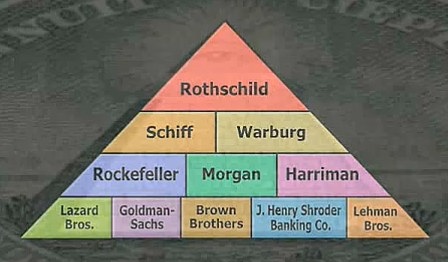
This Awareness indicates that in 1905 the entities Henry MorganPaul WarburgNelson Aldrich (a Senator from new York) -- this Awareness indicates these three along with Jacob SchiffJohn D. Rockefeller and several others, the names not seen clearly, these entities went secretly by train, then by boat, to Jekyl Island -- these entities meeting there for some time, discussing a plan for an economic system that would allow the banking establishment to control the money of this nation.
This Awareness indicates these entities developed a program which was already written, from the Illuminati, and presented by the entity Paul Warburg, and adapted to the needs of their purposes--this being presented as the "Aldrich Plan". This Awareness indicates that the majority of members of the press and Congress objected, knowing that Aldrich worked for the Wall Street bankers; therefore, these entities objected to this plan, feeling that it would not be to the benefit of the people.
This Awareness indicates the entities then returned and worked on an alternative plan, presenting this as the "People's Plan". This Awareness indicates this became the Federal Reserve System. This Awareness indicates that these entities then had this Federal Reserve System passed in Congress on Christmas Eve, when most of the Congress had already left to go home, except for those few working with them, who passed this Federal Reserve Plan -- this was intended to prevent any further run on the banks, or any form of crisis in the economies of this country.

Nelson Rockefeller Sets Stage for World War ll with Japan

This Awareness indicates that in 1929, the crash came, and the banks collected nine-tenths of all personal property on default of mortgages. This Awareness indicates the entities Nelson Rockefeller (named after the Senator Nelson Aldrich), and his brother David, during the 40's served as assistants to the Chase Manhattan Bank and its various interests. This Awareness indicates that these entities assisted in setting up that which was known as the Pacific Institute of research, this in Japan.
This Awareness indicates this Pacific this Pacific Institute was used to create certain political influences in Japan, which helped to polarize the Japan interests against the interests of the United States, and therefore set stage for World War ll in the Pacific. This Awareness indicates this with the assistance of the President Roosevelt. This Awareness indicates the entity Franklin Roosevelt not being fully aware of what was occurring behind the scenes, but being used as a puppet for the energies. This Awareness indicates that essentially John D. Rockefeller and the empire built by him were financed after the Civil war by the European powers of the Rothschild, and these forces were allowed to grow and build during World war ll into that which became the most powerful banking and financial interest in the entire world.

Rockefeller--Rothschilds sold war machine to Russia... sets relatives up in high government positions
This Awareness indicates after World War ll had been completed, the Rockefellers assisted in selling all of the machinery, the war machinery, to Russia and China, this allowing these nations to build up their industrial war machine and to industrialize to a high capacity in order that they might become a greater power. This Awareness indicates that the previous statements as slightly in error--that the Rockefellers sold this, arranged the sale of this to the Rothschilds, the Rothschilds being in control of Russia and China and the Communist forces, and therefore in turn, the Rothschilds assisted in moving the war machinery and industries into these countries. This Awareness indicates that the following of this action, the Rockefellers began to gain greater and greater control over this present United States government--the entity Allan Dulles, being Rockefeller's cousin, was put in charge of the CIA. This Awareness indicates that the entity John Foster Dulles, another cousin, was the secretary of State.

Rockefeller--Rothschild--Kennedy set stages for Vietnam War
This Awareness indicates this began the movement toward greater power in the United States being controlled by the banking system, and the usurping of the power from the hands of the people--this being the government--the power of government being taken from the people. This Awareness indicates this led to that which became the secret government which controlled the United States from the time of World War ll up to recent times.
This Awareness indicates that the Cold War then, as being but a chess game manipulated between the Rothschild and the Rockefellers, as a kind of mind mass-manipulation to lead the world government which was described previously. This Awareness indicates there appeared to be competition between these entities--these banking interests--and this competition was real, yet there was also that complete respect and the mutual cooperation that was underlying much of the surface competition. This Awareness indicates that there also were certain movements when the competition between these entities cost the lives of others, but from the viewpoint of these entities, this was simply part of the financial game. This Awareness indicates that the efforts of the Rothschilds to force the United States into Vietnam--this was in part with the cooperation of the Rockefellers and the Kennedys, due to the desire of the Rothschilds to have greater control in Southeast Asia. This Awareness indicates that this in part relating to the drugs within the golden Triangle area, and in part an effort to use up the military supplies of the United States and to cost more money to bankrupt this nation, even as Britain had been bankrupted by the Spanish War in the 18th Century.

The Plan to Bankrupt all countries
This is all part of the Rothschilds plan for the New World Order to bankrupt all countries and turn them into satellites by foreclosing on the bankrupt countries. This Awareness indicates that there are things happening behind the scenes that yet could prevent this entity from his goals and dreams, yet there is nothing simple or easy about the struggle that will follow as the struggle that is already occurring.
It is actually a kind of covert war going on all over the globe as to who is going to be free and who is going to be in control of the masses, whether they eventually will awaken enough to throw off the oppressors or whether they will cuddle up the oppressors, hoping to seduce them into being nice to their slaves.

The Illuminati--Federal reserve Plot to gain control of the World's Silver and Gold
This Awareness indicates that the present situation wherein the United States economics began to suffer, relates to their time in the mid-sixties, when the silver was taken--the silver backing was taken from the dollar. This Awareness indicates that it was shortly thereafter that a peculiar thing occurred which few entities are aware of, but which had a profound effect on history in general. This Awareness indicates that in 1969, an entity who was remotely related to the Rothschilds, went to Europe and met with various bankers in small countries--these being independent bankers not associated with the Rothschild Illuminati. This entity began explaining a technique whereby these bankers could effect the nature of the seizing of gold. This Awareness indicates the lluminati had seized most of the gold --the Rothschild banks along with the Rockefeller banks, had taken most of the gold and silver from circulation-- and held this in their control. This Awareness indicates at this time it was still possible to buy gold for $ 32 an ounce.
This Awareness indicates that this entity in meeting with these various bankers in sixteen nations, small nations, presented a plan or program whereby these entities could rake off some of the gold and make a large profit in so doing. This Awareness indicates the plan was at follows:
The entities would purchase gold at a price of $ 32 per ounce, then take that gold, or its certificate of ownership, and mortgage that at exactly the same amount--$ 32 per ounce. This Awareness indicates these entities could often mortgage this gold right back to the bank which sold the gold to them. This Awareness indicates these entities then would take the money from the mortgage and purchase more gold at $ 32 an ounce, mortgage that at 100% value, and then again purchase more gold. In this manner , these bankers and money speculators began to drain off the ownership of gold, with the possibility of redeeming that gold which was being tied up by the mortgage, redeeming this at $ 32 per ounce. This Awareness indicates this began happening on a rapid scale, and the gold which was tied up suddenly began to be tied up into the banks of other nations, and these nations having mortgagees which allowed them to redeem this gold at $ 32 per ounce.
This Awareness indicates that after a certain time, the price of gold became quite valuable in various countries--then the entity, the then President Nixon, made the announcement that he would put an end to the gold speculators and their efforts to destroy the American dollar, by taking the gold backing off the dollar. This Awareness indicates that this occurred and the price of gold shot upwards to its present rate. This Awareness indicates that those nations which then had invested in gold, mortgaged that gold at $ 32 an ounce, could then redeem the gold at $ 32 per ounce and resell at the current value

Replay of memory on Maldek (Maldek a Planet belonging to our Solar System which was destroyed)
This Awareness indicates that 85% of the souls upon this plane have lived on Maldek and this as the Luciferian consciousness which is being worked off as part of the Earth's karma. This Awareness indicates this as being dissolved. The entire Illuminati, money changing trip as but a replay of the memory of the action which occurred on Maldek wherein beings were categorized, numbered and enslaved. This Awareness indicates that the movement which began 60.000 years ago in Atlantis was but a recollection of certain states which began on Maldek

Charles E. Wharry (Darkbird18);
This article about the history of the Illuminati and the Banking cartels of the Illuminati Banking families is a eye opener and at the same time a very strange Cosmic twist to it that makes it worth while reading. But the information about how the banking cartels control and start wars to gain control of resources is very interesting because it all about controlling of these resources to control us and keep us always in a maze of confession, fear, hate and doubt; so that we can't focus our attention  on what our true nature is, which is Love and peace of mind, why? Read this article and get a good insight in how they control us and why? Also visit this website for very, "Good Information" on these secret groups and their working. Check it out at   About The Illuminati - Order of The Illumined Wise Men 


Friday, July 8, 2016

Alvin Toffler “The Third Wave”:THE TECHNICIANS OF POWER,Alvin Toffler, Author of ‘Future Shock,’ Dies at 87: Update 09/25/16


Alvin Toffler, Author of ‘Future Shock,’ Dies at 87


Image result for Alvin Toffler’s prophetic 1970 book


Alvin Toffler’s prophetic 1970 book, “Future Shock,” sold millions of copies and catapulted the author to international fame. Credit Susan Wood/Getty ImagesPhoto by: Susan Wood/Getty Images

Alvin Toffler, the celebrated author of “Future Shock,” the first in a trilogy of best-selling books that presciently forecast how people and institutions of the late 20th century would contend with the immense strains and soaring opportunities of accelerating change, died on Monday at his home in Los Angeles. He was 87.
His death was confirmed by his consulting firm, Toffler Associates, based in Reston, Va.
Mr. Toffler was a self-trained social science scholar and successful freelance magazine writer in the mid-1960s when he decided to spend five years studying the underlying causes of a cultural upheaval that he saw overtaking the United States and other developed countries.
The fruit of his research, “Future Shock” (1970), sold millions of copies and was translated into dozens of languages, catapulting Mr. Toffler to international fame. It is still in print.
In the book, in which he synthesized disparate facts from every corner of the globe, he concluded that the convergence of science, capital and communications was producing such swift change that it was creating an entirely new kind of society.
His predictions about the consequences to culture, the family, government and the economy were remarkably accurate. He foresaw the development of cloning, the popularity, and influence of personal computers and the invention of the internet, cable television, and telecommuting.
                              Future Shock Documentary (1972)

'Future Shock' is a documentary film based on the book written
in 1970 by sociologist and futurist Alvin Toffler. Released in 1972,
with a cigar-chomping Orson Welles as on-screen narrator, this piece of futurism is darkly dystopian and oozing techno-paranoia.
“The roaring current of change,” he said, was producing visible and measurable effects in individuals that fractured marriages, overwhelmed families and caused “confusional breakdowns” manifested in rising crime, drug use and social alienation. He saw these phenomena as very human psychological responses to disorientation and proposed that they were challenging the very structures of communities, institutions and nations.
He continued these themes in two successful follow-up books, “The Third Wave” (1980) and “Powershift” (1990), assisted by his wife, Heidi Toffler, who served as a researcher and editor for the trilogy and was a named co-author in subsequent books. She survives him.
Mr. Toffler popularized the phrase “information overload.” His warnings could be bleak, cautioning that people and institutions that failed to keep pace with change would face ruin. But he was generally optimistic. He was among the first authors to recognize that knowledge, not labor and raw materials, would become the most important economic resource of advanced societies.
Critics were not sure what to make of Mr. Toffler’s literary style or scholarship. Richard R. Lingeman wrote in The New York Times that Mr. Toffler “sends flocks of facts and speculation whirling past like birds in a tornado.” In Time magazine, the reviewer R. Z. Sheppard wrote, “Toffler’s redundant delivery and overheated prose turned kernels of truth into puffed generalities.”
Mr. Toffler’s work nevertheless found an eager readership among the general public, on college campuses, in corporate suites and in national governments. Newt Gingrich, the former Republican speaker of the House, met the Tofflers in the 1970s and became close to them. He said “The Third Wave” had immensely influenced his own thinking and was “one of the great seminal works of our time.”
Prime Minister Zhao Ziyang of China convened conferences to discuss “The Third Wave” in the early 1980s, and in 1985 the book was the No. 2 best seller in China. Only the speeches of the Chinese leader Deng Xiaoping sold more copies.
Image result for Alvin Toffler’s prophetic 1970 book
Credit Random HousePhoto by: Random House

Mr. Toffler was born in New York on Oct. 4, 1928, and raised in Brooklyn, the only son and elder of two children of Sam and Rose Toffler, immigrants from Poland. His father was a furrier.
Alvin began to write poetry and stories soon after learning to read and aspired to be a writer from the time he was 7 years old, he told interviewers. His inspiration, he said, came from an uncle and aunt — Phil Album, an editor, and Ruth Album, a poet — who lived with the Tofflers.
“They were Depression-era literary intellectuals,” Mr. Toffler said in an interview for this obituary in 2006, “and they always talked about exciting ideas.”
Mr. Toffler enrolled in New York University in 1946 and, by his account, spent the next four years only mildly interested in his academic work. He was far more engaged in political activism. In the fall of 1948, during a brief trip home from helping to register black voters in North Carolina, he met Adelaide Elizabeth Farrell, known as Heidi.
“I went to Washington Square,” he said, “and as I walked across the park, I saw a girl in one of my classes. And next to her was a gorgeous blonde. We have been inseparable since.”
Where Mr. Toffler was voluble and visionary, Ms. Toffler was cleareyed and direct. Early in 1950, before they were married, she persuaded him to finish his course work at N.Y.U. and graduate with a degree in English.
“I barely made it,” he recalled. “I paid no attention to credits. In my youthful view I thought, ‘Who needs ceremony?’ Heidi is far more practical.”
Both shared expansive intellects and the passion to make their lives matter. Like the writers he most admired, Mr. Toffler wanted experiences to report on. “Steinbeck went to pick grapes,” he said. “Jack London sailed ships.”
The couple decided to move to Cleveland, then at the very center of industrial America. They were married there on April 29, 1950, by a justice of the peace whom Mr. Toffler described as a “roaring drunk.” They lived on the city’s west side and took production jobs in separate factories.
Mr. Toffler learned to weld and repair machinery and came to understand in the most personal way the toll that physical labor can have on industrial workers. He broke a vertebra when a steel beam he was helping to unload twisted unexpectedly and fell on him.
At night, Mr. Toffler wrote poetry and fiction and discovered he was proficient in neither. But he still aspired to be a writer. In 1954, soon after the birth of the couple’s only child, Karen, he persuaded the editor of Industry and Welding, a national trade magazine published in Cleveland, to hire him as a reporter.Image result for Alvin Toffler’s 2006
Mr. Toffler in 2006. Credit Fred Prouser/ReutersPhoto by: Fred Prouser/Reuters
Mr. Toffler recalled: “The editor told me, ‘You’re getting this job because you know how to weld. Now, show me you know how to write.’”
Mr. Toffler soon landed a job as a reporter for Labor’s Daily, a national trade newspaper published in Charleston, W.Va., by the International Typographical Union. It sent him to Washington to cover labor news there in 1957.
Two years later, he sent Fortune magazine a proposal to write an article about the economics of the growing mainstream interest in the arts. Fortune rejected the idea but invited Mr. Toffler to New York for an interview and hired him as its labor editor and columnist.
He left Fortune in 1962 and, with his wife as editor and adviser, began a freelance-writing career covering politics, technology and social science for scholarly journals and writing long interviews for Playboy magazine. His 1964 Playboy interview with the Russian novelist Vladimir Nabokov was considered one of the magazine’s best.
Besides his wife, Mr. Toffler is survived by a sister, Caroline Sitter. The Tofflers’ daughter died in 2000.
Mr. Toffler published 13 books and won numerous honors, including a career achievement award in 2005 from the American Society of Journalists and Authors. He and his wife formed Toffler Associates, a global forecasting and consulting company, originally based in Manchester, Mass., in 1996.
In recent years, benefiting from hindsight, some critics said Mr. Toffler had gotten much wrong. Shel Israel, an author and commentator who writes about social media for Forbes, took issue with Mr. Toffler in 2012 for painting “a picture of people who were isolated and depressed, cut off from human intimacy by a relentless fire hose of messages and data barraging us.”
But, he added: “We are not isolated by it. And when the information overloads us, most people are still wise enough to use the power of the ‘Off’ button to gain some peace.”
In writing “Future Shock” 46 years ago, Mr. Toffler acknowledged that the future he saw coming might ultimately differ in the details from what actually came to pass.
“No serious futurist deals in ‘predictions,’” he wrote in the book’s introduction. “These are left for television oracles and newspaper astrologers.”
He advised readers to “concern themselves more and more with general theme, rather than detail.” That theme, he emphasized, was that “the rateof change has implications quite apart from, and sometimes more important than, the directions of change.”
He added, “We who explore the future are like those ancient mapmakers, and it is in this spirit that the concept of future shock and the theory of the adaptive range are presented here — not as final word, but as a first approximation of the new realities, filled with danger and promise, created by the accelerative thrust.”
Correction: July 1, 2016 
An obituary on Thursday about the author Alvin Toffler misidentified the reviewer who wrote in The New York Times that Mr. Toffler, in his book “Future Shock,” “sends flocks of facts and speculation whirling past like birds in a tornado.” He is Richard R. Lingeman, not the mechanical engineering scholar and systems theorist Richard W. Longman.

              Alvin Toffler “The Third Wave”:THE TECHNICIANS OF POWER


The question "Who runs things?" is a typically Second Wave question.
For until the industrial revolution there was little reason to ask it.
Whether ruled by kings or shamans, warlords, sun gods, or saints,
people were seldom in doubt as to who held power over them. The
ragged peasant, looking up from the fields, saw the palace or
monastery looming hi splendor on the horizon. He needed no political
scientist or newspaper pundit to solve the riddle of power. Everyone
knew who was in charge.
Wherever the Second Wave swept in, however, a new kind of power
emerged, diffuse and faceless. Those in power became the
anonymous "they." Who were "they"?
THE INTEGRATORS
Industrialism, as we have seen, broke society into thousands of
interlocking parts—factories, churches, schools, trade unions, prisons,
hospitals, and the like. It broke the line of command between church,
state, and individual. It broke knowledge into specialized disciplines. It
broke jobs into fragments. It broke families into smaller units. In doing
so, it shattered community life and culture.
Somebody had to put things back together in a different form.
This need gave rise to many new kinds of specialists whose basic task
was integration. Calling themselves executives or


              Alvin Toffler - The New Economy


 THE THIRD WAVE
administrators, commissars, coordinators, presidents, vice* presidents,
bureaucrats, or managers, they cropped up in every business, in every
government, and at every level of society. And they proved
indispensable. They were the integrators.
They defined roles and allocated jobs. They decided who got what
rewards. They made plans, set criteria, and gave or withheld
credentials. They linked production, distribution, transport, and
communications. They set the rules under which organizations
interacted. In short, they fitted the pieces of the society together.
Without them the Second Wave system could never have run.
Marx, in the mid-nineteenth century, thought that whoever owned the
tools and technology—the "means of production"—would control
society. He argued that, because work was interdependent, workers
could disrupt production and seize the tools from their boses. Once
they owned the tools, they would rule society.
Yet history played a trick on him. For the very same inter-dependency
gave even greater leverage to a new group— those who orchestrated
or integrated the system. In the end it-was neither the owners nor the
workers who came to power. In both capitalist and socialist nations, it
was the integrators who rose to the top.
It was not ownership of the "means of production" that gave power. It
was control of the "means of integration.** Let's see what that has
meant.
In business the earliest integrators were the factory proprietors, the
business entrepreneurs, the mill owners and ironmasters. The owner
and a few aides were usually able to coordinate the labor of a large
number of unskilled "hands" and to integrate the firm into the larger
economy.
Since, in that period, owner and integrator were one and the same, it is
not surprising that Marx confused the two and laid so heavy an
emphasis on ownership. As production grew more complex, however,
and the division of labor more specialized, business witnessed an
incredible proliferation of executives and experts who, came between
the boss and his workers. Paperwork mushroomed. Soon in the larger
firms no individual, including the owner or dominant shareholder, could
even begin to understand the whole operation. The owner's decisions
were shaped, and ultimately controlled, by the specialists brought in to
coordinate the system. Thus a new executive elite arose whose power rested
no longer on ownership but rather on control of the integration process.
As the manager grew in power, the stockholder grew less important.
As companies grew bigger, family owners sold out to larger and larger
groups of dispersed shareholders, few of whom knew anything about
the actual operations of the business. Increasingly, shareholders had
to rely on hired managers not merely to run the day-to-day affairs of
the company but even to set its long-range goals and strategies.
Boards of directors, theoretically representing the owners, were
themselves increasingly remote and ill-informed about the operations
they were supposed to direct. And as more and more private
investment was made not by individuals but indirectly through
institutions like pension funds, mutual funds, and the trust departments
of banks, the actual "owners" of industry were still further removed
from control.
The new power of the integrators was, perhaps, most clearly
expressed by W. Michael Blumenthal, former U.S. Secretary of the
Treasury. Before entering government Blumenthal headed the Bendix
Corporation. Once asked if he would some day like to own Bendix,
Blumenthal replied: "It's not ownership that counts—it's control. And as
Chief Executive that's what I've got! We have a shareholders' meeting
next week, and I've got ninety-seven percent of the vote. I only own
eight thousand shares. Control is what's important to me. ... To have
the control over this large animal and to use it in a constructive way,
that's what I want, rather than doing silly things that others want me to
do."


Friday, July 1, 2016

Tragedy and Hope A History of Banking and Money by Carroll Quigley

WantToKnow.info

Tragedy and Hope
A History of Banking and Money by Carroll Quigley

Tragedy and Hope: Carroll Quigley.
"The powers of financial capitalism had [a] far-reaching aim, nothing less than to create a world system of financial control in private hands able to dominate the political system of each country and the economy of the world as a whole. This system was to be controlled in a feudalist fashion by the central banks of the world acting in concert by secret agreements arrived at in frequent private meetings and conferences."
  -- Quote from Caroll Quigley's Tragedy and HopeChapter 20

Jay on Tragedy & Hope 3: Stalin, Hitler, Illuminism & the Occult Empire (Half)


Carroll Quigley was a professor of history at Georgetown University from 1941 to 1976. He also taught at Princeton and at Harvard, and lectured at the Brookings Institution. He was a frequent lecturer at the U.S. Naval Weapons Laboratory, the Foreign Service Institute, and the Naval College at Norfolk, Virginia. In 1958, he served as a consultant to the Congressional Select Committee which set up the National Space Agency. Below are key excerpts on the history of money and banking from Prof. Quigley's masterpiece Tragedy and Hope: A History of the World in Our Time.
Note: The below excerpts are taken from chapters 5, 9, 20, 65, and 77 of Tragedy and Hope, with a focus on Prof. Quigley's excellent discussion of the role of money and banking in world history. This is a 10-page summary. To go directly to a more in-depth 40-page summary, click here.

Chapter 5—European Economic Developments
Commercial Capitalism
Western Civilization is the richest and most powerful social organization ever made by man. One reason for this success has been its economic organization, [which] has passed through six successive stages, of which at least four are called "capitalism." Each stage created the conditions which tended to bring about the next stage.
The [first stage] of self-sufficient agrarian units (manors) was in a society organized so that its upper ranks—the lords, lay and ecclesiastical—found their desires for necessities so well met that they sought to exchange their surpluses of necessities for luxuries of remote origin. This gave rise to a trade in foreign luxuries (spices, fine textiles, fine metals) which was the first evidence of the stage of commercial capitalism. In this second stage, mercantile profits and widening markets created a demand for textiles and other goods which could be met only by application of power to production.
This gave the third stage: industrial capitalism. The stage of industrial capitalism soon gave rise to such an insatiable demand for heavy fixed capital, like railroad lines, steel mills, shipyards, and so on, that these investments could not be financed from the profits and private fortunes of individual proprietors. New instruments for financing industry came into existence in the form of limited-liability corporations and investment banks. These were soon in a position to control the chief parts of the industrial system, since they provided capital to it.
This gave rise to financial capitalism. The control of financial capitalism was used to integrate the industrial system into ever-larger units with interlinking financial controls. This made possible a reduction of competition with a resulting increase in profits. As a result, the industrial system soon found that it was again able to finance its own expansion from its own profits, and, with this achievement, financial controls were weakened, and the stage of monopoly capitalism arrived.
In this fifth stage, great industrial units, working together either directly or through cartels and trade associations, were in a position to exploit the majority of the people. The result was a great economic crisis which soon developed into a struggle for control of the state—the minority hoping to use political power to defend their privileged position, the majority hoping to use the state to curtail the power and privileges of the minority. This dualist struggle dwindled with the rise of economic and social pluralism after 1945.

John Taylor Gatto discusses Carroll Quigley and Tragedy and Hope: A History of the World in Our Time


The Primary Goal of Capitalism
Capitalism provides very powerful motivations for economic activity because it associates economic motivations so closely with self-interest. But this same feature, which is a source of strength in providing economic motivation through the pursuit of profits, is also a source of weakness owing to the fact that so self-centered a motivation contributes very readily to a loss of economic coordination. Each individual, just because he is so powerfully motivated by self-interest, easily loses sight of the role which his own activities play in the economic system as a whole, and tends to act as if his activitieswere the whole, with inevitable injury to that whole.
Capitalism, because it seeks profits as its primary goal, is never primarily seeking to achieve prosperity, high production, high consumption, political power, patriotic improvement, or moral uplift. Any of these may be achieved under capitalism, and any (or all) of them may he sacrificed and lost under capitalism, depending on this relationship to the primary goal of capitalist activity—the pursuit of profits. During the nine-hundred-year history of capitalism, it has, at various times, contributed both to the achievement and to the destruction of these other social goals.
[The] stage of commercial capitalism became institutionalized into a restrictive system, sometimes called "mercantilism," in which merchants sought to gain profits, not from the movements of goods but from restricting the movements of goods. Thus the pursuit of profits, which had earlier led to increased prosperity by increasing trade and production, became a restriction on both trade and production, because profit became an end in itself rather than an accessory mechanism in the economic system as a whole.
In the course of time, however, some merchants began to shift their attention from the goods aspect of commercial interchange to the other, monetary, side of the exchange. They began to accumulate the profits of these transactions, and became increasingly concerned, not with the shipment and exchange of goods, but with the shipment and exchange of moneys. In time they became concerned with the lending of money to merchants to finance their ships and their activities, advancing money for both, at high interest rates, secured by claims on ships or goods as collateral for repayment.
The Operations of Banking Were Concealed So They Appeared Difficult to Master
In sum, specialization of economic activities, by breaking up the economic process, had made it possible for people to concentrate on one portion of the process and, by maximizing that portion, to jeopardize the rest. The process was not only broken up into producers, exchangers, and consumers but there were also two kinds of exchangers (one concerned with goods, the other with money), with almost antithetical, short-term, aims. The problems which inevitably arose could be solved and the system reformed only by reference to the system as a whole.
Unfortunately, however, three parts of the system, concerned with the production, transfer, and consumption of goods, were concrete and clearly visible so that almost anyone could grasp them simply by examining them, while the operations of banking and finance were concealed, scattered, and abstract so that they appeared to many to be difficult. To add to this, bankers themselves did everything they could to make their activities more secret and more esoteric. Their activities were reflected in mysterious marks in ledgers which were never opened to the curious outsider.
In the course of time the central fact of the developing economic system, the relationship between goods and money, became clear, at least to bankers. This relationship, the price system, depended upon five things: the supply and the demand for goods, the supply and the demand for money, and the speed of exchange between money and goods.
An increase in three of these (demand for goods, supply of money, speed of circulation) would move the prices of goods up and the value of money down. This inflation was objectionable to bankers, although desirable to producers and merchants. On the other hand, a decrease in the same three items would be deflationary and would please bankers, worry producers and merchants, and delight consumers (who obtained more goods for less money). The other factors worked in the opposite direction, so that an increase in them (supply of goods, demand for money, and slowness of circulation or exchange) would be deflationary [and vice versa].
Such changes of prices, either inflationary or deflationary, have been major forces in history for the last six centuries at least. Over that long period, their power to modify men's lives and human history has been increasing.
Bankers Obsessed With Maintaining Value of Money
Rising prices benefit debtors and injure creditors, while falling prices do the opposite. A debtor called upon to pay a debt at a time when prices are higher than when he contracted the debt must yield up less goods and services than he obtained at the earlier date, on a lower price level when he borrowed the money. A creditor, such as a bank, which has lent money—equivalent to a certain quantity of goods and services—on one price level, gets back the same amount of money—but a smaller quantity of goods and services—when repayment comes at a higher price level, because the money repaid is then less valuable.
This is why bankers, as creditors in money terms, have been obsessed with maintaining the value of money, although the reason they have traditionally given for this obsession—that "sound money" maintains "business confidence"—has been propagandist rather than accurate.
Hundreds of years ago, bankers began to specialize, with the richer and more influential ones associated increasingly with foreign trade and foreign-exchange transactions. Since these were richer and more cosmopolitan and increasingly concerned with questions of political significance, such as stability and debasement of currencies, war and peace, dynastic marriages, and worldwide trading monopolies, they became the financiers and financial advisers of governments.
Moreover, since their relationships with governments were always in monetary terms and not real terms, and since they were always obsessed with the stability of monetary exchanges between one country's money and another, they used their power and influence to do two things: (1) to get all money and debts expressed in terms of a strictly limited commodity—ultimately gold; and (2) to get all monetary matters out of the control of governments and political authority, on the ground that they would be handled better by private banking interests.
Bankers Create Money Out of Nothing
For generations men had sought to avoid the one drawback of gold, its heaviness, by using pieces of paper to represent specific pieces of gold. We call such pieces of paper gold certificates. Such a certificate entitles its bearer to exchange it for its piece of gold on demand, but in view of the convenience of paper, only a small fraction of certificate holders ever did make such demands.
It early became clear that gold need be held on hand only to the amount needed to cover the fraction of certificates likely to be presented for payment; accordingly, the rest of the gold could be used for business purposes, or, what amounts to the same thing, a volume of certificates could be issued greater than the volume of gold reserved for payment of demands against them. Such an excess volume of paper claims against reserves we now call bank notes.
In effect, this creation of paper claims greater than the reserves available means that bankers were creating money out of nothing. The same thing could be done in another way, not by note-issuing banks but by deposit banks. Deposit bankers discovered that orders and checks drawn against deposits by depositors and given to third persons were often not cashed by the latter but were deposited to their own accounts. Thus there were no actual movements of funds, and payments were made simply by bookkeeping transactions on the accounts.
Accordingly, it was necessary for the banker to keep on hand in actual money ... no more than the fraction of deposits likely to be drawn upon and cashed; the rest could be used for loans, and if these loans were made by creating a deposit for the borrower, who in turn would draw checks upon it rather than withdraw it in money, such "created deposits" or loans could also be covered adequately by retaining reserves to only a fraction of their value.
The Dynasties of International Bankers
The merchant bankers of London ... brought into their financial network the provincial banking centers, organized as commercial banks and savings banks, as well as insurance companies, to form all of these into a single financial system on an international scale which manipulated the quantity and flow of money so that they were able to influence, if not control, governments on one side and industries on the other.
The men who did this, looking backward toward the period of dynastic monarchy in which they had their own roots, aspired to establish dynasties of international bankers and were at least as successful at this as were many of the dynastic political rulers. The greatest of these dynasties, of course, were the descendants of Meyer Amschel Rothschild (1743-1812) of Frankfort, whose male descendants, for at least two generations, generally married first cousins or even nieces.
In concentrating, as we must, on the financial or economic activities of international bankers, we must not totally ignore their other attributes. They were, especially in later generations, cosmopolitan rather than nationalistic. They were usually highly civilized, cultured gentlemen, patrons of education and of the arts, so that today colleges, professorships, opera companies, symphonies, libraries, and museum collections still reflect their munificence. For these purposes they set a pattern of endowed foundations which still surround us today.