The Good The Bad and The Ugly

Friday, September 7, 2018

Behold the Green Dragon, Red Dragon and the Black Dragon Family's Secret Society's: The Myth & Reality of an Asian Secret Society BY RICHARD SPENCE


History certainly has no shortage of enigmatic or controversial brotherhoods, orders, lodges, and societies. The Knights Templar, for instance, are a perennial object of fascination and speculation. Whether the Templars were the inspiration for the no less controversial Freemasons, a band of depraved heretics or the innocent victims of a conspiracy born of greed and envy remains a topic of lively debate.
What no one can contest, however, is that the Knights existed. The beginning and formal end of the Order can be dated with precision, and the names of its leaders are a matter of historical record. Even a dubious organization like the Priory of Sion can be shown to have had a genuine, if recent, existence, though its claims to centuries of tradition and hidden influence remain unsubstantiated. But there are other groups which seem to exist only in that gray zone between reality and imagination, ones whose origins, number, scope, and purpose remain maddeningly vague.

White Dragon Society, Gnostic Illuminati vesves Benjamin Fulford v. NWO


One such entity is the quasi-mythical Green Dragon Society (GDS), also known as the Order of the Green Dragon or simply the Green Dragon. It most often is mentioned as a Japanese secret society, but that is not necessarily the whole story. Other evidence, or at least allegation, argues that its true origins lay in China or Tibet and that its influence extended to the power centers of Tsarist Russia and Nazi Germany. Historical figures from Emperor Hirohito, to Adolf Hitler to Rasputin have been tied to the Green Dragon, legitimately or not. The waters have been further muddied by role-playing games which have combined the Society with H. P. Lovecraft’s Cthulhu Mythos and other fictional elements. Determining what is “real” and what is the playful figment of someone’s imagination can be tricky.
What follows will not solve the mystery of the Green Dragon, but it will try to separate fact from fiction and explain where claims and information came from. In doing so, it will offer a tantalizing glimpse into a mysterious organization that may have played a significant role in shaping modern history.

Enter the Black Dragon

The simplest explanation for the Green Dragon Society is that it is a muddled reference to the better known, and definitely real, Black Dragon Society (BDS) or Kokuryukai. The BDS first appeared about 1901 and was an offshoot of another, older Japanese secret society, the Black Ocean or Genyosha. Like its parent, the Black Dragon was a militant, “ultra-nationalist” body which worked to expand Imperial Japan’s influence on the Asian mainland. The BDS initially concentrated on combating Russian interests in the vast Chinese province of Manchuria. Indeed, the Society took its name from the “Black Dragon” or Amur River which separated Manchuria and Siberia. The Black Dragon’s network of spies and saboteurs took an active part in the subsequent Russo-Japanese War (1904-05) and the Black Dragons later expanded their operations and influence throughout Asia and Europe and even the Americas.
The nominal founder and leader of the Black Dragon were Ryohei Uchida, but the true master, or “dark side emperor,” was Uchida’s shadowy and sinister mentor, Mitsuru Toyama, also a founding member of Genyosha. He reputedly was steeped in “extreme Eastern religious beliefs.”1 That suggests the mysticism and occultism attributed the Green Dragon Society. Might the scheming and secretive Toyama has played a guiding role in both societies?
Were the Black and Green Dragons, if not one and the same, two sides of the same conspiratorial coin? For instance, just as the Black Dragon (Amur) River delineated the northern limit of Manchuria, further south the much smaller Qinglong or Green Dragon River roughly followed the dividing line between Manchuria and China proper. If the Black Dragon Society was primarily anti-Russian in its focus, might the Green Dragon have been anti-Chinese or anti-Western? While the Black Dragon focused on the political side, did the Green deal with the more secretive occult realm?
One obscure but important reference which clearly distinguishes between the Black and Green societies appears in the memoir of Chinese strongman Chiang Kai-shek’s “second wife,” Ch’en Chieh-ju.2 She recalls that her husband contemplated a “completely secret system of private investigators” and considered as models the “Green and Black Dragon Societies of Japan and the Triad societies of Shanghai.”3 Thus, in Chiang’s mind at least, the two Dragons were entirely separate (though not necessarily unrelated), Japanese, and appropriate models for secret intelligence gathering.
As noted, the Black Dragon Society was heavily involved in spying and the kindred spheres of propaganda and subversion. As such, it basically functioned as an extension of the Imperial Army’s “special organ,” the Tokumu Kikan. Not to be outdone in anything, the Japanese Imperial Navy maintained its own secret service, the Joho Kyoko. Just as the Army utilized the Black Dragon to augment or handle its “special needs,” might the Navy have used the Green Dragon in the same way?

Trevor Ravenscroft & Karl Haushofer

The identification of the Green Dragon as a fundamentally mystical order most evidently appears in Trevor Ravenscroft’s 1973 The Spear of Destiny. It is not insignificant that Ravenscroft was a follower of Anthroposophy and its founder Rudolf Steiner, and his book is a distinctly Anthroposophist take on the nefarious occult forces behind Hitler and his Nazi Regime. Ravenscroft firmly connects the Green Dragon to German geo-politician and mystic Karl Haushofer, one of Hitler’s presumed spiritual mentors. According to Ravenscroft, Professor Haushofer “gained… extraordinary gifts through membership of the Green Dragon Society of Japan in which the mastery of the Time Organism and the control of the life forces in the human body is the central aim of ascending degrees of initiation.” Ravenscroft adds that “one of the highest tests of this type of initiation in the Green Dragon Society demands the capacity to control and direct the life force in plants in a somewhat similar manner to the former powers of the Atlantean people.” “Only two other Europeans have been permitted to join this Japanese Order,” [and who, one wonders, were they?] continues Ravenscroft, “which demands oaths of secrecy and obedience of far more strict and uncompromising nature than similar secret societies in the Western world.”4
The major problem with all this is that Ravenscroft’s sources are hazy or non-existent. He likely took a cue from the 1960 work of Louis Pauwels and Jacques Bergier, The Morning of the Magicians. Those authors claim that Haushofer “is said [by whom?] to have been initiated into one of the most important secret Buddhist societies and to have been sworn, if he failed in his ‘mission,’ to commit suicide in accordance with the time-honored ceremonial.”5 Assuming this to be an allusion to the above GDS, we are still faced with the lack of any identifiable source for the authors’ information.
Ravenscroft goes on the claim that members of the Green Dragon Society set-up shop in 1920s Germany and there joined forces with a group of Tibetan monks called the “Society of Green Men.” The latter was, in fact, the “Adepts of Agharti and Schamballah” and their leader was a mysterious “Man with the Green Gloves.”6 It also turns out that the Green Dragons and the Green Men had “been in astral communication for hundreds of years.”7 The united brethren soon established communication with the rising Herr Hitler.

                 Rothchilds Surrender To White Dragons

Others have since elaborated on the above by turning the Green Dragons into an “inner cabal” of both Genyosha and the Black Dragon, and making them “but an outpost of a much larger conspiracy based on the even more secretive group known and the Green Men.”8 While fascinating, such assertions appear not to have any basis in hard fact.
But that is not to say they may not have a germ of truth. For instance, there was an occult figure in late Weimar Berlin sometimes referred to as the “Magician with the Green Gloves” who did become a short-lived soothsayer for Hitler and the Nazi Party. He was no Tibetan but, of all things, a Jew who went under the name of Erik Jan Hanussen. When he became inconvenient by accurately predicting the Reichstag Fire (or arranging it), his erstwhile Nazi pals killed him.9
Likewise, there could very well be something to a Green Dragon-Tibet connection. A green dragon, or Zhug, plays an important role in Tibetan mythology where it symbolizes the “God of Thunder… bravery and all-conquering force.”10 More to the point, perhaps, a Japanese Buddhist monk named Ekai Kawaguchi made two visits to Tibet in the years before World War I, around the same time Haushofer was in Tokyo. On the surface, Kawaguchi seemed a simple religious devotee, but he is known to have had contact with at least one Japanese secret agent while in the Land of Eternal Snows, Narita Yasuteru, as well as an operative of British Indian intelligence.11 Kawaguchi also had links to Annie Besant and her Theosophist sect, another group accused of subversion and general skullduggery.12 More significantly, Kawaguchi was a devotee of Zen Buddhism.
In his 1989 The Unknown Hitler, Wulf Schwarzwaller claims that Haushofer was a master of various Eastern mystical traditions and “had familiarised himself with the Zen teachings of the Japanese Society of the Green Dragon.”13 More recent sources emphasize the Green Dragon’s intimate association with Zen, specifically its Soto branch, and claim that the “Green Dragon has had a tradition of secret propagation,” whatever that means.14
The Buddhist connection may offer some important clues. Buddhism originated in India and spread to Tibet and China, and from there to Japan. Zen (Cha’an) doctrine also had its roots in China. One of the most revered Buddhist “saints” in Japan is Kukai, an 8th-9th-century mystic who spent years studying in China. Interestingly, his main place of enlightenment was the Green Dragon Temple in Xian where he was trained in the occult, tantric traditions originating in Tibet. Returning to Japan, Kukai incorporated these into his version of True Land (Shingon) Buddhism.15 The problem is that Shingon was and is quite distinct from Zen, so which, if either, is connected to the Green Dragon?
To further complicate the picture, there are numerous references to a Chinese Green Dragon Society. Most are linked to the martial arts. Green Dragon kung fu societies are active throughout the world, but most appear to be of fairly recent origin. Oddly enough, during the 1960s, the Chicago-based Green Dragon Society was locked in a bitter feud with the rival Black Dragon Society! One version of the Chinese Green Dragon’s history pegs it as a Taoist secret society formed in response to the 17th-century persecutions launched by the Jesuit-influenced Emperor Kiang Hsi. According to this, the secret society emerged from the Pure Thought Mystical School of Tao, and along with an implacable hatred for the Manchu Dynasty, it remained dedicated to the “practice of Taoist Alchemy and Immortalist Techniques.”16 That sounds a bit like what Ravenscroft described. The Green Dragon also reputedly operated under numerous aliases and disguises. A secretive and even sinister Green Dragon Society also shows up in at least two martial arts films: ‘The Deadly Sword’ (1978) and ‘Seven Promises’ (1980). Finally, a Green Society or Green Gang was (and arguably still is) a major force in the Chinese underworld.
So, could there be two Green Dragon Society’s, one Japanese and Buddhist and the other Chinese and Taoist? This much seems clear: the inter-pollination of Chinese and Japanese Buddhism, and the sects and secret societies they spawned, is centuries old. Within that context, just about anything is possible.
Other oddments, which may or may not mean anything, including the fact that during his marriage to another wife, Chiang Kai-shek paid a visit to a Green Dragon monastery. The late scholar Charles Rice, after sifting through everything he could find on the Green Dragon Society, wondered whether it might be nothing more than the karate club of the Japanese Emperor’s Imperial Guard!17 Strangest of all, perhaps, is a 2004 article from the South China Morning Post which describes the recent arrest of three members of the “Green Dragon Temple Cult” on charges of running a prostitution ring.18 The female victims have assured a place in heaven if they earned enough money for the cult.

Seven Heads of the Green Dragon

                What is the Dragon Family? | CLASSIC


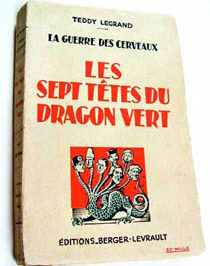
There is another, more involved, though no less mysterious, description of the Green Dragon Society that predates Ravenscroft by forty years and Pauwels and Bergier by almost thirty. It is almost certainly the source for much of what he and others have had to say about the GDS since. The work in question is the 1933 Les Sept Tetes du Dragon Vert [“The Seven Heads of the Green Dragon”] by Teddy Legrand. The title evokes the dragon with “seven heads, ten horns, and seven crowns upon his heads” mentioned in Revelations 12:3, although that beast is red, not green. At first glance, the book seems to be just an obscure piece of French pulp fiction, albeit one replete with real people and real events along with many invented ones.
Basically, the book presents the Green Dragon or, more simply, “The Greens,” a sinister international cabal bent on world domination. An interesting detail is that these secretive conspirators number precisely 72 and were, presumably, the “72 unknown superiors” of conspiratorial legend.19 To achieve its nefarious aim, the Green Dragon generates war, revolution and chaos, and its hand is the unseen common denominator in such seemingly disparate events as the assassination of Franz Ferdinand, the instigation of the Bolshevik Revolution, the murder of the Romanovs, the 1922 killing of German foreign minister Walther Rathenau, the abduction of White Russian general A. P. Kutepov and the apparent suicide of millionaire Swedish “Match King” Ivar Kreuger. All in all, the Green Dragon sounds like another version of the infamous Illuminati who haunts so many conspiracy theories.
At the time of the book’s action, 1929-30, the mysterious Greens are busy facilitating the rise of the “The Man of the Two Z’s” under whose “sharp spurs” Europe would soon tremble.20 The latter is a thinly-veiled and rather prophetic reference to Hitler who had barely come to power when the book was published. The “Two Z’s” were the interlocking arms of the Swastika.
The central figure of Les Sept Tetes… is a British secret agent, the ace of L’Intelligence Service, James Nobody, who may be the original literary inspiration for James Bond. He had already starred in a series of pot-boiler spy novels by French writer Charles Lucieto, and the latest was an effort to continue the franchise after Luciano's recent death. Interestingly, Lucieto was a retired spy, having served the French secret service in World War I. He liked to claim that his Nobody and similar yarns were roman-a-clefs which revealed true if hidden aspects of recent history and current events. His publishers later implied that this had something to do with his untimely demise.
To no great surprise, Lucieto’s successor, “Teddy Legrand,” was a pseudonym. In fact, the author was Pierre Mariel who turns out to be a rather interesting fellow. Nominally he was a journalist, but like Lucieto he had ties to French intelligence. That has led to the claim that the latter “inspired” or even directed his literary efforts as it had his predecessor’s.21 More importantly, perhaps, he was a self-proclaimed expert on the occult. Some years later, under the name Werner Gerson, he would author one of the first books on Nazi occultism.22 Mariel himself was a member of both the Freemasonic Martinist Order and a one-time French grand master of the Ancient and Mystical Order Rosae Crucis (AMORC).23Interestingly, in Les Sept Tetes… Mariel paints the Martinist Order as a conspiratorial sect which played a behind-the-scenes role in the French Revolution and later political upheavals, and which just might have links to the mysterious Green Dragon.24
In the book, brother spies Nobody and Legrand are inspired by their common curiosity about the fate of the Russian Imperial family. The chief object of fascination is an icon on St. Seraphim, supposedly found on the Tsarina Alexandra’s body, which bears a puzzling inscription, in English: “S.I.M.P. The Green Dragon. You were absolutely right. Too late.”25 They quickly determine that the first element, which is accompanied by a six-point “kabbalistic” symbol, stands for “Superieur Inconnu, Maitre Philippe” [Unknown Superior, Master Philippe], a French Martinist mystic who was an early guru to the Tsarina Alexandra.26 They also note the Tsarina’s predilection for the “Tibetan” Swastika as a good luck symbol. The rest of the story follows the duo’s efforts to discover who or what constitutes the Green Dragon.
Some interest inevitably falls on Maitre Philippe’s successor as the royal spiritual guide, Rasputin, who comes across as a tool of the Green Dragon, if not an outright member. Legrand/Mariel correctly observes that during World War I, the dissolute holy man maintained communication with mysterious “Greens,” or simply “The Green,” based in Stockholm in which Mariel portrays as another piece of a larger conspiracy.27 Interestingly, Colonel Stanislaus de Lazovert, one of the men later involved in the plot to kill the dissolute holy man, claimed that Rasputin was a member of the “Green Hand,” a secret order presumably backed by Russia’s Austrian enemies.28 Most recently and reliably, Russian investigator Oleg Shishkin linked Rasputin’s mysterious friends to a Berlin-inspired conspiracy which included German occult lodges and members of the ethnic-German Baltic nobility. Their secret brotherhood, Baltikum, used a green swastika as its symbol.
Coincidentally or not, one of the antagonists encountered by Nobody and Legrand is a Baltic Baron, Otto von Bautenas, whom they identify as no less than one of the “72 Verts.” Bautenas turns out to have been a very real person: an ex-adherent of Baltikum, a close ally of Lithuanian politico Augustine Valdemaras and leader of the fascistic Iron Wolf movement.
Mariel also implies that Anthroposophy kingpin Rudolf Steiner was mixed-up in all this skullduggery and “secret politics” through his connections to pan-German secret societies.29 He also drops Gurdjieff’s and Besant’s names in the same murky mess.
While the book’s action stays within the geographic confines of Europe, shifting from Constantinople, to Scandinavia, to Paris to Berlin, there are numerous references to the Orient, especially Tibet. Legrand and Nobody enlists the aid of one of their old antagonists, Jewish-born “international spy” I.T. Trebitsch-Lincoln, who has transformed himself into the Tibetan lama Dordji Den. Here again, there is at least a kernel of truth; in 1931 the chameleon-like Trebitsch has ordained a Buddhist monk and became “the Venerable Chao Kung.”30
The pair eventually finds themselves in Berlin, in the presence of The Man with the Green Gloves, an apparently Asian soothsayer who has set himself up much as the real Hanussen. They observed an eerie figure that seemed to have “complete mastery of his reflexes.”31 Was this the “control of the life forces” mentioned by Ravenscroft? Like a living statue, “not a muscle in his face moved” as the weird seer conversed in “excellent Oxford English.” Nobody and friend finally realize that they are standing face-to-face with “one of those famous Greens.” The description has led one recent author, Christian von Nidda, to conclude that the Greens were nothing less than “reptilian” beings!32
In the end, Mariel never clearly defines just what the Green Dragon Society is and is not. Doubtless, that was never his intention. Interestingly, there is no suggestion of any Japanese connection. However, as the episode with the Man with Green Gloves suggests, there is the specter of a powerful, mysterious Asiatic hand at work. The true purpose of the Russian Revolution, he believed, was to destroy Europe’s eastern barrier against Asiatic intrusion. Mariel sensed a kind of “permanent conspiracy against the white race – against Western Greco-Latin civilization – which seeks to sap, fracture and shake the edifice of already unstable Europe.”33 When the time came, the conspirators would “substitute him” [the Man of the Two Z’s] as a means of bringing about a New Order.
It also remains uncertain to what degree Mariel intended Les Sept Tetes… to be taken seriously. Clearly, that has not prevented some from doing so. Truth, fiction, or some strange amalgam of the two, Mariel’s little book is undoubtedly the inspiration for most of the claims about the Green Dragon Society which have sprung up since. We are still left to wonder whether, if all the exaggeration, obfuscation, superstitious dread and outright lies were cleared aside, there would be anything there at all. Maybe.
This article was published in New Dawn 112.

Footnotes:

1. “Japan’s Dark Background, 1881-1945.” www.fortunecity.com/tatooine/lieber/50/bds1.htm [15 Oct. 2008].
2. Chieh-ju Ch’en, Chiang Kai-shek’s Secret Past: The Memoir of His Second Wife, Westview Press: Boulder, 2000.
3. Ibid.
4. Trevor Ravenscroft, The Spear of Destiny: The Occult Power Behind the Spear which Pierced the Side of Christ, Weiser Books: Boston, 1982, 246-247.
5. Louis Pauwels and Jacques Bergier, The Morning of the Magicians, Avon Books: New York, 1960, 279.
6. Ravenscroft, 256.
7. Ibid.
8. Gil Trevizo, “The Order of the Green Dragons” (2003), odh.trevizo.org/green_dragons.html [15 Oct. 2008]. This and like articles are connected to the Delta Green role-playing games.
9. On Hanussen’s bizarre career, see Mel Gordon, Erik Jan Hanussen: Hitler’s Jewish Clairvoyant, Feral House: Los Angeles, 2001.
10. “Tibet’s Dragon Culture,” courtesy of Charles Rice, August 2006.
11. Alexander Berzin, “Russian and Japanese Involvement with Pre-Communist Tibet: The Role of the Shambhala Legend,” www.berzinarchives.com/web/en/archives/kalachakra/shambhala/russian_japanese_shambhala.html.[10 Sept. 2008]
12. Richard Spence, Secret Agent 666: Aleister Crowley, British Intelligence and the Occult, Feral House: Los Angeles, 2008, 184, 189.
13. Wulf Schwarz waller, The Unknown Hitler: Behind the Image of History’s Darkest Name, Berkley Books: New York, 1990, 100.
14. For a highly critical view of “Green Dragon Zen,” See groups.google.com/group/alt.philosophy.zen/browse_thread/thread/da7a81921050f728.
15. Trevor Corson, “The Magic of Buddhism,” Kyoto Journal (1 July 2000), www.scrawlingclaw.com/blogs/ArticleArchive/Entries/2000/7/1_The_Magic_of_Buddhism.html [10 Nov. 2008].
16. “The Green Dragon Society & Brotherhood, Chi Tao Ch’uan Gung Fu: A Recent History,” www.orientalherb.com/index.php?cPath=35 [1 Nov. 2008].
17. Charles Rice to the author, 3 July 2003.
18. Clifford Lo, “Sex Cult Might Have Lured 30 Women,” South China Morning Post (16 Jan. 2004).
19. Nolan Romy, Les Grandes Conspirations de Notre Temps, Bruxelles, 2002, 35-50.
20. Teddy Legrand, Les Sept Tetes du Dragon Vert, Berger-Levrault: Paris, 1933, 78.
21. Oleg Shishkin, Ubit’ Rasputina, Olma Press: Moscow, 2000, 36-37.
22. Werner Gerson, Le Nazisme: Societe Secrete, Productions de Paris: Paris, 1969.
23. Shishkin, 36.
24. Legrand, 32.
25. Legrand, 30-33.
26. True name: Nizier Anthelme Philippe.
27. Legrand, 39-40.
28. “Stanislaus Lazovert and the Assassination of Rasputin, 29 December 1916,” www.firstworldwar.com/source/rasputin_stanislaus.htm.
29. Legrand, 228-230.
30. Bernard Wasserstein, The Secret Lives of Trebitsch Lincoln, Penguin Books: New York, 1989, 274.
31. Legrand, 243-244.
32. Christian Von Nidda, Our Secret Planet, Lulu Publications, 124-125.
33. Legrand, 132

About the Author

Dr. Richard B. Spence is a Professor of History at the University of Idaho where he has taught since 1986. His interests include modern Russian, military, espionage and occult history. His published works include Boris Savinkov: Renegade on the Left (1991), Trust No One: The Secret World of Sidney Reilly (2002) and Secret Agent 666: Aleister Crowley, British Intelligence and the Occult (2008). With Walter Bosley, he co-authored Empire of the Wheel: Espionage, the Occult and Murder in Southern California (Corvos, 2011). He is the author of numerous articles in Revolutionary Russia, Intelligence and National Security, International Journal of Intelligence and CounterIntelligence, Journal for the Study of Anti-Semitism, American Communist History, New Dawn and other publications. He has been a guest on Coast to Coast, The Other Side of Midnight, Radio Liberty and many other programs.

Charles Wharry (Darkbird18):

The world is at a turning point and who will rule is about to be decided because this unseen war has been going on for 1000's years and the World Revolution Movement (WRM) which is the 13 Illuminati Family Bloodline and Power Elites (Old World Order) but they are fighting against the "Dragon" which is the true "Light" of the world. This article will be enlightening the facts on this war and who are the players.


Tuesday, August 21, 2018

Update: 01/16/19 YouTube: Rasse Beobachter: Lanz von Liebenfels - Theozoologie “Aryan” race originated from extraterrestrial?


The Best Documentary Ever - The Secret Brotherhood of Atlantis (MUST WATCH !!!)


Lanz von Liebenfels (July 19, 1874 – April 22, 1954) was an Austrian völkisch theorist, former Cistercian monk and founder of the Ariosophy movement.
The term 'Ariosophy', meaning wisdom concerning the Aryans, was first coined by Lanz von Liebenfels in 1915 and became the label for his doctrine in the 1920s. The term 'Ariosophy' is used generically to describe the Aryan-esoteric theories of a subset of the 'Völkische Bewegung'. This broader use of the word is retrospective and was not generally current among the esotericists themselves.
Lanz von Liebenfels was a friend of a student of Guido von List and helped found the "Guido-von-List-Gesellschaft" (Guido von List society) in 1905, and in 1907 he founded the "Ordo Novi templi" (Order of the New Templars).
He published the journal 'Ostara, Briefbücherei der Blonden und Mannesrechtler' from 1905 till 1930.


follow the link below for more information about the journal 'Ostara'
and related articles
© Copyright Peter Crawford 2017


Brief Biography

He was born on July 19, 1874, in the Penzing district of Vienna in what was then Austria-Hungary, as the son of schoolmaster Johann Lanz and his wife Katharina, née Hoffenreich.
His parents were middle class, and his father's ancestors had been burghers in Vienna since the early 18th century.

Stift Heiligenkreuz
Lanz became a monk in the Cistercian order in 1893, assuming the name Georg, and living in the Heiligenkreuz monastery (see right).
In 1894, he claimed to have been "enlightened" after finding the tombstone of a Knight Templar, and began developing his theories of "blond aryanism" and the "lower races".
He left the monastery in 1899; with Lanz claimed that this was due to "growing nervousness".


Die Abtei von Lambach


When young Adolf Hitler became a student at Lambach Abbey, in Austria, the abbot of Lambach, Father Hagen, had already died, but the swastikas he ordered to be carved still decorated the sanctuary of the Abbey.
Wappen des Abtes Hagen
While young Adolf  was a student and chorister at the abbey, a Cistercian monk, named Adolf Joseph Lanz (Liebenfels), made a stay at Lambach.
Hitler - back row - second from right
He stayed for several weeks, working in the monastery library, thoroughly researching and studying Hagen's personal papers.
The monks affirm that during his research he evidenced the signs of great agitation, like of a person who had made a great discovery.
© Copyright Peter Crawford 2017
After his visit to Abbey, Lanz returned to Vienna, where the following year, (1900) he founded the Order of the New Templars, raising a swastika flag over the Templar castle he chose to be the center of the Order. We are, therefore, left with the tantalizing question of whether the young Adolf Hitler, and Liebenfels ever met during this period - and if there is any connection between Hagen' swastikas, Hitler's presence at Lambach, and the later use, by both Hitler and Liebenfels, of the swastika.
In 1903–4  von Liebenfels published a lengthy article under the Latin title 'Anthropozoon Biblicum' ("The Biblical Man-Animal") in a journal for Biblical studies, edited by Moritz Altschüler, a Jewish admirer (?) of Guido von List.

The author undertook a comparative survey of ancient Near Eastern cultures, in which he detected evidence from iconography (see left), and literature, which seemed to point to the continued survival, into early historical times, of hominid 'ape-men' similar to the dwarfish Neanderthal men known from fossil, remains in Europe, or the Pithecanthropus (now called Homo erectus) from Java.
Furthermore, Lanz systematically analyzed the Old Testament in the light of his hypothesis, identifying and interpreting coded references to the 'ape-men' which substantiated an illicit practice of interbreeding between humans and "lower" species in antiquity.

Theozoologie
In 1905 he expanded these researches into a fundamental statement of doctrine titled 'Theozoologie order die Kunde von den Sodoms-Äfflingen und dem Götter-Elektron' - (Theozoology, or the Science of the Sodomite-Apelings and the Divine Electron).

Extraterrestrial Origins of the Aryans
© Copyright Peter Crawford 2017

He stated that the “Aryan” race originated from extraterrestrial, interstellar entities, (termed Theozoa - in fact, Gnostic Æons), while “lower” races (Chandals) were a result of interbreeding between humans and 'ape-men' (or Anthropozoa).
The effects of miscegenation (racial cross-breeding) caused the atrophy of paranormal powers inherited from the Æons, but these could be restored by the selective breeding of pure Aryan lineages.
Miscegenation - (from the Latin 'miscere' 'to mix' and 'genus' "kind") is the mixing of different racial groups through marriage, cohabitation, sexual relations, or procreation. The term miscegenation has been used since the 19th century to refer to interracial marriage and interracial sexual relations, and more generally to the process of genetic admixture. The concept of miscegenation is tied to concepts of racial difference.


The legend of Atlantis 2: Secret Brotherhood 1


Liebenfels, as has already been stated, maintained that the Aryan race was the creation of the Ã†ons, having descended directly from the heavens.
Other humanoid forms (chimpanzees and other great apes - the creations of a lesser 'god' - the Demiurge), it was held, had crossbred with Aryans in the distant past, giving rise to the various Untermenschen still in existence - or not, as in the case of the Neanderthals - (with the Jews as the most developed, and the Polynesians and Negroes at the lower end of the scale).
Aryans have one pair fewer chromosomes than other apes, with ape chromosomes 2 and 4 fusing into a large chromosome (which contains remnants of the centromere and telomeres of the ancestral 2 and 4). Having different numbers of chromosomes is not an barrier to hybridization; similar mismatches are relatively common in existing species, a phenomenon known as 'chromosomal polymorphism'. Current research into human evolution tends to confirm that in some cases, interspecies sexual activity may have been a key part of human evolution.

BLOOD SACRIFICE: Hidden Occult Secrets of Hitler - HD FEATURE


There had, throughout recorded history been a continuation of miscegenation occurring between the Aryans and the Chandals (Untermenschen), resulting in the gradual dilution of the purity of the Aryan racial stock.

'Parsifal'
As a result, there were, in the 19th and 20th centuries, practically no pure Aryans.
(This theory is symbolized in Wagner's Bühnenweihfestspiel 'Parsifal').
The evidence, for Liebenfels, was clearly evident in the decline of Western (and particularly German speaking) societies, as reflected in politics, the fine art, music, architecture, public morality and all aspects of 'modern' life.
Hence the need for what was later termed 'Rassenhygiene'.
The German eugenicist Alfred Ploetz introduced the term Rassenhygiene in his 'Grundlinien einer Rassenhygiene', in 1895. Initially Rassenhygiene was concerned more with the declining birthrate in Germany, and the increasing number of mentally ill and disabled people than with the "Jewish question" and "de-Nordification" (Entnordung), which would come to dominate Rassenhygiene in Germany from the 1920s through to the second World War. The blue print for the attitude of the Third Reich toward other races was written by Erwin Baur, Fritz Lenz and Eugen Fischer and published under the title' Menschliche Erblehre Theorie und Rassenhygiene' (1936). Also, acting on eugenic concerns about the effects of alcohol, tobacco, and syphilis, the Third Reich sponsored research, undertook public education campaigns, and enacted laws that together aimed at eliminating “genetic poisons” linked to birth defects and genetic damage to later generations.
The aristocracy of the Blood
At its core, Rassenhygiene was conceived as the regeneration of the Aryan race, which would be mainly achieved by the strict implementation of Eugenics.
The goal of Liebenfels was for society to return to a healthy, strong and beautiful life, and the Nordic...

(To read the full article on this subject click on the link below)

Rasse Beobachter: Lanz von Liebenfels - Theozoologie: © Copyright Peter Crawford 2017    © Copyright Peter Crawford 2017 Lanz von Liebenfels (July 19, 1874 – April 22, 195...


Darkbitrd18, (Charles Wharry)
To understand the "Dark Brotherhood of Darkness and why they operate in the shadows in secret society's because they have a hidden agenda. To keep us off balance and living in fear and hate for one another because of the difference between us as human beings and to put themselves above all other is a lie they believe because they've have been lied to by the creator of all lie's! But this is all part of the grand plan in our development as organic spices to reach higher and higher levels of consciousness but first, we must WAKE UP! Read this article to understand the who, the what and the why behind racism.


Tuesday, July 31, 2018

The Revolutionary War: How America Became A Jesuit Enclave and Jesuit Order All Roads Lead to the Black Pope

The Revolutionary War: How America Became A Jesuit Enclave

Image result for The Revolutionary War:  Jesuit Enclave and Jesuit Order All Roads Lead to the Black Pope


A most colossal conspiracy against the United States. I do not like the resurrection of the Jesuits. — Former US President John Adams, in 1816

Vatican Secret Societies Jesuits and the New World Order


By P. D. Stuart
We now come to another highly interesting portion of American history, which you would be hard pressed to find in the history books: the part played by the Jesuits in the American Revolutionary War-the War of Independence, 1776-1783.
We have seen the role of the Jesuits in the American Civil War.  But what part,, if any, did they play in the earlier war that transformed America from a collection of independent States to the United States of America?  The uninformed or partisan historians will tell us that this War was mainly, if not entirely, due to the arbitrary and “intolerable acts” of the British government, leading to the American Colonists desire to break with British rule.  I will now venture to shed some light on this dimly reported aspect of American history–and offer you a very different, and we hope more correct view.
That religion played a major role in the American Revolution is beyond dispute.  In 1776, at the time of the Declaration of Independence, there were little over twenty–three priests in all, and the next highest authority was the vicar apostolic in London, who had jurisdiction over the British colonies and satellites in America.  The American Revolutionary War of Independence soon changed that.
The reason there were so few Catholics and so many more Protestants was because of the foundation of the great democracy that is today called the United States of America was laid when millions of European Protestants fled the oppression of the Catholic Church in Europe to seek freedom of conscience and religion in the mostly uninhabited wilderness of North America.  In the main, the settlers were resolved not to duplicate in the New World what they had fled from on the old continent.  These settlers felt that the pope, as a foreign ruler. Should not be allowed to meddle in the politics or laws of America as they suspected that would render it difficult for immigrants, especially Catholics, to be fully loyal to the new country and to its fledgling republican values.
Naturally, there was a fear of Roman Catholics–not unlike the fear many Americans today have of Muslim fundamentalists.  After all, these early Protestant pilgrims had recently escaped the hands of their Catholic compatriots.  In those days people took their Catholicism seriously!  So much so that several states passed laws regulating the activities of Roman Catholics.  For example, in 1647 a Massachusetts statute declared that every priest was an: “incendiary and disturber of the public peace and safety and an enemy of…true Christian religion…”
The early American settlers suspected that the Pope was seeking to meddle in the affairs of the United States—to undermine its republican values—which they said was evidenced by the oath that every Catholic Bishop was required to take: “I will to the utmost of my power see out and oppose schismatics, heretics, and the enemies of our Sovereign Lord (the pope) and his successors.”  However, the period following the restoration of the Jesuits in 1814 saw a tremendous growth in their numbers and influence in America, as evidenced by a large number of Jesuit colleges and universities established on that continent in that century–twenty–two of the Society’s twenty–eight universities.
“In those days,” says historian Rene Fulop Miller, “one of Benjamin Franklin’s friend was a Jesuit; this was John Carroll, who had been brought up in Maryland of Irish parentage…He would later become the Archbishop of Baltimore, and go on to establish the Jesuit University of Georgetown, in “a suburb of the city of Washington, the federal capital…the first Catholic educational institution in the United States.  According to Robert Emmett Curran, in his The Bicentennial History of Georgetown University, the Society of Jesus “resolved in 1786 to found Georgetown (to supply for Catholics in the new republic the clergy whom the Society had provided previously).
John Carroll was born in 1735, at Upper Marlboro, Maryland.  After receiving a Jesuit education at Bohemia in Cecil County, Maryland, Carroll studied abroad at Jesuit colleges in Europe.  He was forced to flee Europe when the Jesuits were expelled from Sweden under the decree of Pope Clement, in 1773.  And on August 15, 1790, Reverend John Carroll was appointed the first Catholic bishop in the United States of America, being consecrated on the feast of the assumption.
Next, the British Parliament passed the Stamps Act, considered by the American colonists as another “intolerable act.”  But by far the worst and most notable of these “intolerable acts” was the Quebec Act (passed on May 20, 1774, it received the Royal Assent on June 22, 1774), which attempted to cede all of the territory west of the Appalachian Mountains and north of the Ohio River to Canada (which at the time was essentially Catholic Quebec).  In particular, the legislation purported to extend the Catholic province of Quebec south and west to the Ohio and Mississippi rivers, and into western colonies of Connecticut, Massachusetts and Virginia-taking land that many Protestant colonists had already claimed.
That this was a deliberately provocative Act–the legislative extension of the province of Quebec into so large an area of what was to become the United States is seen from the fact that Quebec, Canada’s largest province, is three times the size of France and seven times the size of Great Britain.  Thus, the Catholics of Quebec had more than ample land to expand within Quebec, plus the vast expanse that is Canada.
Further, and curiously, the Quebec Act of 1774 “established” Catholicism as the official religion in what was at the time “the British Colony of Canada.” And, in conformity with the practice in Catholic countries of the day, it provided for trials without a jury: denied representative assembly.  The simultaneous passage of the Quebec Act and the Coercive Acts by the British Parliament led the colonists to angrily declare that the Quebec Act an immoral pact between Britain and popery.
What is surprising about this is that the British, who were supposed to be Protestants, included a provision in the Act expressly providing for Canada to remain under the exclusive control of the Roman Catholic Religion and this provision was to apply to the newly ceded territory (i.e. all of the territory west of the Appalachian Mountains and north of the Ohio River). The terms included the stipulation that: “the exercise of the Catholic, Apostolic and Roman religion shall be maintained.”  This was most curious coming from a supposedly Protestant power!
The British-American colonist, mostly Protestants, were naturally outrage, declaring the law to be one of the most “Intolerable Acts” of the British Parliament.  Historian Martin Griffin writes that it caused a good deal of patriotic indignation, and was widely considered, by people on both sides of the Atlantic, to have contributed in no small part to the Revolution of 1776.”
The American colonists lambasted the Quebec Act; denouncing it and the attendant French Alliance as a dagger aimed at the heart; as a betrayal of their religious heritage; and a Trojan horse.  The colonists issued an “Address Written to the People of England,” in which they expressed: “our astonishment that a British Parliament should ever consent to establish in that country (Canada) a religion that has deluged your island in blood, and disbursed impiety, bigotry, persecution, murder, and rebellion through every part of the world.”
Indeed, we must question and regard as very suspicious indeed, the eagerness shown by a Protestant king (George III) to thus favor the Catholic faith, in one of its Protestant colonies, with so gracious a grant of American territory to Roman Catholics.
Another of the Intolerable Acts was the earlier Quartering Act of March 24, 1765, under which the King sent large numbers of British troops to Boston and then demanded that colonists must house them: in private homes if necessary, and feed them too; and if they did not do so they would get shot.  The reader will recognize that these Acts served no useful purpose to the Crown and were clearly inflammatory acts; meant to provoke a radical response from the colonists, as the certainly did.  It has been said that these “Intolerable Acts” were orchestrated by the agency of the Jesuits in England who had the ear of the King. Do you doubt this?  Read again this part Jesuit Oath of Induction (see again Chap 7, ante):
At the time, the papacy not only had to deal with the concerns of Americans that these revolutionary Jesuit outcasts were migrating to America, it also had to quell the fears of the American people that the Catholic Church in America was itself no more than a Trojan horse for the installation of a foreign ruler-the pope.  To overcome these suspicions, the Jesuit John Carroll, advised the pope to have the portion of the oath, which required allegiance to the pope, above all others, removed from the American Bishop’s pledge.  This was done to avoid giving offense to the principles of the Constitution and to the calm fears that the Catholic Bishops were merely puppets of the pope, on American soil.

“THE INTOLERABLE ACTS”

In order to achieve the objectives of the Roman Pontiff, the Jesuits aided by their Illuminated-Masonic vassals in America instigated the American War of Independence. Leading Masonic authors openly claim that Freemasonry had a preponderant role in the movement for independence.  The “Masonic Review” of 1893 goes as far as to state that Freemasonry was the driving force in the formation of the American Union in 1776, claiming that at least fifty-two out of the filthy-six of the “signers of the Declaration of Independence as members” of the Lodge.  Charles Carroll, John Carroll’s cousin, was a signer.
By encouraging Britain to effect into legislation a series of unreasonable and “intolerable acts” (the name given by American patriots to five laws adopted by the British Parliament in 1774), the secret operatives helped create a state of deep resentment and rebellion in the hearts of the American colonist.
One such “intolerable act” was a new government tax scheme on imports of tea.  This is what happened behind the scenes.  Two Scottish Rite Freemasons, Paul Revere, and another Masonic brother, Joesph Warren–one of George  Washington’s generals were members of the oldest Lodge in America, St Andrew in Boston.  George Washington himself was initiated into the Fredericksburg lodge in 1752.  This Boston lodge was based in the Green Dragon Tavern-remembered by some as the “headquarters” of the American Revolution.  The Boston Tea Party operated from the Lodge.  The Boston Tea Party opposed the new tax on tea imports and employed various means of civil and criminal disobedience, including the blocking of non –British ships to port.
( To Read the whole Article go to this Link: The Revolutionary War: How America Became A Jesuit Enclave)