The Battle for Earth & Your Soul - Enki vs Enlil - Eagle vs Serpent - History Altered

Enki and Enlil
According to the ancient Sumerian texts, the Sumerian god, Anu, the “Supreme Lord of the Sky”, the currently reigning titular head of the Sumerian Family Tree, had two sons. They were Enki (Ea), Lord of the Earth and Waters (whose mother was Antu), and Enlil (Ilu), Lord of the Air and Lord of the Command (whose mother was Ki). These two half-brothers -- surprise, surprise -- did not get along.
For Updates and more thoughts, visit the Halexandria Forums
Critical to their rivalry -- particularly from Earth’s viewpoint -- was the fact that Enki had been the first of the Anunnaki to hazard a trip to Earth to begin a mining operation for gold. When this effort did not apparently produce gold in sufficient quantities, Enlil was brought in, given command, and armed with a new plan (an early version of the New Deal). The revised program was to mine gold from deep mines in the Earth.
According to Sumerian texts (as detailed in Genesis of the Grail Kings [1]), during a visit by their father, Anu (the archetypal absentee landlord), the Anunnaki made a decision:
The Battle for Earth & Your Soul - Enki vs Enlil - Eagle vs Serpent - History Altered
“The gods had clasped their hands together,
Had cast lots and had divided.
Anu then went up to heaven.
To Enlil, the Earth was made subject.
The seas, enclosed as with a loop,
They had given to Enki, the Prince of Earth.”
Sounds fair. However. As Laurence Gardner points out: “Enki was not happy about his brother’s promotion because, although Enlil was the elder of the two, his mother (Ki) was Anu’s junior sister, whereas Enki’s mother (Antu) was the senior sister. True kingship, claimed Enki, progressed as a matrilineal institution through the female line, and by this right of descent Enki maintained that he was the first born of the royal succession.”
“I am the great brother of the gods.
I am he who has been born as the first son of the divine Anu.”
If there is a philosophy of Enki, it manifests and explains itself in early Mesopotamian and Egyptian thought, where the true creator of the universe was manifest within nature, and that nature enveloped both the Anunnaki and the humans. Nature, as the Great Mother, was still supreme, despite any patriarchal scheme to the contrary. Admittedly, Enki’s claim of his birthright, the one being based on a matrilineal succession -- essentially the mitochondria DNA link, which is wholly passed through the female line -- was in Enki’s best interests. But Enki was also the maternal grandfather who came to the aid of Inanna when things went badly during her Descent into the Underworld.
With the arrival of Enlil, however, who in his best interests must demean the matriarchal line of succession, and thus nature itself -- everything changed. The Great Mother was dethroned and replaced by a supreme male (as opposed to a male consort for the Queen). The idea of cooperation -- as exemplified by the council of Anunnaki making cooperative decisions -- was quickly replaced by competition, and harmony was forsaken in favor of subservience. The supreme god became abstract, and any physical connection with human or nature was lost -- and thus the link between nature and human also destroyed. When Enlil hit town, there was a whole new deal put into effect.
According to Laurence Gardner [1], “The dominant tenet of the new thought was based wholly on the utmost fear of Enlil, who was known to have instigated the great Flood [or else acquiesced in not warning the humans, or making any attempt to save them], and to have facilitated the invasion and destruction of civilized Sumer. Here was a deity who spared no mercy for those who did not comply with his dictatorial authority.
“Abraham had experienced the vengeful Enlil first hand at the fall of Ur, and he was not about to take any chances with his own survival. He was even prepared to sacrifice the life of his young son, Isaac, to appease the implacable God (Genesis 32:9).” “The oriental scholar Henri Frankfort summarized the situation by making the point that... ‘Those who served Jehovah must forego the richness, the fulfillment, and the consolation of a life which moves in tune with the great rhythms of the earth and sky.”
Bramley [3] has noted that “We, therefore, find Ea [Enki] as the reputed culprit who tried to teach an early man (Adam) the way to spiritual freedom. This suggests that Ea intended his creation, Homo sapiens, to be suited for Earth labor, but at some point, he changed his mind about using spiritual enslavement as a means.”
From a Biblical perspective, it was Enki who (with the critical assistance of his half-sister, Ninki, aka Nin-khursag) created Adam and Eve. It was Enlil, on the other hand, who created “Edin”. Enki was the serpent in the garden, who urged Adam and Eve to eat of the fruit of the Tree of Knowledge of Good and Evil (which was infinitely beneficial to their spiritual growth). It was Enlil, who drove them out of Edin, while Enki was there to clothe them. It is worth noting that Zecharia Sitchin [2] claims that the biblical word for “snake” is Nahash, which comes from the root word NHSH, and which means “to decipher, to find out.” In other words, Enki, the God of Wisdom.
In the time of Noah, it was Enlil who either created the Great Deluge/Flood as a means of wiping out mankind (because they supposedly made too much noise), or else refused to warn the humans or do anything to save them or help them to save themselves. Enki, on the other hand, apparently against orders of the Anunnaki (who Enlil now controlled), provided the boat plans for Noah to build his Ark, and thus save him, his family (and likely a fair number of helpful artisans and their families). Enki included as well the seed of other living things (a “natural” kind of thing to do).
In the Sumerian texts, we have the stories of Enki and Enlil, and for the most part there is portions devoted to each. But in Genesis, Enlil seemingly reigns supreme. Enlil knew early on, that a pound of good Public Relations effort is worth a ton of truth.
Abraham and his descendants served Enlil and followed his precepts. The Egyptians, on the other hand, were Enki’s protégés, and based on food management practices during the devastating droughts around the time of Jacob and Joseph, were doing a lot better than Enlil’s followers. Obviously, Noah backed the right horse in that Enki shared boat plans with the righteous fellow -- whom Enlil later claimed as his own.
But at one point, circa 2000 B.C.E., all hell broke loose. In an all-out war of Enki’s humans against Enlil’s humans -- complete with all manner of diplomatic subterfuge in the mix -- Sodom and Gomorrah took the brunt of the action and were destroyed. By nuclear weaponry! They were A-bombed. The decision for this, however, was not, as you might have expected, due to Enlil’s instigation. Instead, it was due to the actions of his sons, Ninurta and Ningal. The (radioactive) fallout of their actions then resulted in the final destruction of the Sumerian civilization (circa 2000 B.C.E.). Curiously, this event in the Annals of Earth turned out to be something of a Waterloo for Enlil. Not that the guy (dba “God”) fled the scene, but thereafter, the idea of unilateral actions was a bit more constrained. Enlil was no longer the undisputed Lord of the Command among his peers.
Which might be just as well. As Laurence Gardner [1] phrased it: “This muddled and unparalleled concept of Jehovah is right when he was wrong, honest when he was dishonest, was born out of an inherent fear of his vengeful power and unbounded wrath. Whether as Jehovah (in Genesis) or as Enlil (in the Mesopotamian record) it was he who had instigated the Semitic invasions which led to the ‘confusion of tongues’ and the fall of Sumer. It was he who had brought about the devastating Flood, and it was he who had leveled the cities of Sodom and Gomorrah -- not because of their wickedness, as related in Genesis (18-19), but because of the wisdom and insight of their inhabitants, as depicted in the Coptic Paraphrase of Shem. It was Jehovah who had removed the Israelites from their homeland and sending them into seventy years of captivity by King Nebuchadnezzar II and his five Babylonian successors down to King Belshazzer (545-539 BC).”
This latter event is critical as another turning point in the Enki and Enlil warfare, as it reflects a time, circa 600 B.C.E., when Enlil was stepping back from the overt control of Earth. (A fact which does not necessarily imply stepping back from covert control!)
Zecharia Sitchin [2] has taken a different, decidedly pro-Jehovah, the pro-Enlil approach in his writings. While admitting to the complicity of Enlil’s sons in the destruction of Sodom and Gomorrah, Sitchin tends to blame the female (i.e. Inanna) for seducing King Shulgi of Ur (and thus destroying a once thriving civilization). Sitchin also charges Enki’s son, Marduk, who became the Babylonian god, with being perhaps the prime culprit of all the bad news that was extant in what Sitchin refers to as “The Fateful Century” (2123 - 2023). At one point in his book, The Wars of God and Men, Sitchin writes: “There was great jubilation in the land when the great temple was rededicated to Enlil and Ninlil [Enlil’s wife], in the year 1953 B.C.E.; it was only then that the cities of Sumer and Akkad were officially declared habitable again.”
And just guess who was responsible for their being uninhabitable in the first place!?
To appreciate the continuing sage of Enki versus Enlil, it is instructive to note their place in the Sumerian Family Tree, aka the “Grand Assembly of the Anunnaki”.
Marduk (who would become the god of the Babylonians) was Enki’s first born, and that of Enki’s wife, the goddess Damkina. Enki’s other wife was his half-sister, Nin-khursag (meaning “Mountain Queen”), the Lady of Life, also known as Nin-mah, the Great Lady.
Enlil was also espoused to Nin-khursag and their son was Ninurta (Ningirsu), the Mighty Hunter. By another wife, Ninlil (Sud), Enlil had a second son, Nanna (Suen), known as the Bright One. Nanna and his wife, Ningal, were the parents of Inanna (who was called Ishtar by the Babylonians), and who married the Shepherd King Dumu-zi (the latter given in the Semitic Old Testament book of Ezekiel 8:14 as Tammuz).
Another son of Enlil and Ninlil was Nergal (Meslamtaea), King of the Underworld. He married Eresh-kigal, the Queen of the Netherworld, the daughter of Nanna and Ningal (i.e. Inanna’s sister), and the mother of Lilith (who became handmaiden to Inanna, her maternal aunt). Lilith is also notorious as the first wife of Adam, but it was Lilith who rejected him (and thus incurred the wrath of every reject-worthy male on the planet).
By some accounts, Inanna was also the granddaughter of Enki (as well as Enlil). This strange situation was critical in Inanna’s classic tale of her Descent into the Underworld. (I.e. Enlil turned a blind eye, while Enki saved Inanna’s lovely little fanny.) Even more crucial to the plot was the fact that Inanna was also a favorite of the supreme Anu. Thus she was never, never at a loss as to what she thought she could do and get away with. Her story has been well told two books by Susan Ferguson: Inanna Returns and Inanna, Hyperluminal. (Ms. Ferguson does include Enki’s son, Marduk, as the bad guy, but on the other hand, keeps Enki as a favorite. She can do that. It’s her books.)
Speaking of Marduk, not only was he the arch-enemy of Inanna (thus explaining Susan’s plotting), but Marduk thoroughly angered just about everyone about him. Even his father, Enki, must have wondered where he went wrong in raising his first son -- a question not uncommon to any father. At the same time, it must be admitted, Marduk was without question a serious pain in the rear (and elsewhere) for Enlil, and thus Enki might have had moments of genuine pride.
Just as Enki may have been given temporary, overt control over the Earth during the Age of Pisces, Marduk, who was identified with the planet Mars, and thus the astrological sign of Aries, had assumed he would be in charge during the Age of Aries. Depending on the time allotted to each sign -- whether it is 1/12th, or more likely the actual time spent in the sign -- Marduk’s Age of Aries likely ran from roughly 2,000 B.C.E. to about 600 B.C.E. This was his time, therefore, and The Wars of Gods and Men told by Sitchin was in large part Marduk’s attempts to wrest control from Enlil, and the Anunnaki who supported the latter. The fact that it became a very messy war was not necessarily Marduk’s fault.
For the fact remains that, circa 1950 B.C.E., after Enlil’s son, Ninurta, had failed to rally the Anunnaki troops on his own behalf -- and thoroughly bombed on his venture to Sodom and Gomorrah -- Marduk finally got his chance.
“Lord Anu, lord of the gods who from Heaven came to Earth,
and Enlil, lord of Heaven and Earth
who determines the destinies of the land,
Determined for Marduk, the firstborn of Enki,
the Enlil-functions over all mankind;
Made him great among the gods who watch and see,
Called Babylon by name to be exalted, made it supreme in the world;
And established for Marduk, in its midst, an everlasting kingship.”
Marduk, from Babylon, ultimately took vengeance on the Enlil supporters known as the Hebrews, who had opposed Marduk’s reign, and they thereafter spent seventy years in captivity. During this time, Enlil never raised a hand to assist them. In Enlil’s view, they were quite expendable. Obviously, someone -- unlike their ancestral patriarch, Noah, had failed to back the right horse.
For some time (i.e. the Age of Aries), Marduk took over Enlil’s subjugation of the humans -- politics of the slavery kind made strange bedfellows. But the Age of Aries (unlike the Age of Pisces) was mercifully short. And it had the decided advantage of prepping the Anunnaki for Enki’s take over about 600 B.C.E., when the Age of Pisces began.
For Updates and more thoughts, visit the Halexandria Forums
Chronicles of Earth Sumerian Genesis
Forward to:
Anunnaki Sumerian Family Tree The Me
____________________________
References:
[1] Laurence Gardner, Genesis of the Grail Kings, Bantam Press, New York, 1999.
[2] Zecharia Sitchin, The 12th Planet, 1976, The Stairway to Heaven, 1980, The Wars of Gods and Men, 1985, The Lost Realms, 1990, When Time Began, 1990, Genesis Revisited, 1990, Divine Encounters, 1995, Avon Books, New York.
[3] William Bramley, The Gods of Eden, Avon Books, New York, 1989, 1990.
The Library of ialexandriah
Anunnaki
Updated 5 February 2009
Genesis 6:1-4 reads:
“And it came to pass, when men began to multiply on the face of the earth, and daughters were born unto them, That the sons of God saw the daughters of men that they were fair; and they took them wives of all which they chose... There were nephilim in the earth in those days; and also after that, when the sons of God came in unto the daughters of men, and they bare children to them, the same became mighty men which were of old, men of renown.” [emphasis added]
Nephilim is often translated as “giants”, a legitimate and appropriate interpretation, but one which may be only partially accurate. A better definition might be “those who came down”, “those who descended”, or “those who were cast down.” The Anunnaki of ancient Sumerian texts is similarly defined as “those who from heaven to earth came”. Sitchin [1], Gardner [2], and Bramley [3] have all identified the Nephilim as the Anunnaki, more specifically, essentially the rank and file.
For Updates and more thoughts, visit the Halexandria Forums
Virtually all open-minded historical and theological scholars agree the Old Testament’s book of Genesis was extracted from the older Sumerian records, if only because of the similarity in their Comparative Religions. The Enuma Elish, the Sumerian Epic of Creation, and Genesis have a variety of common elements. Stories of a Great Flood and Deluge, among other stories, are also common to both Sumerian and Biblical accounts. An inevitable conclusion is that the Anunnaki were as real as Noah, Moses or Abraham.
Rise of the Archons, Breaking Info, Emerald Tablets, Thoth, Hijacked History Unveiled
Laurence Gardner [2] has written: “Every item of written and pictorial attestation confirms that the ancient Sumerians were absolutely sincere about the existence of the Anunnaki, and those such as Enki, Enlil, Nin-khursag and Inanna fulfilled earthly functions with designated community duties. They were patrons and founders; they were teachers and justices; they were technologists and kingmakers. They were jointly and severally venerated as archons and masters, but there were certainly not idols of religious worship as the ritualistic gods of subsequent cultures became. In fact, the word which was eventually translated to become ‘worship’ was avod, which meant quite simply, ‘work’. The Anunnaki presence may baffle historians, their language may confuse linguists and their advanced techniques may bewilder scientists, but to dismiss them is foolish. The Sumerians have themselves told us precisely who the Anunnaki were, and neither history nor science can prove otherwise.”
The Sumerian records recorded in great detail the stories of the Anunnaki, and among these, that of Enki, Enlil, Ninki, Inanna, Utu, Ningishzida, Marduk, and many others. Chief among these stories was the continuing conflict between Enki and Enlil, the sons of the supreme god of the time, Anu. Much of ancient human history, and the Biblical Genesis, can be explained as the militant differences between these two half-brothers, and how they affected the life of all sentient beings on Earth.
But the Anunnaki were more than just a pair of squabbling half-brothers. They were the council of Gods and Goddesses, who periodically met to consider their future actions with respect to each other, and probably as a smaller, nondescript item on their agenda, the fate of mankind. The Anunnaki, depending upon the context, were the Nephilim, the gods that Abraham’s father, Terah, (according to the book of Joshua) was reputed to have served, the fallen angels, the lesser individuals of the race from which Anu, Enki, Enlil, Inanna and the other notables had sprung, and the “judges” over the question of life and death. They were in fact the bene ha-elohim, which translates as “the sons of the gods”, or equally likely, “the sons of the goddesses.” For example, from Psalm 82:
“Jehovah takes his stand at the Council of El to deliver judgment
among the elohim.” “You too are gods, sons of El Elyon, all of you.”
The Anunnaki have also been equated with the “Watchers” (who are also mentioned in the books of Daniel and Jubilees), i.e. “Behold a watcher and an holy one came down from heaven.” -- Daniel 4:13
According to Zecharia Sitchin [1] and his interpretation of ancient Sumerian texts, the Anunnaki were extraterrestrials (aka “angels”?), who were an extremely long-lived race, potentially living as long as 500,000 years. Laurence Gardner [2] reduces this to more on the order of 50,000 years, and notes specifically that the Anunnaki were not immortal. He point out that no records are currently extant which relates to their natural deaths, but the violent deaths of Apsu, Tiamat, Mummu, and Dumu-zi are provided in some detail. (Sitchin and Gardner also disagree on the date of the Great Deluge/Flood; Sitchin assuming a time frame of 11,000 B.C.E., while Gardner assumes one of 4,000 B.C.E.)
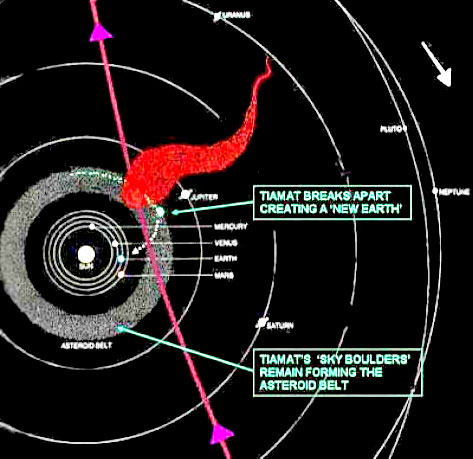
Sitchin’s book, The 12th Planet, published in 1976 was the first modern volume to begin to describe the Anunnaki, their arrival on Earth supposedly some 485,000 years ago, and from where they had come -- a planet called Nibiru. Sitchin believes Nibiru to be in an orbit about our sun, but in a strongly elliptical orbit which requires 3,600 Earth years to make a complete orbit. Nibiru’s perihelion (closest point of approach to the Sun) is thought to be within the main asteroid belt between Mars and Jupiter, at a distance from the Sun of approximately 2.75 A.U. (an A.U. being the distance from the Sun to the Earth). (the Annals of Earth include a detailed description of how Nibiru created the asteroid belt by destroying a planet, Tiamat, in roughly the same orbit, and which created the Earth in the aftermath, the Earth being a remnant of the greater, destroyed planet.)
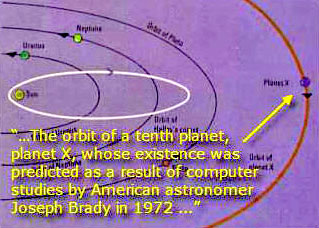
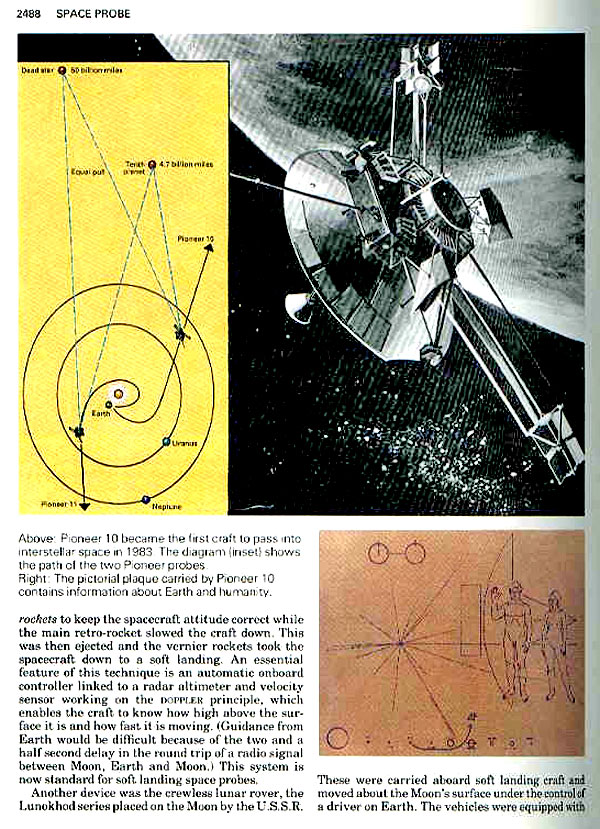
Nibiru is not known to modern astronomy primarily due to the extreme elliptical nature of its orbit and the fact its aphelion (furthest point in the planet’s orbit from the Sun) is more than eight times the distance from the Sun to the planet Pluto (the latter being some 40 A.U. away, and thus the former, some 320 A.U. distant). Furthermore, Nibiru may be now far out in deep space and unlikely to be detected. (Or close by, e.g. Planet X.)
While Sitchin and Gardner may disagree with the extent of the long lives of the Anunnaki, it is clear that these gods and goddesses, baring accidents or “Anunnaki-cide”, lived a very long time. It has also been theorized that because of their long lives, they do not quite move in “the fast lane” -- at least to the extent humans do.
This could be fundamentally important in that, quite possibly, the human life span, while enormously brief as compared to the Anunnaki gods and goddesses, might nevertheless be compensated by the humans possessing the ability to achieve a great deal in a relatively short time. The creativity of a shortened, and thus highly motivated lifespan is likely to be enormously greater than that of a god or semi-god resting on their laurels. This may also relate to the idea of why the gods and goddesses of the Anunnaki even bother with mankind. Humans may, on the one hand, act as workers to accomplish the Anunnaki’s agenda, but an accelerated creativity may be well worth the trouble for the Anunnaki to manage a crew as motley as the human race.
But the connection between humans and the Anunnaki is much more profound than that of masters and slaves. All the evidence strongly advocates the concept that Adam and Eve and their ancestors, cousins, and what-have-you were created by genetic engineering and mixing the DNA of Anunnaki with that of Homo erectus, the reigning progenitor of man at the time. Fundamentally, this was because the Anunnaki needed someone to work the mines in search of gold and other Precious Metals, and in all likelihood the ORME.
http://www.vibrani.com/Anunnaki.htm provides what just may be an insider view of the Anunnaki -- but from the perspective of Enki. The advantage of this link is that it provides extensive details on pre-Anunnaki history. While such channeled information is always speculative, it is nevertheless worthy of serious consideration.
(2/5/9) Another speculative source of possible implications is William James' website, Zero Point - Power of the gods in which he has provided a possible answer to the logical question of what was the Anunnaki's energy/power source. In effect he has linked physics and ancient history by means of "an adventure series which focuses on the unlimited potentials of Zero Point Energy and the ancient gods of civilizations long past." By means of supporting evidence, this combination of science and history effectively provides greater credibility to both. Additionally (and in many respects importantly, Mr. James' writings can also "stir the reader’s imagination to consider the possibilities of this fantastic energy source"... not to mention giving an intriguing insight into the practitioners of the energy source, the Anunnaki.
The most fundamental question with respect to the Anunnaki is whether or not they’re still on Earth! Sitchin [1] has pointed out that he never said they left (and there is no evidence that they did). There was, however, an apparently fundamental Anunnaki policy shift circa 600 B.C.E. wherein the overt, day-to-day interference in human affairs by the Anunnaki disappeared. There is also the scenario encapsulated in Richard Wagner's classic opera The Ring of the Nibelung, which included Night Falls on the Gods and the Entrance of the Gods Into Vahalla -- titles which are suggestive of possible changes in status of the Anunnaki. Finally, there is evidence to suggest that this state of affairs may be temporary, and may be scheduled to end with the end of the Mayan Calendar on or about 2012. A.D.
From mankind’s point of view, the dysfunctional nature of the Anunnaki family, and the continuing rivalry of Enki and Enlil, may still be ongoing and having enormous effects on the quality of our physical, emotional, mental and spiritual lives. It’s a very important question, and one that needs to be answered by each of us.
For Updates and more thoughts, visit the Halexandria Forums
Enki and Enlil Epic of Creation Genesis Sumerian
Forward to:
Sumerian Family Tree Epic of Gilgamesh Night Falls on the Gods
____________________________
References:
[1] Zecharia Sitchin, The 12th Planet, 1976, The Wars of Gods and Men, 1985, Genesis Revisited, 1990, Divine Encounters, 1995, Avon Books, New York.
[2] Laurence Gardner, Genesis of the Grail Kings, Bantam Press, New York, 1999.
[3] Bramley, William, The Gods of Eden, Avon Books, New York, 1989, 1990.
The Library of ialexandriah
 .org
.org
The Alternative History of the World Documentary 2018 The Shining Ones
If you are learning about the Anunnaki, two names you are going to hear a lot are Enki and Enlil. While there are a number of “central characters” in the myths and legends of the Anunnaki, much of the action revolves around these two sibling rivals.
In this article, I am going to give you a crash course in the mythology of Enki and Enlil. But this is a complex topic, and I do not want to jump into it without laying the initial groundwork. So here are the absolute basics, just in case you are brand new to learning about the Anunnaki.
When we talk about the Anunnaki, we are referring to the ancient gods of Mesopotamia. But depending on who you ask, the Anunnaki may also have been alien visitors from a planet called Nibiru which is in a long orbit around the sun.
Naturally the space alien theory doesn’t fly in the mainstream, but it was popularized by a Russian-born American author named Zecharia Sitchin. Since he presented his ideas to the world, they have become a recognizable fixture in popular culture.
I will be talking more about Sitchin and his ideas later, but first I want to get back to Sumerian mythology. I am going to introduce you to Enki and Enlil and their place in the Mesopotamian pantheon, and then I will tell you how they figure into the ancient flood legend. I will describe how they inspired other mythologies and religions, including Christianity.
The Sumerian Pantheon and Creation Myth
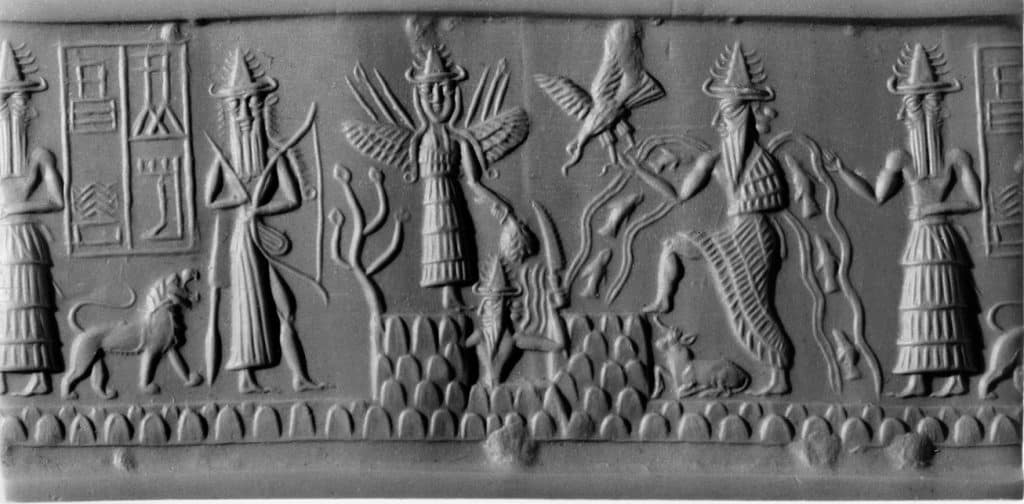
As with many other polytheistic religions, the Sumerian pantheon consists of a number of gods who are all related to one another.
It is easiest to describe the shape of this family tree by starting with Anu. Anu is also known as “An,” the Great Father of the Sky. He is the original supreme deity in the pantheon, lord of all the other gods. He loses this position as the Sumerian tale unfolds, passing it off to Enlil and then (in Babylonian lore) to Marduk.
You will notice that Anu is not the first god in the family tree.
His parents are two primordial gods, Anshar and Kishar. If you happen to be versed in Greek mythology, you can think of these primordial gods as being a little bit like the titans who preceded the ancient Greek gods. After the Greek gods overthrew the titans, the importance of the titans took a backseat to the significance of the gods (in general).
The same is true here—the primordial gods factor into the creation myth of the Sumerians, but are less important later on.
Returning to Anu, Anu’s two consorts are Antu, Great Mother of the Sky, and Ki, the Earth Mother. Both gave him children.
- Ki gave birth to Enlil, Lord of the Air and Earth, Guardian of the Tablet of Destinies (to start), and Nin-khursag, Lady of the Mountain.
- Antu’s child was Enki, Lord of the Earth and Waters, known also as “Ea.
The Lost Book of Enki - Introduction
Enki and Enlil Anunnaki Gods
Enki had been the first of the Anunnaki to hazard a trip to Earth to begin a mining operation for gold. When this effort did not apparently produce gold in sufficient quantities, Enlil was brought in, given command, and armed with a new plan an unparalleled concept of Jehovah being right when he was wrong, honest when he was dishonest, was born out of an inherent fear of his vengeful power and unbounded wrath. Wars of Gods and Men.
As you can see, Enlil and Enki are half-brothers. Following his birth, Enlil cleaved the earth from heaven. At this point, he and Ki took command of the earth, while Anu continued to reign in heaven.
What is the Tablet of Destinies?
Just now I mentioned Enlil as the “Guardian of the Tablet of Destinies.” This is a mythological object of supreme importance. It is quite literally supposed to be a clay tablet engraved with cuneiform. Whichever god possessed it was considered the ruler of the universe.
Note that “Tablet of Destinies” is the proper name for this object. People often get it wrong. You may see it incorrectly referred to as the “Tablets of Destiny.” It is a singular object. I have also seen it called the “Table of Destiny.” I have no idea what is up with that.
In any case, according to many texts, Enlil was in possession of the Tablet for a long time, which made him supreme ruler of the universe, surpassing even Anu. There is however a Sumerian poem titled “Ninurta and the Turtle” which mentions that Enki possessed the Tablet.
The Tablet changes hands a number of times, depending on the text you read. At one point, Tiamat, the Dragon Queen (look for her at the very top of the family tree), possesses it. She gives it to her consort Kingu, who becomes commander of her army. Marduk, Enki’s son, beats Tiamat in single combat, then defeats Kingu, claiming the Tablet and the authority for himself. At that point, Marduk becomes supreme ruler.
Just to complicate matters, this whole tale with Marduk only shows up in the Babylonian version of the myth. In the Sumerian version, Enlil beats Tiamat and reigns supreme.
Anunnaki Gods of Ancient Earth
Yes, I deliberately titled this section “Genesis of the Flood Myth”—not “The Flood Myth of Genesis.” If you have read anything about Anunnaki in the Bible, you likely knew I was going to get around to this. This is where a lot of the stories of the Anunnaki converge. And as you may also have guessed, Enki and Enlil are key players.
THE JUDEO-CHRISTIAN VERSION:
Many people are familiar with the flood myth in the Bible. This is the story of Noah’s Ark. The summary version is that Yahweh was getting fed up with the sins of humankind. More specifically, He was upset about the corruption of mankind by beings referred to as the “Nephilim.” Consider this passage from The Book of Jubilees, 7:21-25:
“21 For owing to these three things came the flood upon the earth, namely, owing to the fornication wherein the Watchers against the law of their ordinances went a whoring after the daughters of men, and took themselves wives of all which they chose: and they made the beginning of uncleanness.”
It is quite easy to equate the “Watchers” or “Nephilim” with the Anunnaki.
I urge you to read up on this topic in detail in my article “Who Were the Nephilim?” Basically, fallen angels brought science and technology to humanity, but did it to enslave and corrupt them. Interbreeding ensued, leading to a race of demigods.
Yahweh decided to wipe out everyone and start over.
So He told Noah to build a great Ark. Noah loaded up the Ark with two of every animal and put his own family onboard. The flood destroyed all animal and human life outside the Ark—as well as (presumably) the fallen angels and Nephilim. Noah’s family were able to repopulate the earth after they disembarked. God put a rainbow in the sky as a promise He would never judge the earth again with another flood.
The Sumerian Version:
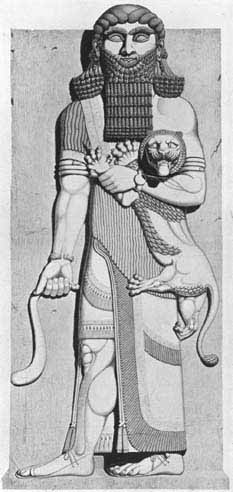 Gilgamesh: Palace of Sargon II, Khorsabad, 8th century BC Assyrian.
The Sumerian flood myth is older than the one in Genesis, which is why I asserted with my title that the Sumerian story is the genesis of the Bible flood myth. This belief is shared by many scholars. It is thought that a number of early ancient Hebrews were in fact inhabitants of Mesopotamia.
This would have enabled them to pick up on the Sumerian myths and legends and use them as a basis for their own religion.
There are a number of Sumerian texts which feature a great flood in one form or another. The earliest known example is in the Epic of Ziusudra. Others include the Epic of Atrahasis and the well-known Epic of Gilgamesh.
The Epic of Gilgamesh is the story which bears the strongest resemblance to the later Genesis version featured in the Bible. Interestingly enough, it doesn’t seem to have been originally included in the tablets; it was edited into Tablet XI later by someone who was inspired by the Epic of Atrahasis.
I will tell you more about Gilgamesh in a moment, but first I want to briefly talk about the Eridu Genesis.
The Eridu Genesis was discovered on a fragmentary tablet by historian Thorkild Jacobsen. This is how we learned the Sumerian creation myth which I have already shared in part with you.
Because the tablets are fragmentary, bits and pieces of the story are missing. In the beginning, we find that Anu, Enlil, Enki and Nin-khursag have created human beings.
Cities have been founded and life is flourishing.
There is then a missing section. Following that, we find out that a major destructive flood is on its way, and the pantheon has decided not to warn humanity or do anything to save them.
Enki decides he isn’t okay with this, so he warns a hero and tells him he should build an Ark. In the Eridu Genesis, this hero is Atra-hasis. In the better-known Epic of Gilgamesh, it is Utnapishtim.
Obviously the stories of Enlil and Enki are woven deeply into the fabric of Sumerian legends. These two played a role in numerous different aspects of the mythos. There are many ways that I could approach this discussion, but I have decided that the simplest way to organize the information would be to write a summary on each. While I could simply tell a detailed chronology of events, I personally find it easier to remember information when it is presented in relation to specific characters.
Enlil: Humanity’s Oppressor
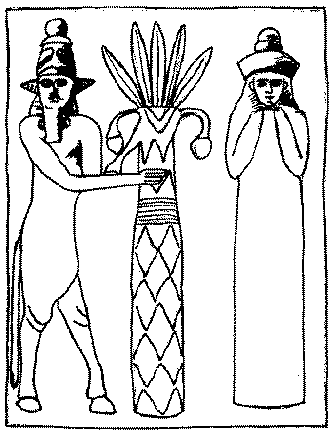
Enlil’s role in Sumerian mythology can be summed up with reference to humanity in one word: oppressor.
Enlil was actually the god who (according to the Atrahasis-Epos text) originally commissioned the creation of the human race.
You might think that would be a good thing, but the only reason he wanted human beings was so that he would have a race he could enslave to do his bidding.
In fact, this was itself a bid for power among the gods. In the Sumerian myth (not the Babylonian one, which involves Marduk, as discussed earlier), a number of the gods are on strike because they are tired of maintaining creation.
Enlil proposes that he will solve the issue of the strike if he is named supreme ruler of the gods. In this version of the story, it is he (not Marduk) who subdues Tiamat.
Later on, Enlil becomes tired of humanity’s “noise,” and as a result, decides to kill them all with the great flood. As the god of weather, this was easy for him to do.
This then brings us full circle back to the story of Utnapishtim from the Epic of Gilgamesh, who was saved by Enki and corresponds to Noah in the Judeo-Christian version of the myth.
Amusingly enough, Enlil eventually gets over his anger after the flood and decides to make Utnapishtim immortal.
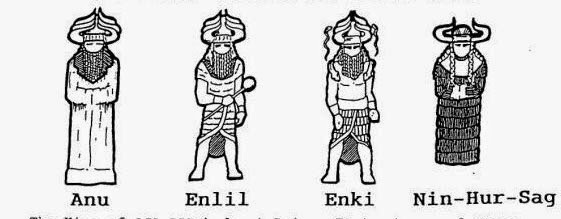
Enki: Humanity’s Champion
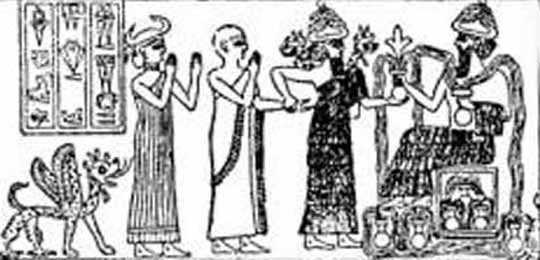
Enki stands with the Gods
Now let’s talk about Enki, Enlil’s half-brother. Enki’s role can be summed up as humanity’s creator and champion.
While Enlil is battling with Tiamat, Enki is missing the whole thing, because he is asleep. Thankfully, his mother Antu, also known as “Nammu,” is able to communicate with him. She says:
Oh my son, arise from thy bed, from thy (slumber), work what is wise, Fashion servants for the Gods, may they produce their (bread?).
Enki wakes up and suggests the creation of a slave race—humanity. Now, you might think this made it his idea, but in truth, it was Enlil’s. Enlil was the one who spoke to Nammu, who then suggested the idea to Enki.
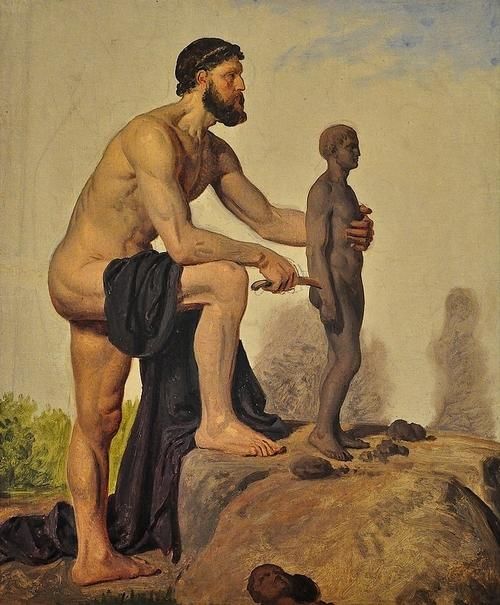
The Creation Of Man From Clay
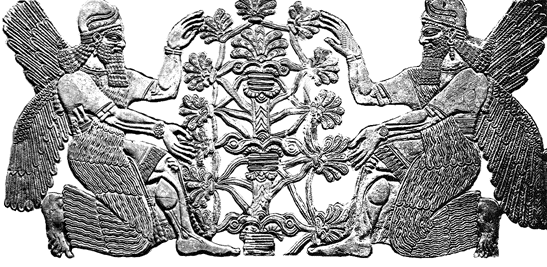
Enki himself creates human beings out of a mixture of clay and the blood of the slain god Kingu.
If you are knowledgeable about Greek mythology, this probably will ring a bell—Prometheus, the ancient titan, created humanity out of clay. The two function as very similar figures. Like Prometheus, Enki tends to stand up for the human race in conflict with the gods.
Coming back around to the flood story, Enki wasn’t too pleased when he discovered Enlil planned to wipe out the race he’d created.
So he took it upon himself to warn Utnapishtim. He told Utnapishtim to construct an Ark.
Like Noah, Utnapishtim was commanded to load the Ark up with animals. Together with his wife, he preserved life on earth when the flood was unleashed.
After the waters began to recede, he released the animals to repopulate the planet. As I mentioned previously, Enlil eventually got over his outrage and granted immortality to Utnapishtim and his wife.
The Extraterrestrial Version of the Flood Myth:
You now know the Sumerian and Judeo-Christian versions of the creation and flood myths.
The modern extraterrestrial version was popularized by author Zecharia Sitchin in volumes such as The Lost Book of Enki.
The idea is this: the Anunnaki weren’t gods, or weren’t just gods—they were alien visitors from outer space. You have probably heard Arthur C. Clarke’s famous quotation, “Any sufficiently advanced technology is indistinguishable from magic.” This is the underlying assumption in equating the Anunnaki with aliens.
If ancient humans encountered beings from another world, they would describe them in a language which made sense to them at the time. As they did not have the word “aliens,” they would simply go with “gods.”
There are numerous parallels and arguments which Sitchin and other Anunnaki alien theorists draw across the texts. There is no way to sum it all up here (I suggest checking out the rest of the articles on our site), but here are a few key pointers:
- The Anunnaki come from the planet Nibiru.
- They came to earth to mine gold, which they require to power their civilization. They created and enslaved humanity to do the hard work for them.
- All the familiar players from Sumerian mythology—Enlil, Enki, Anu, Marduk and the rest—were actually alien administrators.
- Nibiru is in a long orbit around the sun. The last time it came close to Earth, it upset the tides, causing the great flood.
- Eventually Nibiru will return, causing another cataclysm.
Those in the mainstream view Sitchin’s work with some disdain—but I would argue that it helps to view the extraterrestrial story as modern mythology. Think about it for a moment. Even the Sumerian and Babylonian texts conflict over whatever seed of truth may have inspired them. So yes, there are some inconsistencies involving Sitchin’s alien theory—but there are inconsistencies between the ancient texts as well.
So I want to wrap this up on the same note I usually come back to with our research. I hope that you now have a much stronger understanding of both Enki and Enlil and their roles in Sumerian mythology and the Anunnaki alien mythos. You also should have a pretty good idea how this all ties into Judeo-Christian lore.
But I really hope that your main takeaway is this: Every version of every story is interpretive. The truth behind the stories is unknown. By piecing together what we learn from a range of different mythologies—both ancient and modern—we can start to imagine what the completed puzzle might look like.
All of these pieces have value, and all have something to tell us about our collective journey as humankind. This is why it pays to keep an open mind!