
Carlos Castaneda: The Myth and the Man
From New Dawn 187 (Jul-Aug 2021)
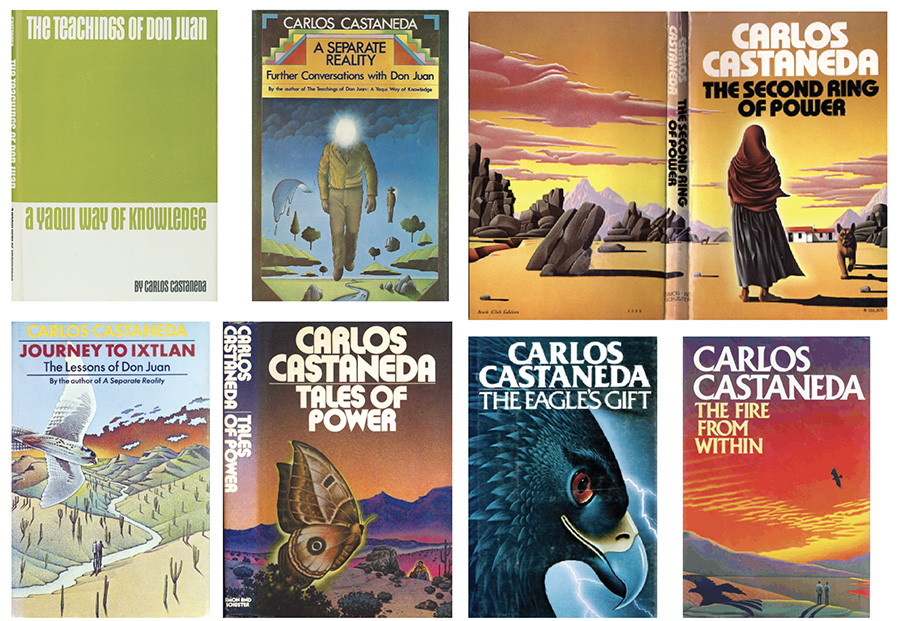
Carlos Castaneda burst onto the scene in the 1960s after rave reviews of his early books, The Teachings of Don Juan and A Separate Reality. This was during the early heyday of psychedelics and here was an anthropologist telling the world how to do it right – and by right, I mean using drugs to enter advanced states of consciousness while guided by his Native American teacher, don Juan Matus. Over the next couple decades, Castaneda went on to publish several best-sellers about an ancient lineage of shamans who originated in central Mexico.
During those years, Castaneda has been the subject of acclaim, almost to mythological proportions from adoring fans. He was also, and continues to be, the target of ruthless criticism among assertions that he was a fraud, that he made the whole darn story up, and delights in laughing at us all on the way to the bank.
In my view, he is neither deserving of being placed on a pedestal, which is contrary to shamanic teachings he espoused, nor of having people decry his work without accurate foundation. I rest my considerations on having implemented the teachings in his books and subsequently finding my own teacher, which it turned out was to be don Juan, himself. I also used Castaneda’s books as a primary reference to fully engage the path and crystalise don Juan’s instructions to me. In other words, I replicated Castaneda’s experiment.
I think Castaneda was a brilliant anthropologist. His books clearly paved the path for others to enact. But he shouldn’t be equated as having the knowledge of don Juan, as even with Castaneda’s extensive learning their worlds remained far apart. However, with his artful renditions of encountering a world seen and lived by only a few, it is easy to allow him a meritorious rise to stardom.
The Teachings
Don Juan hooked Castaneda into learning the craft by giving him an anthropologist’s dream, that of introducing him to a foreign cultures’ practices of using lizards as dreaming emissaries, visiting inorganic worlds, and learning the social machinations of shamans. But this didn’t speak to the main agenda of don Juan’s teachings: engaging Castaneda with his complete energy body, accelerating the development of consciousness, and doing so in a way that would move him away from ancient perspectives and into contemporary practices.
In the early stages of Castaneda’s apprenticeship, mind-altering substances – power plants – were integral to his learning shamanism. He initially thought they were the basis of don Juan’s teachings. However, he later realised that this thinking was erroneous. Castaneda came to understand that don Juan gave him several types of psychoactive plants to alter his awareness in order to gain experience.Without using them, don Juan thought that Castaneda was too slow to catch onto the teachings. But once Castaneda grasped the meaning behind their use, he stopped using them, noting that the most meaningful events and personal changes occurred when he was sober and clear-headed, and not from having ingested drugs.1 As a result of his research efforts, Castaneda was awarded a doctorate in anthropology from University of California, Los Angeles (UCLA).
An important consideration, Castaneda’s conversations with don Juan were in Spanish, so Castaneda translated them into English. Initially, he used the term “sorcery” for the philosophy, translating from don Juan’s use of the word “brujo” which has many connotations. Early in his apprenticeship, Castaneda also relegated the teachings to Yaqui culture. But don Juan regarded the teachings not to be associated with any culture and found both sorcery and Yaqui connections to be inadequate. In his later work, Castaneda settled on the terms “shaman” and “seer.”2-4
My Task
Carlos Castaneda - The Teachings of Don Juan (Abridged Version)
Castaneda’s task given to him by don Juan was to bring to light shamanic teachings, not by what he thought about them but in line with don Juan’s verbatim instructions and explanations. Don Juan later gave me the task of writing about Castaneda’s books. As part of my training with don Juan, I had to rely on Castaneda’s books for many of the details concerning shamanic practices. My apprenticeship was similar to yet different than Castaneda’s. While I have had many experiences that parallel his, our characters and temperaments are not well-matched. This resulted in contrasting methods of instruction by don Juan. For instance, Castaneda was with don Juan for extended periods; I was with him only for short visits. Don Juan fully explained his teachings to Castaneda; don Juan required that I obtain additional instruction from a wide variety of sources in order to expand and elaborate on his teachings to Castaneda.
The Great Debunking
Castaneda’s work was and continues to be controversial. People of high esteem claim that awarding Castaneda a doctorate was UCLA’s worst mistake ever. Everyone knows his books are fiction (really?… everyone?). Castaneda is a fraud, continued a litany of accusations. He never talked with me about it, so it must be false. Such shamans could not possibly exist. Their worldview is simply preposterous. You won’t find one anthropologist who doesn’t think Castaneda to be a clever con man. It’s a hoax. UCLA has revoked his PhD! On and on….
Debunking the Debunkers
I’ve found that much of the criticism is baseless, often riddled with errors. While I rely on my experience as evidence of Castaneda’s legitimacy, there are other factors. Hearing well-credentialed scientists decry Castaneda, stating that his PhD had been revoked, I wanted to verify the claim. A representative of the UCLA anthropology department told me that it wasn’t true, that Castaneda was viewed as any other PhD graduate and, oh, by the way, the anthropology department hears such erroneous claims and rumours all the time.5
It is noteworthy that jumping on the debunking bandwagon (any bandwagon) is a fallacy of logic, of good reasoning. People enjoying their bandwagon ride tend to studiously disregard corroborations of Castaneda’s work. A body of evidence supporting Castaneda’s efforts includes an assortment of books written by both academics and laypeople.6-15 But, hey, let’s not pay attention. Too messy to do so. Our worldview, and so the world itself, might crumble.
To balance things out, I’ve met academic notables who support Castaneda’s efforts, even saying that anthropology students would do well to verse themselves in Castaneda’s books because he demonstrated a high level of proficiency in conducting himself as an anthropologist in the field when dealing with don Juan and other shamans.16
It’s also important to assess the work of the debunkers. It is often the case that they commit the same mistakes of research methodology that they accuse Castaneda of committing. (Projection, plain and simple.) And they take to their bank the claims of their colleagues without critical evaluation, a dereliction of scientific duty. As a result, part of the arguments against Castaneda stands on compiling and continuing prior research errors. As don Juan maintained, the intent for most people is to shun information that doesn’t conform with their thoughts.17
An Emic Style
Another factor in addressing Castaneda’s legitimacy is understanding his style of anthropological investigation, which he stated was an emic approach, a classic but seldom used method.18 This is an accounting based on the point of view of a participant rather than an etic approach where the researcher is on the outside looking in. Etic practitioners often say that theirs is the more objective method whereas those in the emic camp say you really don’t know until you’ve been there yourself.
If we apply an emic standard, and so regard his research as originating from inside the shamanic tradition rather than the more common and seemingly detached observing and reporting, Castaneda’s books are entirely consistent with that body of teachings. His books may then be viewed as the culmination of a learning project where he was required to perform the teachings to achieve anthropological insight. In this light, his books represent having personally learned about and then reported on shamanism, a true representation of emic anthropology.
Wavefield Science
Controversies surrounding Castaneda are no different than those surrounding new scientific theories or pretty much any other advance in thinking and understanding. For example, modern quantum wavefield physics is also controversial as are and were many scientific discoveries. It often takes a couple generations for new views, especially those at a cosmological level, to take hold.19
It turns out that the emerging field of wavefield physics supports what shamans have known for centuries (with scientific publications occurring after Castaneda began publishing): the world is exclusively energy, physical objects only appear to be material due to a coherence of energy, other dimensions exist, and any point of view or method is an interpretation. Modern wavefield science deals exactly with the same central pillars of cosmology shamans have investigated. It is therefore accurate to say that the considerations of a new breed of wavefield researchers are now catching up to those of ancient shamans.20 Emerging wavefield theory stands to be key evidence in validating Castaneda’s work.
The Man
Aside from professional controversy, there was (and maybe still is) concerns that Castaneda had somehow slipped off the path don Juan helped him navigate only to entertain the dark side of life a bit too much. This line of thinking presents a host of problems, some of which I’ll address. First, though, darkness is a common element among mystics, shamans being one type. For example, old cycle shamans referred to the dark sea of awareness because its content was beyond their grasp, and so the unknown was dark, as in not yet grasped.
And then there’s the dark side of the old cycle that don Juan struggled to get Castaneda to turn away from, things like controlling others, seeking recognition, and succumbing to the unknown in a way that prevented more robust growth. In addition, given that he was a three-prong nagual (a certain type of energy body) subject to erratic behaviour and that he also had old cycle tendencies, a dimension of darkness was within him. Castaneda illuminated these personal foibles throughout his books, adding immeasurable insights to his writings.
It may be that Castaneda placed too much emphasis on achieving academic recognition. He may have not made the full shamanic cut in that he placed more emphasis on anthropology than on don Juan’s wisdom of trying to get him to avoid those types of pitfalls.
As portrayed in his books, Castaneda may also have fallen too much under the influence of those around him. At a given point, don Juan was out of the picture and Castaneda’s sense of membership hinged on those with whom he associated. As a result, once ardent followers lamented that his work had become darker than the higher-end shamanism of don Juan. This was something don Juan warned him about (another testament to the books and author) but he evidently struggled.
Furthermore, in his later years Castaneda suffered from terminal illness, something that can derail the best of us. He died on 27 April 1998, 72 years old, due to complications arising from liver cancer.21
Carlos Castaneda

Carlos Castaneda, born Carlos César Salvador Arana (December 25, 1925 – April 27, 1998), was a Peruvian-born author and anthropology graduate whose books described alleged initiations into Yaqui sorcery under a shaman named Don Juan Matus but were subsequently exposed as fabrications lacking verifiable empirical evidence.[1][2] Immigrating to the United States in 1951, Castaneda studied at the University of California, Los Angeles, where he obtained a PhD in 1973 based on his dissertation, an early version of his first book, The Teachings of Don Juan: A Yaqui Way of Knowledge (1968), initially accepted as ethnographic fieldwork despite methodological flaws.[1][3]The series, which expanded to over a dozen volumes detailing mystical practices, peyote rituals, and metaphysical concepts, achieved massive commercial success, selling millions of copies and shaping countercultural and New Age ideologies in the late 20th century, though without corroboration from independent anthropological sources or physical evidence of Don Juan's existence.[1][3] Academic critiques, including those by Richard de Mille, highlighted inconsistencies across Castaneda's narratives, plagiarized elements from other ethnographies, and chronological impossibilities, confirming the accounts as literary inventions rather than factual reportage.[4][3]Castaneda's fabricated persona extended to personal history, with self-reported birth details conflicting with immigration records, and he cultivated a reclusive guru status, founding the organization Cleargreen to promote "Tensegrity" exercises derived from his invented traditions, amassing followers until his death from liver cancer while evading scholarly accountability.[1][2] Despite the hoax's revelation eroding his academic standing, the enduring appeal of his works underscores vulnerabilities in anthropological validation processes during the psychedelic era, where experiential claims often supplanted rigorous causal verification.[3][1]
Early Life
Birth and Peruvian Background
Carlos Castaneda, born Carlos César Salvador Arana, entered the world on December 25, 1925, in Cajamarca, a highland city in northern Peru known for its colonial architecture and pre-Incan archaeological sites.[1] Peruvian immigration and birth records, corroborated by U.S. entry documents, confirm this date and location, contradicting earlier self-reported biographies that placed his birth in São Paulo, Brazil, in 1931.[5] [1]His father, César Nemécio Arana Burungaray (born 1892), worked as a goldsmith, reflecting a modest artisan heritage typical of provincial Peruvian families in the early 20th century.[6] Castaneda was born to unmarried parents, with his mother identified in some genealogical records as Luisa de Freitas-Valle, though details on her background remain sparse and unverified beyond family lineage claims.[1] [7]Little documented evidence exists of his childhood or adolescence in Cajamarca, a region marked by rural agrarian life and Quechua-influenced culture, but Peruvian civil records indicate he resided there until immigrating to the United States as an adult in 1951.[1] This Andean upbringing, amid economic constraints and traditional craftsmanship, contrasted sharply with the shamanic narratives he later authored, which drew scant direct connection to verifiable Peruvian indigenous practices from his locale.[5]
Immigration and Early Struggles in the U.S.
Castaneda immigrated to the United States in 1951, entering through San Francisco at the age of 25.[1] Records confirm his arrival from Peru, where he had been born Carlos César Salvador Arana Castaneda on December 25, 1925, though he later provided conflicting details about his birthplace, sometimes claiming São Paulo, Brazil.[2] As a young immigrant without established family ties or resources in the U.S., he navigated initial years marked by adaptation to a new cultural and economic environment, eventually relocating to Los Angeles in 1955.[1]In Los Angeles, Castaneda supported himself through part-time employment while pursuing education at Los Angeles City College, from which he earned an Associate of Arts degree in psychology in 1959.[1] Specific details of his jobs remain undocumented in available records, but such work was typical for immigrants balancing survival with studies amid limited opportunities. He became a naturalized U.S. citizen during this period, formalizing his status before advancing to higher education. These years preceded his enrollment in the University of California, Los Angeles (UCLA) anthropology program in the fall of 1959, reflecting a trajectory of incremental progress from entry-level adaptation to academic preparation.[2]Castaneda's early U.S. phase was characterized by personal secrecy, including habitual alterations to biographical details, as noted by contemporaries and later accounts.[2] No verified evidence points to acute financial destitution or dramatic hardships beyond the standard challenges faced by mid-20th-century Peruvian immigrants, such as language barriers and economic competition, though his reliance on part-time labor underscores modest circumstances. This foundation enabled his shift toward formal anthropological training, setting the stage for subsequent claims about fieldwork experiences.[1]
Academic Career
Undergraduate Studies
Castaneda immigrated to the United States in 1951 and initially attended Los Angeles City College, where he studied creative writing in 1956.[8] By fall 1959, he enrolled as an undergraduate in the anthropology department at the University of California, Los Angeles (UCLA).[1][7] His studies at UCLA included coursework in anthropology, with some early involvement in psychology.[9]He completed his Bachelor of Arts degree in anthropology in September 1962.[7][10] This period marked his transition from irregular academic pursuits to formal training in anthropological methods, laying groundwork for his later fieldwork claims.[8] Enrollment records indicate he attended on an intermittent basis during this time.[7]
Graduate Work and Thesis on Don Juan
Castaneda enrolled in the graduate program in anthropology at the University of California, Los Angeles (UCLA) after receiving his B.A. in the same field in September 1962.[7] His research centered on Yaqui shamanism, drawing from claimed fieldwork in Sonora, Mexico, involving interactions with an alleged Yaqui Indian sorcerer named Don Juan Matus beginning around 1960.[11]The product of this graduate work was his master's thesis, The Teachings of Don Juan: A Yaqui Way of Knowledge, submitted to UCLA and published by the University of California Press in 1968 as a scholarly ethnographic text.[12][2] The 196-page volume presented annotated field notes, dialogues, and descriptions of rituals, including the use of peyote as a hallucinogenic aid to perception, framed within anthropological analysis of indigenous knowledge systems.[1] It was reviewed positively in academic circles initially, contributing to Castaneda's completion of the master's degree, though the department's acceptance reflected the era's openness to experiential ethnography amid growing interest in altered states of consciousness.[3]Despite its academic imprimatur, the thesis faced scrutiny from anthropologists for lacking verifiable evidence of Don Juan's existence or the described practices, with critics like Richard de Mille later arguing in 1976 that inconsistencies in timelines, geography, and Yaqui cultural details indicated fabrication rather than genuine fieldwork.[1] UCLA's Anthropology Department, however, did not revoke the degree, and the work propelled Castaneda's career, aligning with a permissive academic environment in the late 1960s where subjective narratives sometimes supplanted strict empiricism in cultural studies.[8] This episode highlights tensions in anthropological methodology, where claims of insider apprenticeship were debated against demands for falsifiable data, yet the thesis's publication by a university press lent it institutional credibility at the time.[13]
Claimed Encounters with Don Juan Matus
Initial Meeting and Alleged Fieldwork (1960-1965)
In the summer of 1960, Carlos Castaneda, then an anthropology undergraduate at the University of California, Los Angeles (UCLA), claimed to have first met Don Juan Matus, a purported Yaqui shaman from Sonora, Mexico, in a border town in the American Southwest, specifically near Nogales, Arizona. According to Castaneda's account in his 1968 book The Teachings of Don Juan: A Yaqui Way of Knowledge, the encounter occurred while he was collecting data on medicinal plants, including peyote, for a field archaeology methods class taught by Professor Clement Meighan; a friend introduced him to Don Juan as an expert on peyote, leading to an initial silent and reserved interaction at a bus depot.[14][8][15]
Carlos Castaneda - A Separate Reality (Abridged Version)
Castaneda asserted that this meeting initiated sporadic visits and discussions, with formal teachings commencing on June 23, 1961, in Arizona, after Don Juan tested his commitment by instructing him to locate a specific "spot of power" on the shaman's porch. Over the subsequent years, Castaneda described conducting alleged fieldwork in the Arizona-Sonora desert, involving repeated trips to Don Juan's home for instruction on shamanic practices, including the use of hallucinogenic plants such as peyote (referred to as Mescalito) and Datura. These encounters purportedly spanned until at least September 30, 1965, the date of the last recorded teaching session in his notes, which formed the basis for his UCLA master's thesis submitted in 1967 and published in 1968.[14][14]However, the veracity of these claims has been widely contested by anthropologists and scholars, who point to a lack of independent corroboration for Don Juan's existence and inconsistencies in Castaneda's timelines and descriptions. Critics such as Robert Fikes argue that Don Juan is a fictional construct, noting the absence of historical peyote rituals among Yaqui people in Sonora and Arizona, which undermines the ethnographic foundation of the fieldwork. Richard de Mille highlighted textual contradictions, such as conflicting locations for events, suggesting fabrication rather than genuine apprenticeship. Weston La Barre dismissed the accounts as pseudo-ethnography offering no novel insights into peyotism, attributing Castaneda's success to literary invention amid 1960s psychedelic enthusiasm rather than rigorous anthropology.[1][1][1]
Descriptions of Teachings and Peyote Experiences
Castaneda described Don Juan Matus, a purported Yaqui shaman, as teaching that peyote (Lophophora williamsii) contained Mescalito, a personified spirit entity residing in all peyote plants and serving as a selective teacher for those seeking alliance.[14] According to these accounts, Mescalito appeared during ingestion ceremonies to impart moral lessons or warnings, often in humanoid or animal forms, and rejected unworthy participants by inducing fear or illness rather than revelation.[16] Don Juan emphasized peyote's role in fostering "non-ordinary reality," where rational thought dissolved to allow direct apprehension of the world's underlying forces, contrasting this with "ordinary reality" bound by perceptual habits.[17]In detailed narratives of his peyote experiences from 1960 onward, Castaneda reported consuming dried peyote buttons in group settings supervised by Don Juan, leading to physical symptoms such as nausea, convulsions, and a sense of suffocation, followed by vivid hallucinations.[16] One early session involved perceiving a glowing black dog as Mescalito's manifestation, with which he interacted playfully before receiving admonitions about personal flaws like arrogance.[16] Subsequent ingestions allegedly produced encounters with luminous entities, spatial distortions, and teachings on "power plants" that enabled "stopping the world"—a perceptual halt enabling sorceric awareness—though Castaneda noted Mescalito's lessons often critiqued his intellectual skepticism rather than endorsing abstract philosophy.[14]Broader teachings intertwined with these experiences portrayed knowledge acquisition as a battle against four "enemies": fear (initial barrier to the unknown), clarity (hubris from partial insight), power (corrupting influence), and old age (inevitable decline).[3] Don Juan instructed that peyote facilitated alliance with allies—spirit forces accessed via plants—but required humility and physical prowess, warning of madness or death for the unprepared.[14] These descriptions framed shamanism as pragmatic sorcery, prioritizing experiential transformation over cultural ritual, with peyote as a gateway to perceiving the "tonal" (ordered world) versus the chaotic "nagual."[17]Anthropological analysis has questioned the authenticity of these peyote-centric teachings, observing that Yaqui traditions in Sonora and Arizona lack historical peyote use, which aligns more with Huichol or Native American Church practices; this suggests Castaneda's accounts incorporated syncretic elements beyond verifiable Yaqui shamanism.[1][3]
Authorship and Publications
Breakthrough Books and Commercial Success (1968-1970s)
Castaneda's debut book, The Teachings of Don Juan: A Yaqui Way of Knowledge, was published on May 23, 1968, by the University of California Press as an expanded version of his 1968 master's thesis in anthropology.[18] Presented as a nonfiction account of ethnographic fieldwork among Yaqui Indians, it described purported initiations into shamanic knowledge through peyote rituals and philosophical dialogues with a figure named Don Juan Matus.[18] Though initially received as an academic contribution to studies of indigenous psychotropic practices, the book's vivid narratives aligned with the era's psychedelic counterculture, propelling it beyond scholarly circles.[7]Building on this foundation, Castaneda released A Separate Reality: Further Conversations with Don Juan on February 22, 1971, via Simon & Schuster, which shifted his publishing toward mass-market appeal.[19] This sequel elaborated on themes of non-ordinary reality and power plants, followed by Journey to Ixtlan: The Lessons of Don Juan in 1972, recast from earlier dissertation material to emphasize existential "stopping the world" techniques over drug-induced visions.[20] Journey to Ixtlan achieved national bestseller status in hardcover, while reprints of The Teachings of Don Juan reportedly sold 16,000 copies weekly, generating substantial royalties that made Castaneda a millionaire.[20]The momentum continued with Tales of Power in December 1974, chronicling advanced sorcery apprenticeships and metaphysical battles.[21] By the mid-1970s, these volumes had collectively sold millions, translated into multiple languages, and cemented Castaneda's role in popularizing shamanistic mysticism amid rising interest in Eastern and indigenous spiritualities.[19] Their commercial dominance reflected a cultural appetite for experiential transcendence, though academic scrutiny of factual inconsistencies began emerging by decade's end.[20]
Later Volumes and Narrative Inconsistencies (1980s-1990s)
Castaneda published The Eagle's Gift in 1981, recounting alleged journeys with female apprentices to ancient Toltec sites in Mexico, where they encountered spectral figures from Don Juan's lineage, including interactions with "the Eagle" as a cosmic force.[1] This volume introduced expanded mythological elements, such as parallel worlds and nagual transformations, diverging from the earlier focus on individual fieldwork with Don Juan. Subsequent works included The Fire from Within (1984), detailing esoteric knowledge from Don Genaro on intent and assembly points of perception; The Power of Silence (1987), emphasizing warrior discipline and the avoidance of verbal traps; The Art of Dreaming (1993), outlining techniques for lucid dreaming and navigating dream realms as pathways to power; and The Wheel of Time: The Shamans of Ancient Mexico, Their Thoughts About Life, Death and the Universe (1998, originally published by LA Eidolona Press with ISBN 9780966411607; paperback edition published by Washington Square Press (Simon & Schuster) on January 1, 2001 with ISBN 9780743412803), a compilation of excerpts from his earlier books accompanied by commentary.[1][22] These later texts increasingly portrayed a collective sorcery tradition involving multiple initiates, rather than the solitary mentorship of the initial volumes.[4]Critics, notably Richard de Mille in his 1980 compilation The Don Juan Papers, highlighted narrative discrepancies that undermined the accounts' veracity, such as incompatible timelines for events like Castaneda's alleged rabbit hunts contradicting claims of vegetarianism under Don Juan's guidance.[1] De Mille documented over 100 internal contradictions across the series, including plagiarized motifs from non-Yaqui sources like Carlos Arana's writings and Western philosophy, suggesting fabrication over empirical ethnography.[23] For instance, early books positioned hallucinogens like peyote as central to enlightenment, yet later volumes retroactively diminished them as mere "crutches for beginners," implying Don Juan's initial teachings were provisional or misleading—an inconsistency de Mille attributed to evolving narrative needs post-critique.[24]These inconsistencies extended to core elements like Don Juan's departure: described in 1974's Tales of Power as a physical leap into a canyon, but reframed in subsequent works as an "immaculate death" or continued ethereal influence, allowing posthumous appearances that clashed with prior finality.[12] The introduction of unnamed female "warriors" in 1977's The Second Ring of Power and their prominence in 1980s volumes conflicted with earlier depictions of isolated male mentorship, with no corroborating anthropological evidence for such a structured Yaqui-Toltec sorcery cadre.[4] De Mille's forensic analysis, drawing on lost field notes and verifiable impossibilities (e.g., geographic and chronological mismatches), argued the series comprised allegorical fiction masquerading as nonfiction, a view reinforced by academic dismissals noting the absence of testable predictions or replicable experiences.[23] Castaneda offered no direct rebuttals, maintaining silence on scholarly challenges while sales persisted among enthusiasts, though anthropological consensus treated the later narratives as inventive mythology rather than factual reportage.[24]
Tensegrity and Organizational Ventures
Formulation of Magical Passes
In the early 1990s, Carlos Castaneda publicly introduced "magical passes," a series of physical movements purportedly derived from the shamanic practices taught to him by Don Juan Matus, as part of a system he termed Tensegrity—a neologism borrowed from architect R. Buckminster Fuller's concept of tensional integrity in structural engineering.[25] These passes were described by Castaneda as deliberate, stylized motions designed to redistribute and accumulate "energy" within the body, drawing from ancient Toltec traditions that he claimed spanned 27 generations over millennia.[26] The first Tensegrity workshops occurred in 1993, marking Castaneda's reemergence after a decade of seclusion, with initial sessions held at the Rim Institute in Arizona and attended by small groups of participants.[26] [9]Castaneda formulated the passes for systematic teaching by selecting and adapting movements he asserted were originally used by Mesoamerican shamans in states of heightened awareness, such as during hunting or dreaming, to maintain vitality and counter physical decline.[26] He emphasized their role in "intent," a core concept in his writings, where practitioners allegedly align bodily energy fields to achieve perceptual shifts akin to those in his earlier peyote-influenced narratives.[27] Critics, however, have noted parallels to martial arts forms, particularly kung fu, which Castaneda studied intensively from 1974 to 1989 under instructor Howard Lee, suggesting the passes may represent a repackaged synthesis rather than unadulterated shamanic transmission.[26] Workshops expanded in the mid-1990s, evolving from informal demonstrations to structured series focusing on themes like energy circulation and recapitulation of personal history.In 1995, Castaneda co-founded Cleargreen Incorporated with associates Carol Tiggs, Florinda Donner-Grau, and Taisha Abelar to formalize and commercialize Tensegrity instruction, sponsoring international seminars, videos, and practitioner certifications that disseminated the passes globally.[28] [9] This organizational structure enabled the passes' formulation into accessible modules, with over 200 events held by the late 1990s across the United States, Europe, and Latin America.[28] The 1998 publication of Magical Passes: The Practical Wisdom of the Shamans of Ancient Mexico provided the most detailed codification, outlining 12 principal series of movements—such as the "Series for Freeing the Energy Body" and "Intent Movements"—accompanied by over 450 computer-generated illustrations and explanations of their energetic mechanics.[29] Castaneda maintained that these represented a curated subset from thousands known to the shamanic lineage, prioritized for modern practitioners to combat "energy leaks" from sedentary lifestyles.[30] Despite claims of empirical efficacy in enhancing awareness, independent verification remains absent, with anecdotal reports from workshops forming the primary evidence.[26]
Cleargreen Incorporation and Workshops
Cleargreen Incorporated was founded in 1995 by Carlos Castaneda alongside his associates Carol Tiggs, Florinda Donner-Grau, and Taisha Abelar, with the explicit aim of promoting and teaching Tensegrity—a system of physical movements purportedly derived from the shamanic practices described in Castaneda's writings.[28][31] The organization positioned Tensegrity as a modern adaptation of ancient Toltec exercises intended to enhance personal energy and awareness, distinct from traditional yoga or martial arts by emphasizing intent and perceptual shifts.[28]Workshops organized by Cleargreen focused on instructing participants in "magical passes," sequences of movements claimed to recapitulate energy flows and combat physical stagnation, often conducted in multi-day immersive formats.[32] These events drew attendees seeking practical applications of Castaneda's teachings, with sessions incorporating lectures on concepts like inner silence and dreaming alongside guided practice.[33] By the late 1990s, Cleargreen had hosted workshops in multiple countries, including the United States, Mexico, and parts of Europe, amassing over 200 events globally by the early 2000s.[28] Attendance reportedly reached thousands at peak seminars, facilitated through structured programs that blended demonstration, repetition, and group dynamics.[23]Post-1998, following Castaneda's death, Cleargreen persisted under the stewardship of Tiggs and other surviving associates, evolving workshops to include online formats and themed series such as conflict resolution through Tensegrity practices.[33] The corporation maintained its focus on commercialization via certification programs and event fees, though participant testimonials and official materials emphasize empirical self-reported benefits in vitality and focus, without independent clinical validation.[32]
Personal Relationships
Multiple Marriages and Living Arrangements
Castaneda married Margaret Runyan, a fellow student he met at Los Angeles City College in 1955, in Tijuana, Mexico, on January 27, 1960.[34] The couple cohabited for approximately six months before separating, as Castaneda began extended absences for purported fieldwork.[34] Runyan gave birth to a son, C.J., in 1961, with Castaneda listed as the father on the birth certificate, though he provided minimal involvement thereafter.[35] No other legal marriages are documented in available records, despite claims in Runyan's 1996 memoir of a union lasting until 1973; the brevity of their cohabitation and Castaneda's later obfuscation of personal details cast doubt on extended formal ties.[36][34]From the 1970s onward, Castaneda maintained communal living arrangements in multiple apartments in Westwood, Los Angeles, with a select group of female associates who functioned as devoted companions and apprentices.[37] Key figures included Carol Tiggs (Patty Duffy), Florinda Donner-Grau (Regina Thal), and Taisha Abelar (Maryann Simko), who adopted these pseudonyms to align with Castaneda's narrative of Yaqui sorcery and severed external family contacts.[38][37] These women, often termed "witches" or "chacmools" in group lore—drawing from Mesoamerican terminology for ritual figures—shared households characterized by strict discipline, including bans on heterosexual relationships outside the circle and collective adherence to Castaneda's Tensegrity practices.[38][23]The dynamics resembled a hierarchical family unit, with Castaneda at the center exerting control over daily routines, finances, and personal identities; followers contributed to Cleargreen Incorporated, the entity formed in 1995 to promote his teachings, while living platonically yet intimately bound to his worldview.[37][38] By the 1990s, the group expanded to include additional women like Dee Ann, who resided in adjacent units and participated in workshops, though men were excluded from the inner core.[23] These arrangements persisted until Castaneda's death in 1998, after which several associates, including Donner-Grau, Abelar, Tiggs, and others, vanished amid reports of psychological strain and possible suicides, underscoring the insular and demanding nature of the communal setup.[38][37]
Recruitment and Control of Female Associates
Castaneda began recruiting women into his inner circle in the early 1970s while serving as an adjunct lecturer at the University of California, Los Angeles, targeting intelligent and vulnerable individuals drawn to his lectures on shamanism and Yaqui mysticism.[39] Among the earliest were Regine Margarita Thal, Maryann Simko, and Kathleen "Chickie" Pohlman, whom he met through academic channels and persuaded to join his communal living arrangement in a Westwood compound starting in 1973.[39] [38] Later recruits, such as Dee Ann Ahlvers in the mid-1980s, were attracted via his published works and Tensegrity workshops, relocating to Los Angeles under promises of spiritual transformation and "erasing personal history" to achieve enlightenment.[38] [37]These women, often referred to by Castaneda and his group as "chacmools" or "witches," were subjected to strict control mechanisms rooted in his purported teachings from Don Juan Matus, including mandatory isolation from family and prior social networks to prevent external influences.[39] [38] Recruits adopted new identities with Yaqui-inspired names—such as Thal becoming Florinda Donner-Grau, Simko becoming Taisha Abelar, Pohlman becoming Carol Tiggs, Ahlvers becoming Kylie Lundahl, and Amalia Marquez becoming Talia Bey—while destroying personal photographs and documents to symbolically sever past lives.[39] [37] The group enforced uniformity in appearance, mandating short, dyed-blond haircuts, rigid diets, and communal routines in the Pandora Avenue compound, where television and outside media were prohibited.[39] [38]Sexual relationships formed a core element of recruitment and retention, with initiates expected to engage intimately with Castaneda as a demonstration of loyalty and energetic alignment, fostering emotional and financial dependence.[39] [37] He positioned himself as the "nagual," an infallible spiritual leader whose authority justified hierarchical dominance, psychological manipulation through mind games, and pitting women against one another to maintain division and obedience.[37] Reproduction was forbidden; pregnancies were terminated to avoid distractions from the path, and dissenters faced expulsion or threats of energetic harm derived from shamanic lore.[39] Inner circle members contributed unpaid labor to Cleargreen Incorporated, Castaneda's Tensegrity enterprise founded in 1995, while living monastically and avoiding public scrutiny.[38]The depth of this control persisted beyond Castaneda's death on April 27, 1998, when five key associates—Donner-Grau, Abelar, Lundahl, Bey, and Patricia Partin (Nuri Alexander)—vanished from the compound days later, severing all traceable ties in a manner consistent with ingrained doctrines of noble departure and suicide as transcendence.[39] [37] Partin's remains were discovered in Death Valley in 2003, identified via DNA in 2006, with evidence suggesting self-inflicted death; the others remain missing, underscoring the enduring psychological hold of the group's isolationist practices.[39] [37]
Final Years and Death
Health Decline and Hepatocellular Carcinoma
In the summer of 1997, Castaneda was diagnosed with liver cancer, specifically hepatocellular carcinoma, a malignancy originating in the liver cells often linked to chronic liver damage or toxins.[39][40] His condition deteriorated over the subsequent months, with his attorney and estate executor, Deborah Drooz, later stating he had been ill for approximately 10 to 12 months prior to his death.[12] Despite the severity of hepatocellular carcinoma, which typically progresses rapidly in advanced stages and carries a poor prognosis without intervention, Castaneda maintained secrecy about his illness, consistent with his teachings that "sorcerers" should not succumb to sickness or appear vulnerable.[39]Castaneda's health decline was concealed from his inner circle and followers, many of whom adhered to his philosophy emphasizing physical vitality through practices like Tensegrity exercises.[38] He continued public-facing activities, including workshops, while privately managing symptoms, reportedly signing his will just days before his passing.[41] This opacity extended to his medical care; no records indicate aggressive treatments like chemotherapy or surgery, which might have been pursued given the disease's etiology potentially tied to long-term exposure to hallucinogens such as peyote or datura described in his works.[2]On April 27, 1998, Castaneda died at his home in Westwood, Los Angeles, at an estimated age of 72, from complications of the untreated hepatocellular carcinoma.[42][2] The death was not publicly announced until nearly two months later, on June 19, 1998, via statements from Drooz, with no funeral or memorial service held; his body was cremated shortly thereafter.[43] This delay and minimal disclosure fueled speculation among observers, underscoring the insular dynamics of his group, where his mortality contradicted the narrative of transcendent mastery he promoted.[44]
Post-Death Events Involving Followers
Following Castaneda's death from hepatocellular carcinoma on April 27, 1998, the announcement was withheld until June 19, 1998, by his estate executor, entertainment lawyer Deborah Drooz.[2] In the days and weeks immediately after, five of his closest female associates—Regine Thal (pen name Florinda Donner), Maryann Simko (pen name Taisha Abelar), Dee Ann Ahlvers (pen name Kylie Lundahl), Amalia Marquez (pen name Talia Bey), and Patricia Partin (pen name Nuri Alexander)—vanished without trace from Los Angeles.[37][39] These women, referred to internally as "chacmools" or "witches," had lived communally with Castaneda, adopted new identities, severed family ties, and managed aspects of his Tensegrity operations.[38][39]Partin's skeletal remains were discovered in 2003 at Panamint Dunes in Death Valley National Park, alongside her red Ford Escort, a pink jogging suit, and a rusted pocketknife; DNA confirmation identified her in 2004, with the cause of death undetermined but consistent with exposure or dehydration in the remote desert location.[37][38] The other four remain missing, with no bodies recovered and no official death records filed in Los Angeles County as of 2024; families reported the disappearances to authorities, but investigations yielded no leads.[38] Former associates, including author Amy Wallace, cited the women's prior discussions of firearms, pills, and a collective "departure" to join Castaneda in another realm, aligning with his teachings on intentional death as a path to transcendence or "jumping into the abyss."[38][39] These accounts suggest a possible suicide pact, though unproven by forensic evidence beyond Partin's case.[39][37]Cleargreen Incorporated, the entity Castaneda founded in 1995 to promote Tensegrity workshops and materials, persisted under surviving associates like Carol Tiggs (Kathy Pohlman) and Tensegrity instructors, continuing seminars attended by thousands and managing his intellectual property, which generated revenue from book sales exceeding eight million copies by 1998.[41][39] Regarding the missing women, Cleargreen issued evasive statements claiming they had not "departed" but chosen to withdraw from public view to allow "this dream to take wings," framing their absence as a mystical reconnaissance or voluntary dispersal rather than tragedy.[39][23] The organization provided no assistance to inquiring families and rebuffed law enforcement inquiries, such as a 1998 report of Partin's abandoned vehicle.[38]Legal disputes erupted over Castaneda's estate, valued at over $1 million, with his acknowledged son, Carl, alleging in probate court that followers held his father as a "virtual prisoner" in his final months, isolating him and questioning the validity of a trust naming the chacmools as beneficiaries.[41][38] Marquez's family renewed search efforts in 2014, prompting a missing persons file, but Cleargreen sold the group's Westwood compound in 2009 without disclosing details.[37] As of 2024, Cleargreen maintains an active website promoting Tensegrity, with no updates on the unresolved cases.[37]
Core Controversies
Evidence Against Don Juan's Existence
Critics of Carlos Castaneda's works, particularly Richard de Mille in his 1976 book Castaneda's Journey: The Power and the Allegory, compiled extensive textual analysis revealing internal contradictions in the Don Juan narratives, such as shifting descriptions of the shaman's personality—from a terrifying figure in early books to a more benevolent mentor later—and chronological impossibilities, like events spanning multiple years that conflicted with Castaneda's documented academic schedule at UCLA.[45] De Mille further demonstrated that key passages describing peyote rituals and shamanic practices were plagiarized or closely paraphrased from established anthropological texts, including Weston La Barre's The Peyote Cult (1938) and Frank Waters' Book of the Hopi (1963), suggesting the stories were synthesized rather than derived from fieldwork encounters.[4]Castaneda provided no empirical corroboration for Don Juan's existence, including photographs, audio recordings, field notes, or testimonies from independent witnesses, despite claiming years of apprenticeship beginning in 1960 near the U.S.-Mexico border.[38] Investigations by skeptics and journalists in the 1970s, including attempts to locate the supposed Yaqui shaman in Sonora, Mexico, yielded no traces of a figure matching Don Juan's profile—an elderly, unmarried Yaqui-Yuma brujo knowledgeable in sorcery—among tribal communities or historical records.[46] Yaqui cultural practices depicted, such as heavy reliance on peyote (a sacrament more central to Huichol or Native American Church traditions than Yaqui), deviated from ethnographic accounts, with no Yaqui elders or anthropologists reporting similar figures or teachings during the period Castaneda described.[47]De Mille's 1980 follow-up, The Don Juan Papers, incorporated contributions from over 30 scholars who highlighted additional anomalies, such as the improbability of Don Juan's "immaculate death" in 1973 (evading all witnesses) and the absence of any ripple effects in Yaqui society from the purported transmission of ancient Toltec knowledge.[48] These analyses culminated in the consensus among critics that the lack of verifiable evidence, combined with demonstrable fabrication techniques, rendered Don Juan's historicity untenable, positioning the books as a sophisticated literary hoax rather than anthropological reportage.[45][47]This view persists in modern online collections, such as the Ted K Archive, which hosts a digital edition of The Teachings of Don Juan, noting that it is "now widely considered a work of fiction," and also includes Geoffrey Gray's article "The Case of the Missing Chacmools," which describes Castaneda's Don Juan stories as a hoax and literary invention, his persona as fraudulent, and concludes he was a "literary fraudster" and "creep" rather than a reliable source on shamanism. Notably, no direct commentary from Ted Kaczynski on Castaneda appears in the archive.[49][50]
Anthropological Fraud and Ethical Lapses
Castaneda's doctoral dissertation at UCLA, published as The Teachings of Don Juan: A Yaqui Way of Knowledge in 1968, was accepted as a legitimate ethnographic study despite lacking verifiable field notes, photographs, or independent corroboration of the central figure, the purported Yaqui shaman Don Juan Matus. The UCLA anthropology department awarded him a PhD in 1970, even as some faculty expressed reservations about the absence of empirical evidence supporting the claimed apprenticeship and rituals involving peyote and datura. Subsequent scrutiny revealed that descriptions of Yaqui practices in the work deviated significantly from established anthropological records of Sonora's indigenous groups, with no incorporation of Yaqui-specific vocabulary or cultural terms to authenticate the encounters.[38][51][3]Investigative analyses, particularly by Richard de Mille in Castaneda's Journey (1976) and The Don Juan Papers (1980), demonstrated through textual comparisons that Castaneda fabricated key events by borrowing and altering narratives from prior anthropological texts, such as Victor Turner's work on rituals and Weston La Barre's studies on peyotism, without attribution. De Mille identified over 20 instances of inconsistencies, including impossible timelines for Castaneda's alleged field trips and contradictions in Don Juan's biography across volumes, concluding the accounts constituted a "playful fraud" rather than genuine fieldwork. Yaqui representatives and other indigenous scholars further contested the portrayal, noting that the depicted shamanic behaviors and power objects had no basis in verifiable Yaqui traditions, undermining the work's claim to anthropological validity.[4][52][51]These revelations highlighted ethical breaches in Castaneda's adherence to anthropological standards, which demand transparency, replicability, and fidelity to observed data rather than invention for narrative effect. By presenting fictionalized experiences as empirical research, Castaneda misled peers and the public, contributing to a broader erosion of trust in ethnographic methods during the era's psychedelic enthusiasm, where academic rigor sometimes yielded to cultural fascination. UCLA declined to revoke the PhD in 1978, with committee chair Walter Goldschmidt stating there was "no information whatever that would support the claims," yet affirming the degree's original conferral without retroactive invalidation. Critics argued this reflected institutional reluctance to admit oversight rather than vindication, as the fraud's exposure invalidated the dissertation's foundational premises.[8][1][24]
Cult-Like Dynamics and Follower Exploitation
Castaneda cultivated a hierarchical inner circle of devoted followers, predominantly women known as "the witches" or chacmools, who resided in communal compounds in Los Angeles and enforced rigid discipline among participants.[39] These women, including Florinda Donner-Grau, Taisha Abelar, and others who adopted pseudonyms such as Kylie Lundahl (formerly Dee Ann Ahlvers), were required to abandon family connections, destroy personal photographs, and undergo uniform haircuts and ritualistic baths to symbolize detachment from ordinary reality.[38] Control mechanisms emphasized psychological isolation, with prohibitions on drugs, caffeine, and external relationships, alongside mandatory adherence to "impeccable" behavior derived from Castaneda's teachings on Yaqui shamanism.[39]Exploitation manifested in followers' unpaid labor for Cleargreen Incorporated, the entity Castaneda established in the early 1990s to commercialize Tensegrity—a system of purported magical movements adapted from his writings.[39] Group members organized and instructed workshops attended by thousands worldwide, generating revenue through fees, merchandise sales, and related publications, while forgoing personal careers and financial independence.[38] Castaneda's books, which sold over 10 million copies by the late 1990s, further enriched the collective, yet followers reported cycles of emotional manipulation, including sudden banishments for minor infractions like consuming prohibited items, fostering dependency on his approval.[39]Sexual dynamics reinforced subordination, with multiple women entering polygamous arrangements with Castaneda; initiation often involved coerced group encounters or personal submission framed as pathways to enlightenment.[38] Former associate Amy Wallace detailed in her 2003 memoir how such practices, combined with teachings glorifying suicide as an honorable "crossing" for the adept, eroded autonomy and instilled fear of "predators" from alternate realities.[39] Critics, drawing from ex-follower accounts, describe these elements as hallmarks of authoritarian control, prioritizing Castaneda's authority over individual well-being, though Cleargreen maintained the practices enhanced spiritual energy without coercion.[38]
Reception Over Time
Early Enthusiasm in Counterculture
Castaneda's The Teachings of Don Juan: A Yaqui Way of Knowledge, published in 1968 by the University of California Press as an extension of his master's thesis, rapidly gained traction among countercultural enthusiasts drawn to its accounts of psychedelic experiences with peyote and datura under the guidance of an alleged Yaqui shaman.[53] The narrative's emphasis on altered states of consciousness, non-ordinary reality, and critiques of rational Western thought aligned with the era's widespread experimentation with hallucinogens and rejection of materialist paradigms, positioning the book as a bridge between anthropology and mysticism.[3] Initial readers, including members of the hippie subculture, embraced it for purportedly unveiling indigenous wisdom traditions that promised personal transformation beyond conventional science and religion.[54]By the early 1970s, the book had ascended bestseller lists, reflecting surging demand amid the psychedelic movement's peak, with Castaneda's subsequent works like A Separate Reality (1971) amplifying this appeal through further "insights" from Don Juan on sorcery and perception.[53] Sales figures underscored the fervor: the 1968 title alone continued selling approximately 7,500 copies annually into the 2000s, contributing to over eight million copies of Castaneda's oeuvre in 17 languages by the late 1990s.[55] Countercultural figures and spiritual seekers hailed the texts as essential reading for achieving "impeccability" and transcending ego-bound existence, influencing practices from communal rituals to individual quests for enlightenment.[56]This enthusiasm stemmed partly from the books' vivid, experiential prose, which evoked the transformative potential of shamanism at a time when mainstream institutions dismissed such pursuits, fostering a sense of subversive discovery among readers disillusioned with post-World War II conformity.[57] Endorsements from intellectuals and media coverage portrayed Castaneda as a pioneer demystifying ancient knowledge, though early academic validation from his UCLA dissertation committee lent initial credibility that propelled popular uptake.[3] The works' integration of fieldwork anecdotes with philosophical challenges to perceptual limits resonated in settings like California's burgeoning spiritual communes, where they inspired adaptations of Don Juan's "warrior" ethos into everyday countercultural lifestyles.[54]
Academic Dismantling and Public Skepticism
In the mid-1970s, detailed scholarly analyses began systematically undermining the ethnographic claims in Castaneda's works, with investigative writer Richard de Mille's Castaneda's Journey: The Power and the Allegory (1976) identifying numerous inconsistencies, such as impossible physical feats attributed to Don Juan (e.g., leaping from a 30-foot cliff onto a mesquite bush without injury, defying human biomechanics) and verbatim plagiarisms from earlier anthropological texts like William Willis's The Ethnography of the Yaqui and sources on Mazatec mushroom rituals.[4] De Mille's follow-up, The Don Juan Papers: Further Castaneda Controversies (1980), compiled forty essays from anthropologists, linguists, and philosophers, further demonstrating fabrications, including linguistic errors (e.g., Don Juan's Spanish-infused Yaqui dialect mismatched known patterns) and recycled narratives from Castaneda's own unpublished manuscripts.[58] These exposures revealed Castaneda's accounts as literary inventions rather than fieldwork, eroding his standing in anthropology despite his 1973 UCLA Ph.D., which was based on The Teachings of Don Juan (1968).[1]Anthropologist Weston La Barre, a leading authority on peyote cults with decades of fieldwork among Native American groups, lambasted Castaneda's depictions in an unpublished 1971 review of A Separate Reality (1971), terming them "pseudo-profound deeply vulgar pseudo-ethnography" riddled with inaccuracies, such as misrepresentations of peyote's physiological effects and Yaqui cultural practices that contradicted established ethnographies.[23] La Barre argued that Castaneda's shamanic visions lacked empirical grounding, substituting self-indulgent hallucinations for verifiable data, a critique echoed by Yaqui representatives who denied any knowledge of a sorcerer matching Don Juan's profile.[59] By 1978, UCLA anthropology professor Walter Goldschmidt, after reviewing evidence, publicly stated that the department possessed "no information whatever that would support the claim that Don Juan existed," signaling institutional retraction of earlier endorsements.[8]Public skepticism paralleled academic scrutiny, with mainstream outlets shifting from acclaim to condemnation; for instance, obituaries following Castaneda's 1998 death often hesitated to label him outright a fraud but acknowledged the hoax-like elements, reflecting broader disillusionment.[60] While initial countercultural appeal masked flaws—possibly abetted by 1960s academic tolerance for psychedelic narratives—subsequent consensus in anthropology deemed his oeuvre fraudulent, with no peer-reviewed defenses sustaining its factual basis amid the plagiarisms and contradictions.[3] This dismantling highlighted vulnerabilities in anthropological validation processes, where subjective experiential reports evaded rigorous falsification until de Mille's forensic approach intervened.[24]
Enduring Influence and Pseudoscientific Echoes
Despite widespread academic repudiation as fabricated anthropology, Castaneda's writings maintained commercial success, with over 8 million copies sold across 17 languages by the time of his death in 1998, and estimates reaching 10 million during his lifetime.[61][39] His narratives of shamanic knowledge, blending purported Yaqui traditions with psychedelic experiences and metaphysical dualism (e.g., the "tonal" as ordinary reality and "nagual" as non-ordinary perception), resonated in countercultural and New Age circles, influencing perceptions of indigenous spirituality and mysticism long after evidentiary critiques emerged.[62][13] For example, niche online collections such as the Ted K Archive continue to host the full text of The Teachings of Don Juan alongside Geoffrey Gray's "The Case of the Missing Chacmools," which describes Castaneda's Don Juan stories as a hoax and literary invention, his persona as fraudulent, and concludes he was a "literary fraudster" and "creep" rather than a reliable source on shamanism.[49][50] This juxtaposition illustrates the ongoing availability of his work in digital collections despite persistent skepticism and documentation of its unreliability.Posthumously, Castaneda's ideas persisted through Cleargreen Incorporated, founded by him in 1995 to promote "Tensegrity"—a system of physical movements claimed to derive from ancient Toltec practices for energy cultivation, though lacking verifiable historical or ethnographic roots.[28][63] Cleargreen organized over 200 workshops across the United States, Europe, and elsewhere until at least the early 2000s, adapting Castaneda's teachings into marketable seminars that echoed pseudoscientific claims of enhanced perception and vitality without empirical validation.[28][23] These efforts perpetuated a legacy of untestable assertions, such as perceiving "separate realities" via psychotropic aids or disciplined awareness, which anthropologists identified as inconsistent with Yaqui cosmology and reliant on fictional invention rather than fieldwork data.[1][8]The pseudoscientific echoes of Castaneda's oeuvre appear in broader New Age appropriations, where his fabricated shamanism informed unsubstantiated theories linking consciousness to quantum phenomena or alternate dimensions, often divorced from causal mechanisms or replicable evidence.[64] Critics, including ethnographers, noted textual contradictions—such as incompatible descriptions of Don Juan's persona and rituals—that undermined claims of authenticity, yet these did not fully erode appeal among seekers prioritizing experiential narrative over falsifiability.[1] While mainstream academia, prone to institutional biases favoring materialist paradigms, largely dismissed the works as hoaxery by the 1970s, residual influence lingers in self-help and esoteric literature, illustrating how charismatic pseudoscience can endure via commercial dissemination absent rigorous scrutiny.[8][51]
References


No comments:
Post a Comment